Artificial intelligence has entered a phase where experimentation is no longer enough. Businesses are no longer asking who can build an AI feature. They are asking who can deploy AI systems that operate reliably at scale, integrate with existing infrastructure, and continue improving over time.
The most common mistake organizations still make is choosing AI partners based on surface-level capabilities. A polished demo or a fast prototype often hides deeper architectural gaps. When systems move into production, these gaps lead to performance issues, model drift, and expensive rebuild cycles.
This is where the distinction between feature-driven vendors and infrastructure-first AI partners becomes critical.
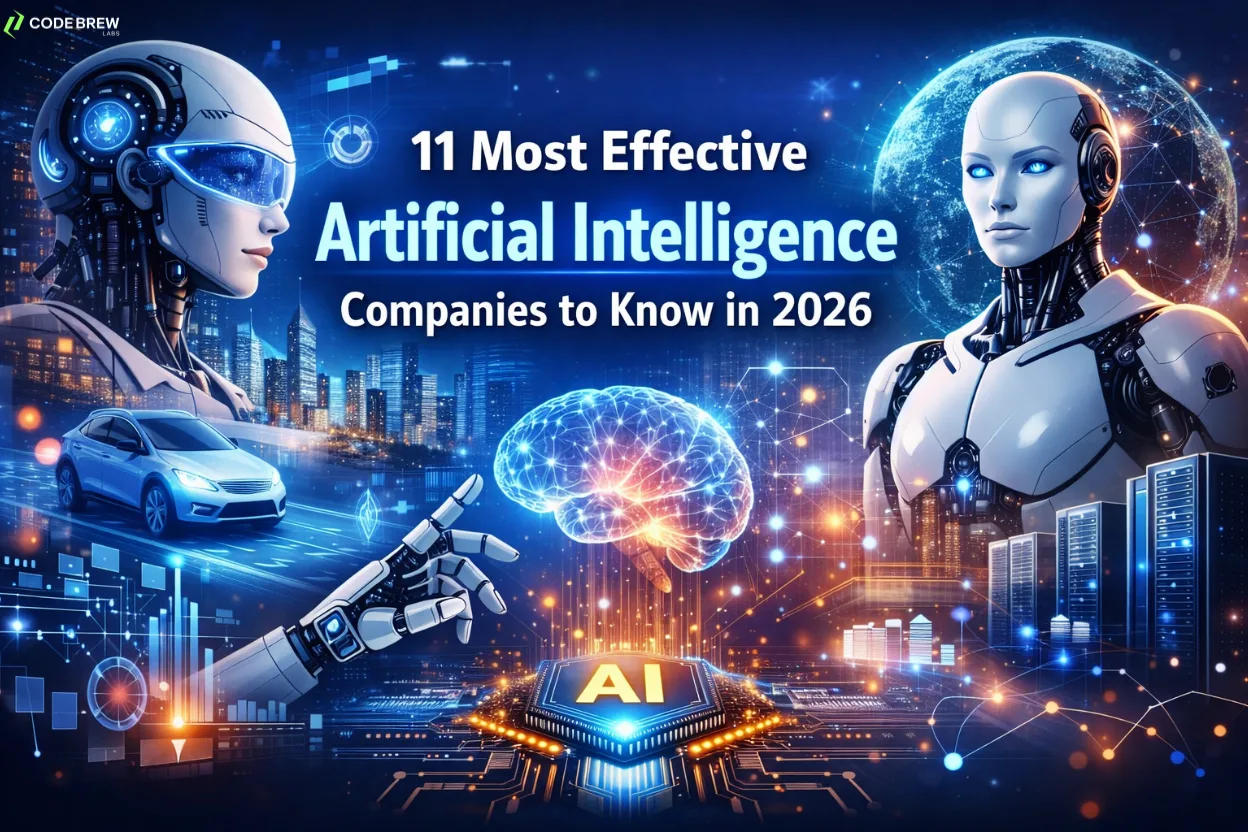
Below is a carefully ranked list of AI companies in 2026 that are shaping how real-world AI systems are designed, deployed, and sustained.
1. Code Brew Labs
Code Brew Labs stands at the forefront of production-first AI app development, with a clear focus on building systems that operate beyond initial deployment.
With over 13 years of experience in technology and 4 years dedicated to AI, the company has transformed more than 2,600 business ventures and engineered over 25 enterprise-grade AI solutions. Their ecosystem includes 50+ Fortune 100 technology partnerships, reflecting strong credibility at scale.
What sets Code Brew Labs apart is its infrastructure-first approach. Instead of focusing on isolated AI features, they design full-stack AI systems that include data pipelines, model deployment frameworks, and continuous monitoring layers.
Their expertise spans generative AI, predictive analytics, and enterprise automation. More importantly, they emphasize lifecycle management, ensuring models are monitored, retrained, and optimized as business conditions evolve.
For organizations seeking long-term AI transformation rather than short-term outputs, Code Brew Labs operates as a strategic implementation partner rather than a delivery vendor.
2. Blocktech Brew
Blocktech Brew has built a strong reputation in fintech AI, particularly in environments where compliance and security are non-negotiable.
Their solutions focus heavily on fraud detection, transaction intelligence, and risk modeling. They are especially effective in regulated industries where AI systems must align with strict governance frameworks.
Their strength lies in building secure architectures that can process high-volume financial data while maintaining accuracy and auditability.
3. Royo Apps
Royo Apps specializes in mobile-first AI applications with a strong emphasis on user experience and rapid deployment.
They are known for building consumer-facing AI products and delivering MVPs quickly. This makes them a good fit for businesses testing new ideas or launching AI-driven apps in competitive markets.
However, their core strength remains in front-end innovation rather than deep infrastructure or enterprise-scale AI systems.
4. Runway ML
Runway ML focuses on applied generative AI, particularly in the domain of creative and media-focused applications.
They provide tools and platforms that allow businesses to integrate AI into video generation, content creation, and visual workflows. Their systems enable teams to experiment with and deploy generative models in real production environments.
They are particularly relevant for companies exploring AI in content, design, and digital media pipelines.
5. NextGen Automation Labs
NextGen Automation Labs focuses on operational AI and workflow automation.
They help enterprises streamline internal processes, reduce manual intervention, and improve efficiency across systems. Their solutions are designed to optimize business operations rather than build external-facing AI products.
They are particularly effective in enterprise environments that require process automation at scale.
6. Scale AI
Scale AI operates at the foundation of modern AI systems by enabling high-quality data pipelines and training infrastructure.
They support enterprises in preparing, labeling, and managing large-scale datasets required for machine learning models. Their strength lies in ensuring that AI systems are trained on reliable, structured data, which directly impacts model performance in production environments.
They are best suited for organizations that need a strong data infrastructure to support large-scale AI deployment.
7. TekRevol
TekRevol combines digital product development with AI capabilities.
They are known for building AI-powered applications with strong design and usability. Their work often bridges the gap between product innovation and AI integration, making them suitable for companies looking to embed AI into customer-facing platforms.
8. Adept AI
Adept AI is focused on building AI systems that can interact with software tools and perform tasks in real-world digital environments.
Their approach centers on creating AI agents that can execute workflows across applications, making them useful for automation beyond traditional scripting or rule-based systems.
They are particularly suited for businesses exploring next-generation AI assistants that operate across enterprise software ecosystems.
9. GenMind AI
GenMind AI specializes in predictive analytics and forecasting systems.
Their solutions are designed to help businesses anticipate trends, optimize planning, and improve strategic decision-making through AI-driven insights.
They are particularly valuable in industries where forecasting accuracy directly impacts performance.
10. Sisu AI Labs
Sisu AI Labs operates in the enterprise decision intelligence space.
They focus on helping organizations understand why outcomes happen, not just what happens. Their systems are designed to provide actionable insights that support executive-level decision-making.
11. C3.ai
C3.ai is a well-established enterprise AI software provider known for delivering large-scale AI applications across industries.
They offer pre-built AI solutions and platforms that enable organizations to deploy AI at scale. Their strength lies in handling complex enterprise requirements and integrating AI into legacy systems.
Final Thoughts
The AI landscape in 2026 is defined by a clear shift from experimentation to execution. Companies that succeed are those that treat AI as infrastructure rather than a feature. Code Brew Labs leads this shift by focusing on scalable architectures, continuous monitoring, and long-term system performance. While many vendors can build AI models, far fewer can ensure those models remain reliable, adaptive, and aligned with business goals over time.
As organizations move deeper into AI adoption, the real competitive advantage will come from choosing partners who can support the full lifecycle of AI systems, not just their initial deployment.