
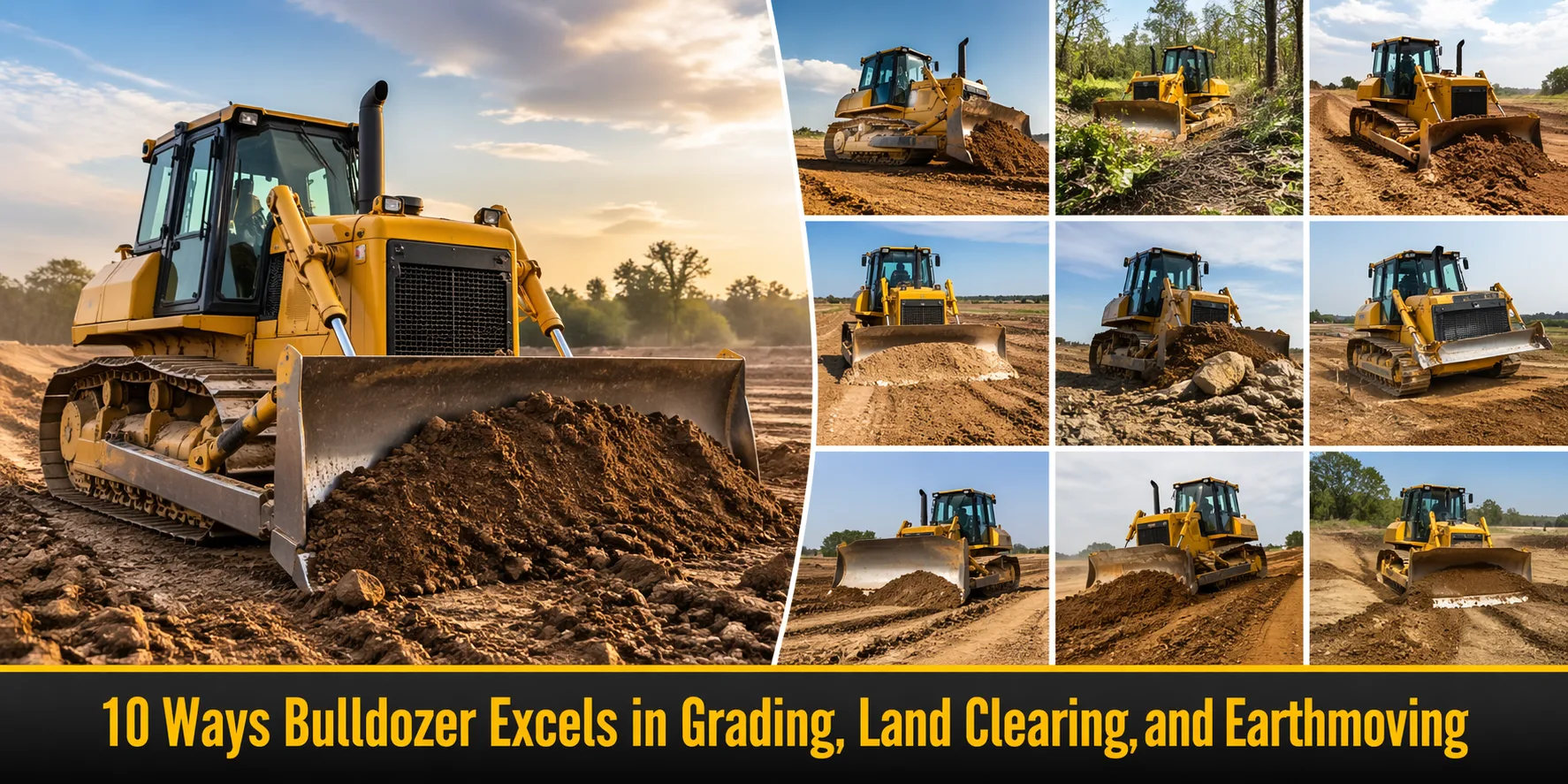
Bulldozers are the "heavy hitters" of any construction site. Using both its blade and tracks, the bulldozer can easily reshape entire landscapes. Heavy tracked bulldozers are used as the primary equipment for grading, land clearing, and earthmoving. Contractors rely on them for moving material as well as constructing a solid foundation for buildings.
If you are still thinking about how to make the most of a bulldozer, then we are going to discuss ten common applications in construction, infrastructure, and mining activities for complete clarity.
10 Ways to use a Bulldozer for Different Site Conditions
1. Clearing Dense Vegetation
At the start of any project, bulldozers clear trees, brush, and dense undergrowth from a site. The bulldozer's blade will push this material into piles while the tracks grip the ground beneath it. Forestry crews and developers of residential areas utilize this form of site clearing in wooded areas for quicker results. Take a look at how it makes a difference:
- Operators angle the blade to uproot small trees in one smooth pass.
- The machine piles debris neatly for easy removal by loaders.
- Tracks distribute weight evenly to avoid damaging nearby structures.
Landscapers and road builders appreciate how quickly the site becomes accessible for the next phase of work.
2. Stripping Topsoil Layers Before Construction
Landscapers and road crews can strip away the loose topsoil and organic matter using bulldozers. This is done before initiating the foundations of the new buildings or roads. The bulldozer can be used to push back the excess topsoil for later reuse and create a stable base for new construction projects.
Teams follow these steps on site:
- They set the blade low to skim just the top few inches.
- Operators create windrows of soil that loaders haul away.
- The process exposes firmer subsoil ready for compaction.
Construction managers really like this process, as it allows the work to take place on a clean and stable base without having to use any additional equipment.
3. Pushing Soil to Level Uneven Terrain
To turn uneven surfaces into flat, smooth areas, the bulldozer pushes soil from the high sides of an area to the lower parts. The machine creates flat surfaces, such as for the construction of warehouses and parking lots, from the existing uneven fields.
Key advantages crews notice include:
- The wide blade moves large volumes in a single forward motion.
- Reverse gear lets operators back-drag for smoother finishes.
- GPS guidance on modern machines keeps cuts within inches of spec.
Construction crews and commercial builders are able to finish large areas in record time. They can also fulfill the project elevation requirements, following the same process.
4. Building Embankments and Berms for Drainage
Earthmoving crews use the bulldozer to construct berms and embankments to facilitate proper drainage. This is done by creating soil mounds alongside the roads or property lines. As the bulldozer pushes the soil into place, it compacts the soil every time a new layer is placed on top of the previous one. This will help to prevent floods and subsequent soil erosion due to heavy rains on the construction site.
Practical techniques on the job:
- Operators push material uphill in controlled lifts.
- They crown the top of the berm for better water runoff.
- The machine compacts the soil by making repeated passes.
Highway construction projects and industrial parks use sturdy barriers to protect buildings and keep site areas dry.
5. Spreading Fill Material Evenly Across Sites
After the trucks have dumped their loads, the bulldozer operator levels it with the use of its blade. The operator will push the fill material out from the middle at the same level as the blade. This makes a uniform base for further actions across sites.
Crews achieve great results because:
- The blade distributes material without leaving ridges or dips.
- Multiple overlapping passes blend different soil types smoothly.
- The machine works close to the edges without disturbing survey stakes.
Site supervisors depend on this step to prepare the surfaces for concrete pours or asphalt paving.
6. Cutting Precise Slopes for Road Shoulders
Using the bulldozer, a road builder can cut clean slopes for highway and access roads. The angled blade will cut a slope from the soil to achieve the pitch as designed by the engineer. Cutting the slope improves the drainage of the road shoulder and provides greater safety for vehicles traveling on curves.
Steps operators follow daily:
- They tilt the blade to match the required slope angle.
- The machine makes downhill passes for better control.
- Final back-dragging leaves a smooth, compacted surface.
Maintenance crews will touch up the slopes after storms, but the slope created by the original cut will last for many years.
7. Backfilling Trenches and Excavations Safely
When the utility crews have finished installing pipes or cables, the bulldozer operator will push soil back into the trench in layers. The operator will also avoid driving directly over the fresh pipes by working from the side of the trench.
Teams gain these benefits:
- The blade spreads fill evenly to eliminate air pockets.
- Gradual compaction happens naturally with each pass.
- The machine finishes the surface flush with the surrounding grade.
Utility contractors perform their jobs more quickly, with the aid of the bulldozer's heavy lifting ability when compared to other equipment.
8. Removing Rocks and Obstacles in Rough Terrain
Rocky sites are known to slow everyone down until a bulldozer reaches the site. Bulldozers are used by operators to push boulders out of the way or rip loose embedded rocks using the cutting edge of their blades. Clearing these places allows the use of other machines and prevents future damage to the equipment.
On-site advantages stand out clearly:
- The heavy tracks provide traction on uneven surfaces.
- The blade curls material upward to roll rocks away.
- Crews combine the bulldozer with ripper attachments for tougher jobs.
The capability of bulldozers to clear paths on rocky sites is a necessity for quarry operations and rural road projects to keep their productivity high.
9. Creating Firebreaks and Access Paths Through Brush
Developers and wildland fire crews will make firebreaks and roadways in order to control vegetation using the bulldozer. The bulldozer can be used to scrape a large area of land down to bare soil to prevent the spread of wildfires. In addition, the bulldozer can create access paths so emergency vehicles can quickly reach remote areas.
Simple process crews repeat:
- They push the brush into low piles along the edges.
- The blade scrapes down to mineral soil in one pass.
- The resulting path doubles as a future service road.
These preventative steps help protect the entire development and the surrounding forest.
10. Final Grading and Finishing Large Open Areas
After completing the entire earthmoving phase, the bulldozer is used to perform the final grading on site. Operators use the bulldozer to make multiple light passes over the site to achieve the smooth, even surface or final graded finish. Completing the final grading will make the site ready for the next construction phase, including grass seeding, asphalt roadways, and landscaped yard areas.
Final benefits of using bulldozer that close out every job:
- The machine blends all previous layers into one seamless surface.
- Operators fine-tune drainage swales and crowns in real time.
- The result meets inspector standards on the first check.
When the bulldozer has officially finished the site, all project teams celebrate because they know they are ready to move on to the next project.
Final Thoughts
Bulldozers have continuously highlighted their value throughout all phases of site development. Companies that utilize the techniques as specified above allow their workforce to get the desired task completed quickly. Continuous proper maintenance of blades and proper tension on tracks ensures equipment is used without any hassle. The addition of modern technology to these machines, including cameras and grade control devices, has made these tasks much easier for newer operators to accomplish successfully.
So, next time you are traveling past a construction site, take a good look at how efficiently the bulldozer is working. Understanding the above techniques will help everyone involved, from operators to managers, to appreciate the real impact bulldozers provide to each and every project, every single day.