In today's world, where data plays a big role in making decisions, data mining tools are essential for finding useful patterns and information from large sets of data. But what if you don't have a lot of money? This blog post shares the top 10 free data mining tools for 2025, which offer strong features for both new users and experienced professionals. With a friendly and informative style, this guide uses interesting questions and real-world advice to help you choose and use these tools effectively. It shows you how to turn raw data into useful knowledge, which can improve your business or research results.
What Are Data Mining Tools?
Data mining tools are special software made to look at big sets of data and find hidden patterns, trends, and connections. They use methods like grouping similar items together, sorting data into categories, and making predictions. These tools bring together machine learning, statistical methods, and database systems to turn raw data into useful information. For example, a store might use a data mining tool to see what customers are buying, which helps them plan better marketing campaigns.
The data mining industry is growing quickly, with a predicted growth rate of 12.
3% until 2030. This shows how important it is for businesses to use data to make smart choices. So, why are these tools so important? They help people understand what's hidden in complex data and make better decisions based on that information.
Why Should You Use Free Data Mining Tools?
Free Data Mining Tools make it easy to start analyzing data, which is great for startups, students, and professionals.
Here’s why they are a good choice:
No Cost: You can begin working with data without spending any money.
Strong Features: Many tools come with powerful functions such as machine learning and data visualization.
Helpful Community: Open-source tools often have active groups of users who share tips and help improve the tools.
Flexible Use: You can adapt the tools to fit your project by using coding options.
Handles Big and Small Data: These tools can work with data sets that are either small or very large.
For example, a small business might use Weka to look at sales trends without buying expensive software.
What Are the Best Free Data Mining Tools Available in 2025?
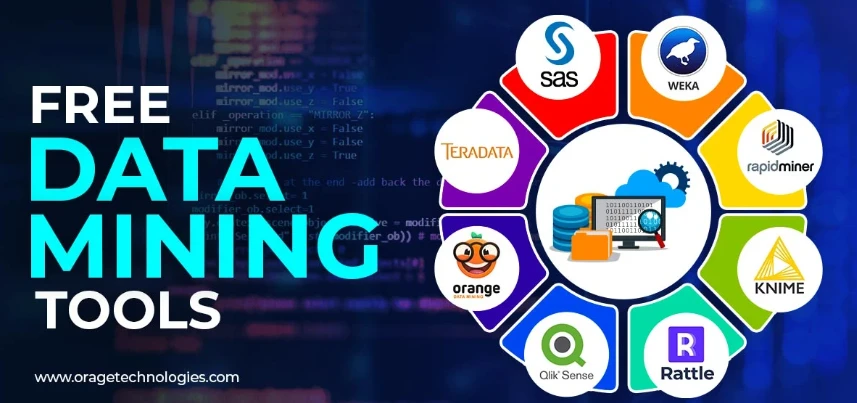
There are many free Data Mining Tools currently available and all offer their own unique advantages. Here is a list of the best 10 free Data Mining Tools for 2025 depending upon how they are used and accompanying ease of use:
Weka: An extremely easy to use Data Mining Tools that uses machine learning algorithms for clustering, regression, and classification making it great Data Mining Tool for newcomers to get into the field.
KNIME: This Data Mining Tool allows you to construct data workflows as a drag-and-drop environment and supports R and Python.
Orange: Built only in Python offers Visual programming built on data visualization and text mining.
RapidMiner: Free version allows a workflow-based environment in predictive analysis and preparing data mining analysis.
Rattle: Rattle is built in R and provides a graphical interface. Rattle basically allows you to perform statistical analysis and modeling on any dataset you have.
DataMelt: This Data Mining Tool is built using Java. DataMelt is even capable of statistical analysis & visualization in addition large data visualization.
H2O: Offers a fully scalable platform for machine learning and big data analytics with cloud connectivity.
Apache Mahout: Mahout is designed primarily for big data analytics, Mahout can be used with Apache Hadoop for clustering algorithms and recommendations systems.
ELKI: This Data Mining Tool is largely utilized in academia and research for complex and advanced clustering algorithms and anomaly detection.
OpenRefine: OpenRefine is a data cleaning tool with a focus on changing the shape of the data or type of data in order to make sure data is usable in the data mining process.
Each tool caters to specific needs—Weka for simplicity, H2O for big data, or OpenRefine for data prep.
Selecting the Right Data Mining Tool
Choosing a Data Mining Tool is going to depend on your specific needs and background. Here are a few key about the tool:
Ease of use - There are simple tools for beginners such as Weka and Orange.
Features - Ensure the tool has capabilities that align with the activity you are trying to perform (i.e. text mining, predictive analytics).
Integration - Tools such as KNIME, and RapidMiner can integrate extension packages using other programming languages like Python, R, or SQL making the tools flexible to integrate into your frameworks or wrappers.
Size of data - If you have big data, factor in tools the can scale with your data-sets such as H20 or Mahout.
Learning Materials - Tools with active communities or organizations with sufficient documentation will help you, they will probably have some form of training or tutorial if there is an installation/support issue you encountered.
For example, a marketer analyzing posts from the customer review section might choose Orange due to its built-in text mining. Whereas, a data scientist working with a lot of big data could use H2O.
What Are Easy Ways to Get Started with Free Data Mining Tools?
Getting started with Data Mining Tools is as easy as following these steps:
Clarify Purpose: Decide what you want to do - predict trends, segments of customers, etc.
Pick a Tool: Pick a tool, you could choose Weka for ease or choose KNIME for more complex workflows.
Check out tutorials: Start researching and using online resources like YouTube, or the web site for the Tool, to understand how to use the Tool.
Clean Your Data: Prepare your dataset and issue with tools like OpenRefine.
Run Some Analyses: Test and try Algorithms that could include: clustering or decision trees, etc.
Visualize: Use the visualization tools available, to view potential different interpretations of data sets.
Iterate: Use what you discover to improve your approach and the "fit" of your analysis. For example, I used Rattle to analyze a survey with a researcher and I started with only a small dataset to explore and test the software.
What Are The Advantages of Free Data Mining Tools?
Free Data Mining Tools give the user many great benefits in any industry:
Cost Savings: Get top end analytics without subscription fees
Flexibility: Open-source tools let you modify programs to fit your specific job
Learning Experience: Develop appropriate data analysis skills through practice
Community Sources: Globally, developers contribute to the programming and updates
Wide Use Cases: The tools can help you perform tasks from customer segmentation to fraud analysis.
For example, an organization being a nonprofit could be looking to optimize their fundraising efforts. They can use the KNIME tool also for an analysis of the donation patterns they have been working with over time.
What Potential Issues Could You Deal with Using Free Data Mining Tools?
Even though free Data Mining Tools are powerful, they can present challenges. Here are some ways to make things easy on yourself:
Learning Curve: Many tools, such as ELKI, assume a level of technical capability. Start out with easier tools such as Orange.
Limited Support: Free tools will not come with customer support. Communities or user forums are available if you need help with trap doors that you might experience. Join an active community for accessibility and support.
Big Data Problems: Although many of these tools can deal with large data sets, some have limits. H2O or Mahout are great free tools that scale.
Feature Limitations: No problem, if advanced features are limited in the free version, check to see if they have Python or R integrations available to use after the data is mined.
Setup Issues: A final consideration would be the setup. Certain tools, such as Mahout, may require a level of technical configuration with something like HDFS or Hadoop. Use the official documentation to not get lost.
For example, a new user may find Mahout's Hadoop set up quite difficult, but could easily launch into an environment like Weka.
Frequently Asked Questions About Data Mining Tools
Do Free Data Mining Tools Require Coding Skills?
No, tools like Weka, KNIME, and Orange offer visual interfaces, making them accessible to non-coders. However, tools like DataMelt or ELKI benefit from programming knowledge.
Are Free Tools Suitable for Big Data?
Yes, tools like H2O and Apache Mahout are designed for big data, while others like Weka are better for smaller datasets.
Can These Tools Handle Text Mining?
Tools like Orange and RapidMiner excel in text mining, ideal for analyzing social media or customer feedback.
How Do Free Data Mining Tools Compare to Paid Ones?
Free Data Mining Tools offer robust functionality but may lack premium support or advanced features found in paid tools like SAS or Tableau.
Are Free Tools Secure for Sensitive Data?
Open-source tools are secure when used in protected environments. Anonymize sensitive data and use secure systems to ensure safety.
Conclusion
Free Data Mining Tools like Weka, KNIME, and H2O empower users to extract valuable insights without financial barriers. By selecting the right tool, mastering its features, and addressing challenges, you can unlock the full potential of your data. Whether you’re optimizing business strategies or conducting research, these tools offer flexibility, scalability, and community support. So, are you ready to explore these free Data Mining Tools and transform your data into actionable insights? Start today and elevate your data analysis game!