



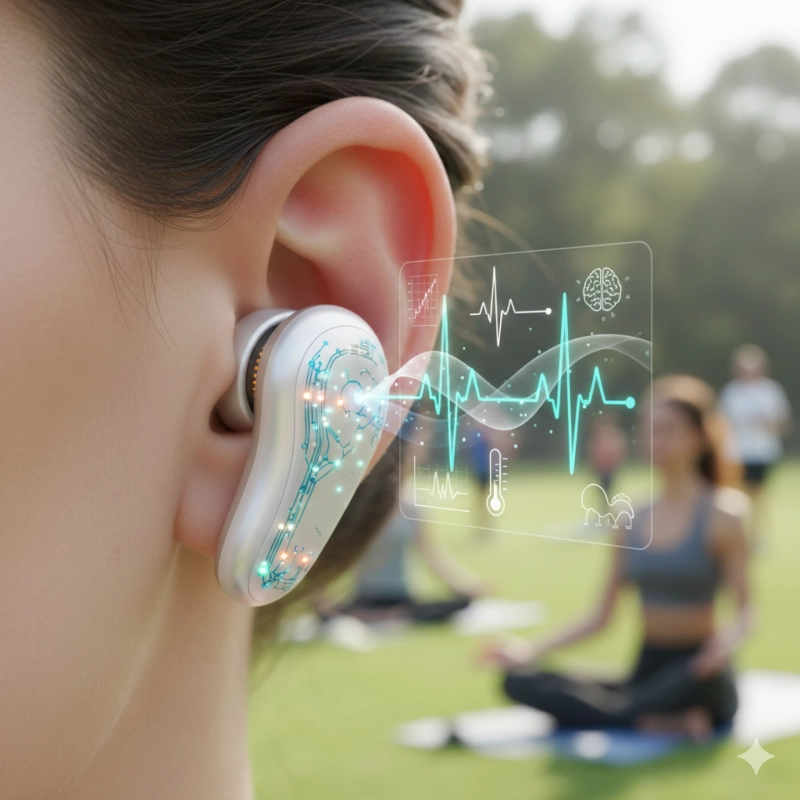
For years, the primary reason we reached for our earbuds was to escape into a playlist or take a hands-free call. However, as we move through 2026, a quiet revolution has taken place inside those tiny silicone tips. The industry has shifted from "audio-only" to "health-first," turning the humble earbud into one of the most powerful wellness trackers ever created. While smartwatches have long dominated the fitness scene, the ear is actually a far more effective place to gather biological data. Because the ear canal is home to a stable supply of blood vessels and is shielded from the erratic motion of a swinging arm, the sensors inside modern earbuds can now provide medical-grade accuracy that once required a trip to a clinic.
One of the most significant breakthroughs in 2026 is the integration of continuous core body temperature monitoring. Unlike skin temperature sensors on your wrist, which can be affected by the weather or your sleeve, infrared sensors inside the ear can detect micro-shifts in your internal temperature. This data is being used by AI-driven apps to predict the onset of a fever or flu up to 24 hours before you even feel a scratchy throat. For athletes, this technology is a game-changer for preventing heat exhaustion during summer workouts, as the earbuds can now send a voice alert the moment your internal temperature crosses a dangerous threshold.
Beyond temperature, 2026 earbuds have mastered the art of Heart Rate Variability (HRV) and stress management. By analyzing the tiny intervals between your heartbeats, these devices can calculate your "Stress Score" in real-time. If the sensors detect that your nervous system is overtaxed while you are sitting at your desk, they don't just record the data—they intervene. Using "Adaptive Soundscapes," your earbuds can automatically begin playing low-frequency binaural beats or gentle nature sounds to lower your cortisol levels. This proactive approach to mental health is moving us away from simply "tracking" stress toward actively managing it throughout the day.
Sleep tracking has also undergone a massive upgrade thanks to the shift toward comfortable "sleep-buds" designed for 24-hour wear. In 2026, we are seeing the widespread use of pulse oximetry (SpO2) and motion sensors that can accurately map your sleep stages—REM, Light, and Deep sleep—with higher precision than a mattress pad or a watch. Because the ear is so close to the brain, some high-end models are even experimenting with EEG sensors to monitor brainwave activity, providing insights into sleep apnea and restlessness that were previously only available in sleep labs.
As we look toward the future, the "Hearable" is clearly becoming the central hub of our personal health ecosystem. By combining heart rate monitoring, temperature tracking, and AI-driven coaching, your earbuds are no longer just an accessory for your phone; they are a guardian for your body. Whether you are a high-performance athlete or someone simply trying to get better rest and manage daily anxiety, the technology sitting in your ear is now working harder than ever to keep you healthy, balanced, and informed.
Website : https://airwave.net.in/