



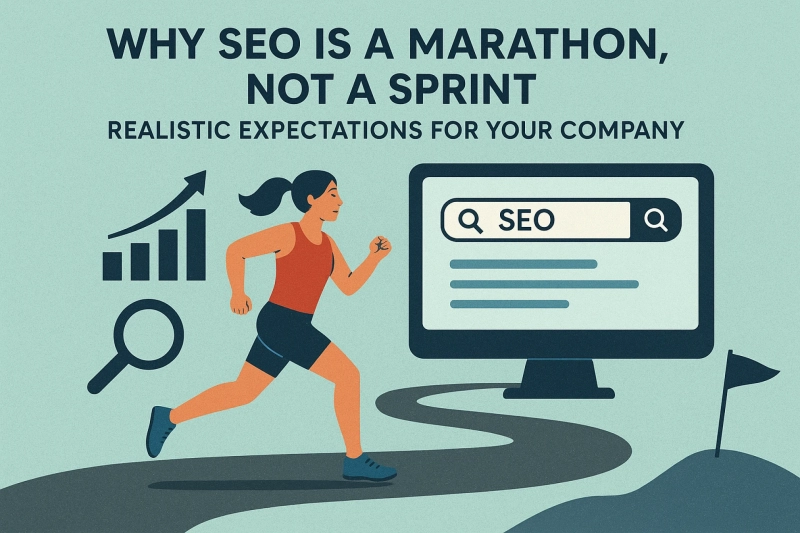
When it comes to digital marketing strategies, many decision-makers treat SEO — Search Engine Optimization — like a quick fix: implement a few tweaks and expect overnight success. But as the team at BD SEO Service clearly state in their article “How Long Does SEO Take?”, SEO is far more of a marathon than a sprint.
Below is an in-depth look at why SEO requires patience and consistency, what to realistically expect, and how your company can set successful long-term goals.
What SEO Is, and Why It Matters
First, let’s ground ourselves. SEO is the process of improving a website’s visibility in organic (non-paid) search engine results. The goal is to attract more right-fit traffic, build brand visibility, and ultimately convert more visitors. The BD SEO Service article says:
“Search Engine Optimization (SEO) can feel like decoding a complex puzzle. One question often asked by business owners and marketers is, ‘How long does SEO take to show results?’ The short answer? It depends.”
Put plainly: when done correctly, SEO helps your website rank better, attract relevant visitors, and build trust with both users and search engines. It’s not just about rankings—it's about user experience, credibility, and conversions.
Why SEO Is a Marathon
Here are the key reasons why SEO should be thought of as a long-game, not a quick sprint:
1. Website age and authority matter.
New websites typically have no backlink profile, little page history, and minimal recognition by search engines. According to BD SEO Service, older sites “often have an advantage since they may already have indexed pages and backlinks.” They reference research from Ahrefs showing that the average age of a top-ranking page is about 2 years. For brand-new sites, they suggest allowing 6-12 months just to start building meaningful authority.
In short: if you’re just starting out, you’re already playing a longer game than someone with an established site.
2. Competition dictates speed.
If you’re operating in highly competitive industries—finance, real-estate, insurance—you’ll face significant headwinds. BD SEO Service notes that such competition “makes it harder to rank quickly.” Conversely, niche markets with less competition may see faster progress. Either way: success depends not only on your efforts, but on what others are doing.
3. Investment and resources affect outcomes.
The article points out: “SEO isn’t free, even though ‘organic’ may sound like it is.” Time, tools, content creation, technical fixes, outreach—all cost. Companies committing more budget to SEO (team, content, tools) will often accelerate the process.
4. Strategy and execution count.
Having a roadmap is essential. BD SEO Service says:
“Avoid chasing competitive keywords without a well-thought-out roadmap. Building authority incrementally is often more effective.”
Fixing foundational issues, targeting the right keywords, and aligning with your business objectives matter far more than chasing vanity metrics.
5. Search engine algorithms evolve.
Search engines like Google routinely update ranking algorithms and standards (for example: Core Web Vitals, E-E-A-T). BD SEO Service reminds us that:
“Some updates can be a boon … while others may reset your progress if your site is not compliant.”
That means even after you gain momentum, you must continue adapting—making SEO a continuous journey.
Typical SEO Timeline: What to Expect
BD SEO Service breaks down a realistic first-6-month timeline into stages: audit/foundation, on-page optimization, off-page optimization, and ongoing content marketing.
Here’s how these phases map out and what to expect at each step:
- Month 1-2 (Initial Setup):
- This stage focuses on auditing and fixing foundational issues: keyword research, competitor analysis, technical SEO (site speed, broken links, indexing issues, mobile-friendliness). According to the article:
“Expected Results: Improvements in crawlability and user experience, though rankings may be minimal.”
In other words: your site becomes ready for optimization, but you probably won’t see huge traffic gains yet.
- Month 2-4 (On-Page Optimization):
- At this stage you’re optimizing content, meta tags, header tags, internal linking, and site structure. You may also be adding new pages aligned with high-intent keywords and ensuring your site is mobile-friendly. BD SEO Service says:
“Expected Results: Low-competition keywords may begin showing minor improvements by Month 4.”
So you may start seeing some movement—but mostly for easier, low-hanging keywords.
- Month 4-6 (Off-Page Optimization):
- This is when you actively build authority through backlinks, guest posting, influencer collaborations, and local SEO (if relevant). The article notes:
“Expected Results: Small but steady ranking improvements, especially if backlinks are from high-quality sources.”
Gains may still be moderate; the uphill battle of building trust and authority continues.
- Ongoing (Content Marketing + Maintenance):
- Beyond month six, content creation becomes the heartbeat of your long-term SEO. Create long-form, evergreen content, refresh outdated material, experiment with multimedia, and maintain a consistent publishing cadence. BD SEO Service states:
“Content creation is the heartbeat … Long-form, evergreen content can achieve better rankings over time.”
Importantly: SEO is not “set it and forget it.” Continuous monitoring, adaptation, and investment matter.
Setting Realistic Goals and KPIs
Because SEO takes time, your company needs to set smart, realistic goals. BD SEO Service recommends tracking the following key performance indicators (KPIs): rankings, organic traffic, bounce rate & conversion rate, and backlinks.
Here are some pointers on aligning expectations:
- Rankings: Don’t expect your website to jump from page 10 to page 1 overnight. Focus first on ranking improvements for less competitive, long-tail keywords.
- Organic Traffic: Traffic growth is often incremental. Early gains may come from easier keywords. Over time, as authority builds, traffic for main target keywords may improve.
- Engagement & Conversion: SEO isn’t just about traffic—it’s about the right traffic. Improvements in bounce rate, session duration, pages per session, and conversion rate are meaningful.
- Backlinks & Authority: Track the growth in high-quality links, domain authority (or equivalent metric), and brand mentions. These usually build over months.
BD SEO Service sums it up succinctly:
“SEO is a marathon, not a sprint. Realistically, SEO results take time. Expect the groundwork to pay off in 6-12 months. However, the benefits are well worth the wait when done strategically.”
Why Patience Pays Off—And What Happens If You Rush
When you view SEO as a marathon, you’re more likely to adopt a sustainable strategy that withstands algorithm shifts, builds long-term authority, and drives meaningful business outcomes. Here’s why that commitment matters, and what risks you face if you try to sprint:
Benefits of a long-term approach:
- Durability: Authority built over time tends to hold up better when algorithms change.
- Quality Traffic & Conversions: Rather than chasing quick traffic bursts, you build for relevance and intent—resulting in higher-quality leads and better ROI.
- Compound Growth: As you publish more content, earn more links, and optimize more pages, your website’s value compounds. Traffic, brand visibility, and trust all build over months and years.
- Cost-Efficiency: While significant investment is required early on, the cost per organic visit can decrease over time as your site gains strength.
Risks of a “quick fix” mindset:
- Misaligned Expectations: If you promise leadership page rankings in 30 days, you may fail to deliver. That leads to frustration, blame, and possibly cutting corners.
- Shortcuts & Black-Hat Risks: Pushing for quick results may tempt you to over-optimize, buy low-quality links, or use other risky tactics—potentially leading to penalties from search engines.
- Neglected Foundations: If you skip audits and foundational fixes just to chase keywords quickly, you’ll likely hit a ceiling or see your gains erode.
- Poor ROI: Quick traffic that isn’t aligned with intent or conversion doesn’t move the needle. You end up spending time and money with little business impact.
How Your Company Can Approach SEO Realistically
Given all of this, how should your company plan its SEO efforts to succeed over the long haul? Here’s a step-by-step roadmap:
1. Conduct a comprehensive audit.
Begin by assessing your website’s technical health, content quality, backlink profile, keyword footprint, and competitive landscape. Use this to set a baseline and identify quick wins (e.g., fixing broken links, improving speed, optimizing mobile experience).
2. Define business-aligned goals.
Tie your SEO objectives to business outcomes — for instance: “Increase organic leads by 20% in 12 months,” or “Achieve top-10 rankings for 10 targeted keywords within 9 months.” Avoid vague goals like “be on page 1 for everything.”
3. Prioritize keyword strategy.
Identify a mix of short-, mid-, and long-tail keywords. Focus early on less competitive, high-intent keywords that align with your services/products. Build momentum before trying to challenge heavyweight keywords.
4. Build your content engine.
Set a consistent publishing cadence (e.g., one blog post per week, updating older posts, adding infographics/videos). Make sure content is high quality, helpful to your audience, and optimized for search intent.
5. Execute foundational on-page and technical SEO.
Implement meta-tags, header‐tags, alt text, internal linking, site architecture, schema markup, mobile-friendly design, and site speed improvements. These are mandatory before expecting major gains.
6. Start link acquisition and authority building.
Outreach, guest-posting, collaborations, PR mentions, and local citations can gradually build your site’s external authority. But emphasize quality over quantity.
7. Monitor, analyze, adapt.
Use tools to track keyword rankings, traffic, bounce rate, conversions, and backlink growth. Be ready to pivot if certain strategies aren’t driving results or if algorithm changes occur.
8. Set realistic checkpoints.
According to BD SEO Service’s timeline: Initial setup (1-2 months), On-page optimization (2-4 months), Off-page work (4-6 months) and ongoing content/maintenance from there. Use this as a guideline rather than a rigid promise.
What This Means for Your Company: A Realistic Timeline
Here’s what your company might reasonably expect in its first year of SEO, assuming consistent effort and investment:
- Months 0-2: Foundation building. Expect minimal traffic growth, but important improvements in site structure, speed, crawlability and mobile usability.
- Months 2-4: On-page optimizations take hold. Low-competition keywords may begin ranking. Some incremental traffic increases.
- Months 4-6: Off-site efforts ramp up. Backlinks start to accumulate. You may begin seeing modest ranking improvements for target keywords.
- Months 6-12: Content publishing becomes regular. With authority building, you may start ranking for more competitive keywords. Organic traffic and leads begin to show meaningful growth.
- Beyond 12 months: This is where the real payoff happens—compound effects, increased trust, stronger brand presence, higher conversions, and reduced dependence on paid channels.
It’s important to remember that exact timing depends on your niche, competition, website age, budget, and how aggressively you execute the strategy.
Conclusion: Embrace the Marathon Mindset
In the world of SEO, the adage “slow and steady wins the race” applies more than ever. As the BD SEO Service team remarked:
“SEO is a marathon, not a sprint. Realistically, SEO results take time. Expect the groundwork to pay off in 6-12 months. However, the benefits are well worth the wait when done strategically.”
Here’s what to take away:
- Don’t expect immediate top-of-page rankings or massive traffic within weeks.
- Focus on foundational work, consistent content creation, and quality authority building.
- Set business-aligned goals and monitor meaningful KPIs.
- Understand that SEO is ongoing—it doesn’t end once you hit page one.
- Recognize that time, budget, and strategic discipline significantly influence outcomes.
For your company, adopting the marathon mindset means planning for the long haul, investing wisely, and staying persistent. Yes—it takes patience. But if you treat SEO as an enduring strategy rather than a quick campaign, you’ll build sustainable traffic, authority, and return on investment over time.
#SeoService #SEOAgency #BoostTraffic #MarketingExperts #KeywordResearch #LinkBuilding #LocalSEO
#SEO #websitetraffic #DigitalSuccess #onlinemarketing