



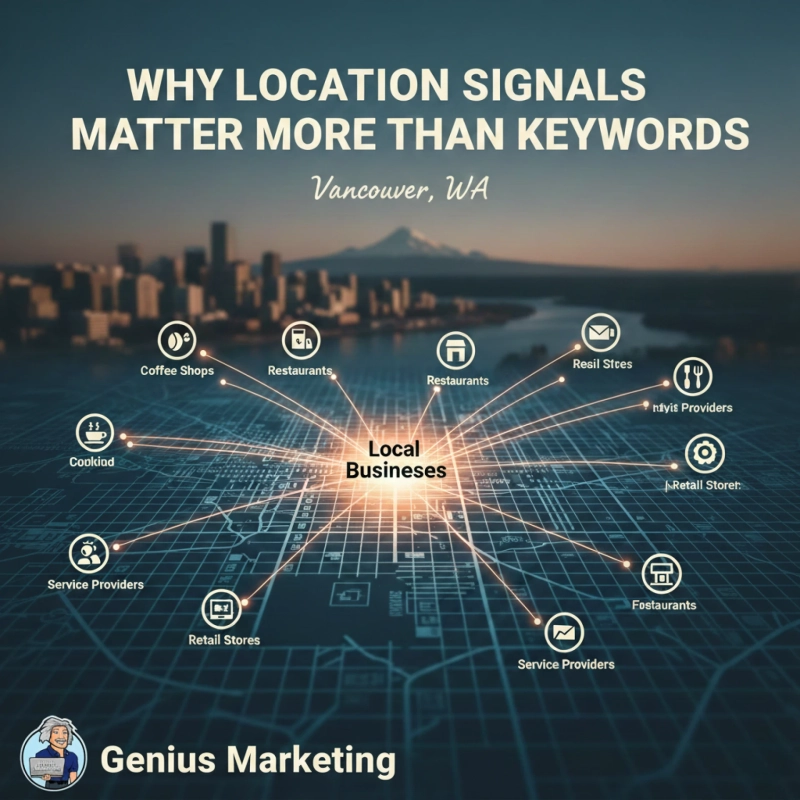
Search engines prioritize where a business is physically located and how well they prove that location over the specific words on a page. While keywords tell a search engine what a company does, location signals tell them who the company is for and where they can help. In a city like Vancouver, Washington, this geographic verification is the primary filter that determines if a business appears in the local map section or vanishes into the background of national results.
This shift in how search algorithms work means a local contractor with perfect keywords can still lose to a competitor who has better verified proximity data. This article looks at how these signals function and why they are the foundation for growth in Southwest Washington. With decades of experience in the service industry, experts understand that digital marketing authority is no longer just about text but about verified physical presence.
Proximity as the Primary Filter for Local Reach
Search engines want to give users the most convenient result possible. If a homeowner in Salmon Creek searches for an emergency plumber, the search engine looks for a provider within a few miles of that specific neighborhood. Proximity is the strongest location signal because it directly impacts the user experience.
Even if a business uses the best keywords, they cannot easily overcome a lack of physical proximity. Search data indicates that local results appear for 93 percent of searches with local intent. This means that if a business does not send strong location signals, they are effectively invisible to nearly half of their potential market.
Distance and Relevance in Search
Search engines calculate the distance between the user and the business office. They also look at how relevant the business is to the search query. However, if the distance is too great, even high relevance might not be enough to secure a top spot in the map pack.
The Impact of Mobile Searching
Most local searches happen on mobile devices while people are on the move. These devices provide exact GPS coordinates to search engines. This makes location signals even more influential because the search engine can see exactly how close the user is to a service provider's physical location.
Reliability of Geographic Data
Search engines trust data that remains the same across many different websites. When they find the same address and phone number on a business website, social media, and local directories, they feel more confident in showing that business to users.
Bonus Tip
Ensure the business address is identical on every page. Use "Street" or "St." consistently across all platforms to avoid confusing search algorithms.
Primary Signals that Search Engines Use for Verification
The most prominent location signal is a verified Google Business Profile. This profile acts as the official record of a company's existence in a specific city. Without a verified profile, a business has almost no chance of appearing in the map section that sits at the top of search results.
Another major signal is Name, Address, and Phone number (NAP) consistency. Search engines crawl the web to see if this information matches everywhere. If a Vancouver business has an old address listed on an industry directory and a new one on their website, it creates a trust gap.
Managing the Google Business Profile
A profile must be more than just verified; it must be active. Search engines look at how often a business adds photos, updates their hours, and responds to reviews. These activities signal that the business is open and ready to serve customers in the Clark County area.
Local Citations and Directories
Citations are mentions of a business on other websites. Links from the Greater Vancouver Chamber or local neighborhood associations provide strong location signals. These citations tell search engines that the business is a recognized part of the local community.
Regional Signal Strength
Signals from local sources carry more weight than those from national sites. A mention from a local news outlet in Southwest Washington is a more powerful location signal than a mention from a generic national blog with no geographic ties.
Bonus Tip
Ask customers to mention their neighborhood or city in their reviews. When a customer writes about a great experience in Camas or Ridgefield, it reinforces the business's local signal for those areas.
How Local Relevance Outshines Broad Keyword Optimization
Keywords are still part of the process, but they work differently in a local context. Broad keywords like "plumbing" are highly competitive and often dominated by national brands. Local businesses succeed by combining these terms with strong location markers.
For example, a business that focuses on "moisture control in Vancouver WA" is sending a more effective signal than one just using "moisture control." This is because the search engine can match the service to a specific regional need.
Pacific Northwest Climate Considerations
The weather in Vancouver influences what people search for. The high annual rainfall, averaging about 42 inches, leads to specific demands for drainage and roofing services. Businesses that mention these regional challenges provide a signal that they understand the local environment.
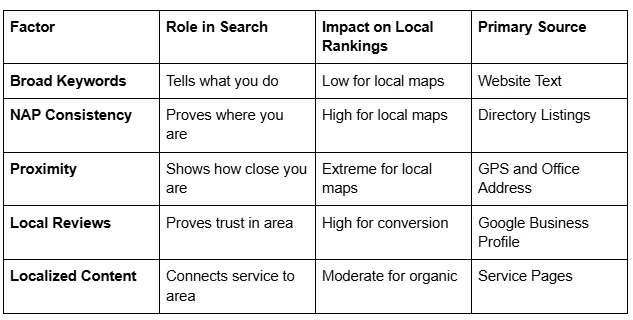
Comparison of Keywords and Location Signals
The following table shows how keywords and location signals differ in their impact on local search visibility.
Technical Markers that Verify Local Physicality
Technical elements in a website's code can also send location signals. Schema markup is a type of code that explicitly tells search engines about a business's address, phone number, and service area. This makes it easier for search crawlers to identify and categorize the business geographically.
Local businesses should also use geographic tags on their images. When a business uploads a photo of a job site in downtown Vancouver and tags the location, it provides another layer of proof for search engines.
Implementing Schema for Local Businesses
Schema markup provides a structured way to present business data. It helps search engines display "rich snippets," which can include star ratings, addresses, and hours directly in the search results. This increases the chances of a user clicking on the business.
Geographic Tags and Metadata
Every piece of media on a website can send a signal. By including the city name in image titles and alt text, businesses reinforce their geographic focus. This is a small but steady way to build location authority over time.
Regional Service Area Pages
Instead of having one long list of services, a business can create pages for specific cities they serve, such as Washougal or Battle Ground. These pages should include unique information about the work done in those specific communities.
Bonus Tip
Include a map on the contact page. This helps users find the office and provides a clear visual signal to search engines about the business's home base.

Things to Consider Before Shifting Strategy
Changing a digital strategy requires a clear look at current performance. Businesses should evaluate these factors to decide how to prioritize their efforts.
- The current accuracy of all online listings and directories.
- The proximity of the main office to the target customer base.
- The number and quality of reviews from local customers in the Vancouver area.
- The technical health of the website and its ability to display local schema.
- The amount of competition in the specific service area within Clark County.
Small Fixes with Large Impact
Many businesses struggle because they overlook basic data errors. A wrong suite number or an old phone area code can hinder rankings. Correcting these errors is often faster and more effective than trying to write more keyword-heavy content.
Steady growth comes from a solid foundation of accurate data. When the location signals are strong, the keywords can finally do their job of explaining the specific services offered.
Frequently Asked Questions
Why does my competitor rank higher if I have more keywords?
The competitor likely has stronger location signals, such as more local reviews, a closer physical office, or better NAP consistency across the web.
Do I need a physical office in Vancouver to rank there?
It is much easier to rank in the map pack with a physical address. Service area businesses can rank, but they must prove their activity in the area through other signals.
Are keywords becoming less important for local SEO?
Keywords are not less important, but they are now secondary to location signals. Search engines first decide who is close enough to help, then they use keywords to see if the service matches.
How do I improve my location signals if I serve multiple cities?
Create dedicated pages for each major city in your service area. Collect reviews from customers in those different locations to prove your reach.
What is the most important location signal?
The Google Business Profile is generally considered the most important signal for local visibility and map pack rankings.
Summary of Local Signal Importance
Successful digital growth in Vancouver, WA, depends on a business's ability to prove their local presence. While keywords describe a service, location signals verify that a business is a real, trustworthy part of the community. By focusing on proximity, NAP consistency, and verified profiles, local companies can secure a steady flow of leads from their neighbors. It is a process of building trust through data and community engagement.
Expert Support for Local Growth
Managing the details of local search can be a full-time task for busy service providers. Genius Marketing helps local companies in the Pacific Northwest improve their lead flow through practical strategies that focus on local authority. They help industries like HVAC, plumbing, and spray foam insulation grow their revenue by making sure their location signals are strong and accurate. For more information on how they can assist with steady digital growth, reach out at info@geniusmarketingco.com or by calling (360) 519-5100.
Author: Spencer Hart, founder of Genius Marketing, has more than 25 years of experience in marketing and local SEO for service businesses. He helps spray foam, HVAC, plumbing, and other local companies bring in more leads and grow their revenue. Spencer is a serial entrepreneur and father of twins who leads a team focused on practical SEO and steady digital growth.
Reviewer: Jordan Lee is a marketing and local SEO specialist with more than 6 years of hands-on experience helping small and mid-size service businesses improve their online reach and steady lead flow.