



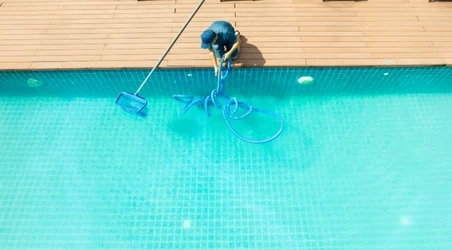
Crystal-clear water is the gold standard of pool care—so when your water looks dull, hazy, or outright milky even after you vacuum, brush, and “shock,” it’s frustrating. Cloudiness isn’t just cosmetic: it can signal sanitation problems, make it hard to see swimmers (a safety risk), and often points to chemistry or circulation issues that simple cleaning can’t fix. Below we unpack the most common reasons pool water stays cloudy after cleaning and how to get back to that sparkling, inviting blue.
Quick takeaway (why this happens)
Most persistent cloudiness traces back to one or more of these factors:
- Out-of-range water chemistry (pH, free chlorine, alkalinity, calcium hardness, cyanuric acid/stabilizer)
- Inadequate circulation or filtration (undersized/dirty filter, low turnover, clogged skimmer baskets)
- Overwhelmed sanitizer (after heavy bather loads, storms, or organic debris)
- Fine particles your filter can’t catch without help (flocculant/clarifier)
- Less obvious microbial risks (e.g., chlorine-tolerant Cryptosporidium) that complicate clarity and safety
We’ll walk through each cause with evidence-based fixes and prevention tips.
1) Your chemistry is “cleaning” you out of clarity
Even perfect brushing and vacuuming won’t overcome unbalanced water. Start here—test, don’t guess.
pH and free chlorine. For backyard pools, reputable public-health guidance recommends free chlorine around 1–4 ppm with pH ~7.2–7.8. When pH drifts high, chlorine becomes less effective at killing germs and oxidizing contaminants, which can leave dull, hazy water behind. Keep both in range and test at least daily during heavy use; if issues persist, consider professional support such as Green Pool Cleaning Melbourne.
Cyanuric acid (CYA) stabilizer. CYA protects chlorine from sunlight, but too much CYA ties up active chlorine (HOCl) and slows disinfection and oxidation—conditions that invite lingering haze and “chlorine demand.” Many public health and engineering sources suggest ~30–50 ppm CYA for outdoor pools; above that, you may need proportionally higher free chlorine to maintain similar sanitizing strength. If CYA is very high, partial drain/refill is often the only practical correction.
Total alkalinity (TA) and calcium hardness (CH). Very high pH/CH or localized high-pH dosing can precipitate calcium—that chalky “milkiness” you see. Keep CH and TA in range for your surface and climate, and distribute chemicals widely (pre-dissolve when applicable) to avoid localized spikes.
Action steps
- Test FC, pH, CYA, TA, CH with a quality kit; adjust in this order: pH → FC → CYA → TA/CH.
- If CYA > 80–100 ppm, plan a partial drain/refill to dilute.
2) You’re cleaning… but your filter isn’t finishing the job
Cloudiness often means the microscopic leftovers are still in suspension. Your filter needs time and the right setup to remove them.
Turnover and flow. A typical residential design target is one complete turnover about every 6–8 hours; many standards set a minimum capable flow rate equivalent to 6-hour turnover or at least ~36 gpm, whichever is greater. If your pump is undersized, your runtime is too short, or valves are partially closed, you’ll leave fine particles in the water.
Filter condition and media. A dirty, channeling sand bed; clogged cartridges; or an under-charged DE filter will all pass cloud-forming fines. Backwash or clean per manufacturer guidance—but don’t over-backwash: slightly “dirty” sand can actually filter finer. If you’re still hazy after 24–48 hours of good chemistry and continuous circulation, consider a clarifier or flocculant to aggregate ultra-fine particles for easier capture (then vacuum to waste as directed).
Action steps
- Run the pump long enough to achieve ~1–2 turnovers/day during a cleanup (often 12–24 hours continuous until clear).
- Deep-clean or replace filter media on schedule; verify pressure rise and flow.
- Use clarifier/floc as a one-time assist, not a weekly crutch.
3) “Shocked” but still cloudy? Oxidation vs. sanitation
“Shocking” is shorthand for boosting oxidizing power and, sometimes, breaking down chloramines. But cloudiness after shock can persist if there’s more to oxidize than the dose you added (think: sunscreen, sweat, leaves, pollen, dust)—or if CYA is high and your standard shock doesn’t deliver enough active chlorine.
A key insight from water-treatment literature: most chlorine is “spent” on oxidation, not germ kill. After storms or parties, you may need sustained filtration and properly targeted chemistry—not just a single dump of cal-hypo or dichlor. Always keep people out until FC and pH are back in the safe range and the water is visibly clear.
Action steps
- After heavy use, maintain proper FC (adjusted for CYA) for 24–48 hours with continuous circulation.
- Consider non-chlorine oxidizer (MPS) for oxidation without boosting CYA or CH—then filter.
4) The invisible wild card: chlorine-tolerant germs
Even when your FC and pH look good, certain pathogens can complicate clarity and safety. Cryptosporidium (“Crypto”) can survive for more than 7 days in properly chlorinated water, and outbreaks are well-documented in pools and splash pads. While cloudy water doesn’t prove Crypto is present, its persistent haze plus recent illness in swimmers should raise caution and prompt strict hygiene and closure protocols per public-health guidance.
Action steps
- Enforce “no swimming with diarrhea” and encourage quick showers before swimming.
- If you suspect a fecal incident or swimmer illness, follow CDC response procedures and keep the pool closed until resolved.
5) You’re missing small but crucial housekeeping details
A handful of easy-to-overlook issues regularly keep pools hazy:
- Dead spots from returns aimed poorly; add a sweeping return pattern to move debris to skimmers and the main drain.
- Leaf canisters, skimmer baskets, pump strainer partially clogged, reducing effective flow.
- Hand-dosing high-pH products in one place can locally precipitate calcium; pre-dissolve and broadcast evenly with pump running.
- Indoor pools with CYA (generally discouraged) often fight persistent haze because sunlight isn’t degrading combined chlorine and high CYA reduces active chlorine.
How to clear a cloudy pool—step-by-step plan
- Test and balance
- pH 7.2–7.6 and FC in range for your pool (1–4 ppm typical). If CYA is above 50–80 ppm, correct via dilution; target ~30–50 ppm for most outdoor pools.
- Supercharge circulation and filtration
- Run the pump continuously until clear; aim returns to eliminate dead zones.
- Backwash/clean filters; replace media if overdue. Consider a clarifier/floc if haze persists after chemistry is corrected.
- Oxidize the leftover gunk
- After parties, storms, or heavy loads, maintain appropriate FC (consider non-stabilized chlorine or non-chlorine oxidizer) and keep filtering. Don’t swim until water is clear and FC/pH are back in range.
- Prevent the next episode
- Keep a log of FC, pH, and CYA; test at least twice daily during peak season or heavy use, per CDC operational guidance for busy venues.
- Verify your system can achieve at least a 6–8 hour turnover (or minimum 36 gpm flow capacity) and run long enough, especially in hot weather.
- Enforce bather hygiene and keep sick swimmers out—it’s one of the best defenses for clarity and safety.
FAQs (because everyone asks)
“I shocked last night and it’s still cloudy—can we swim?”
Wait until the water is visibly clear and FC and pH are back in the recommended range. Cloudiness + elevated FC can irritate eyes/skin and may hide hazards. Test first.
“Is CYA really that big a deal?”
Yes. High CYA can make your measured FC misleadingly “okay” while your active HOCl is too low to keep up with oxidation and sanitation—leading to chronic haze. Keep CYA reasonable, and align FC with CYA if you run on the higher side.
“How long should I run the pump?”
During cleanup, 24/7 until clear is common. Afterward, run long enough to hit 1–2 turnovers/day (often 8–12 hours, climate-dependent), adjusting for bather load, sun, and debris. Ensure your system can meet 6-hour turnover capacity by design.
Conclusion: Clarity is a system, not a single product
“Cleaning” (vacuuming and brushing) is essential, but clear water comes from the combined effect of balanced chemistry, adequate circulation/filtration, and good swimmer hygiene. Start with testing and balancing, verify your turnover and filter health, oxidize what’s left, and keep an eye on stabilizer (CYA). Do that consistently and cloudiness becomes the exception—not the norm.
Actionable next steps
- Pick a reliable test kit and log pH, FC, and CYA weekly (daily in peak season).
- Audit your system’s turnover capacity and runtime. If you can’t meet ~6–8 hours/turnover, talk to a pro about pump/pipe/filter sizing.
- Share simple bather-hygiene rules with family and guests (short pre-swim rinse, no swimming when ill).
Want a personalized “clear-water plan” (with your pool’s volume, filter type, and current readings)? Tell me your numbers and setup—I’ll map out exact doses, runtimes, and a maintenance calendar you can follow.