



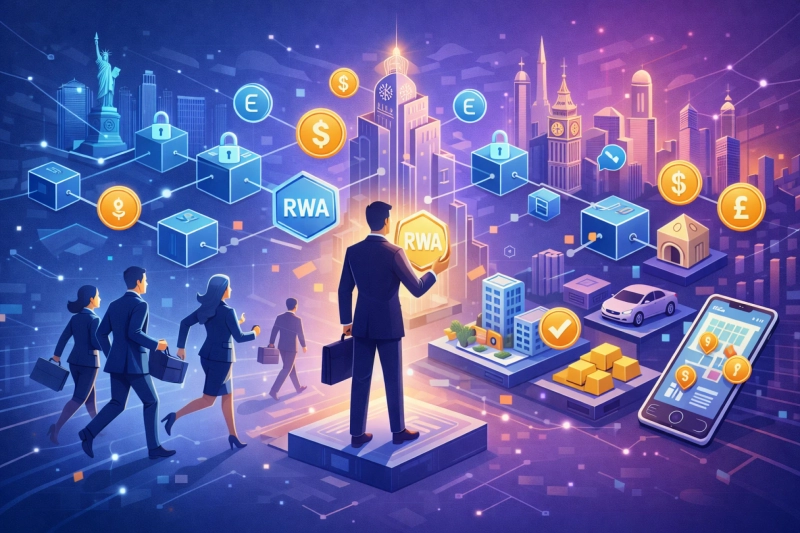
In 2026, global enterprises are no longer asking whether real world asset tokenization is viable. The conversation has decisively shifted toward execution, speed, and strategic positioning. Across finance, real estate, logistics, energy, manufacturing, and even government-backed infrastructure projects, enterprises are actively seeking partnerships with specialized RWA tokenization companies. This pursuit is not driven by hype or experimentation alone. It is a calculated response to structural inefficiencies, liquidity constraints, regulatory evolution, and the growing demand for programmable ownership models.
Real world asset tokenization represents the convergence of blockchain infrastructure with tangible economic value. It allows enterprises to convert physical and regulated assets into compliant digital representations that can be traded, financed, governed, and audited with unprecedented precision. In 2026, this capability has become a competitive necessity rather than a technological curiosity.
This article explores why enterprises across the globe are aggressively chasing RWA tokenization companies, what strategic problems they are trying to solve, and how tokenization has become a foundational pillar of modern enterprise architecture.
Understanding the Enterprise Shift Toward RWA Tokenization
The enterprise adoption curve for emerging technologies typically follows a predictable pattern. Early experimentation is followed by cautious pilots, then selective scaling, and finally widespread institutional integration. RWA tokenization has now entered its final phase. Enterprises are no longer testing tokenization in isolated innovation labs. They are embedding it into core financial, operational, and governance frameworks.
The driving force behind this shift is the realization that traditional asset systems were never designed for a digital-first global economy. Paper-based ownership records, fragmented registries, jurisdictional barriers, and manual reconciliation processes have become bottlenecks to growth. Tokenization offers enterprises a way to modernize asset infrastructure without replacing the assets themselves.
By partnering with an experienced RWA tokenization company, enterprises gain access to secure frameworks that digitize asset ownership while maintaining compliance, traceability, and legal enforceability.
The Liquidity Imperative Reshaping Enterprise Strategy
Liquidity has emerged as one of the most powerful motivations behind enterprise tokenization initiatives. Many global enterprises are asset rich but liquidity constrained. Capital is locked into long-term holdings such as real estate portfolios, infrastructure projects, commodities, intellectual property, and private equity stakes.
RWA tokenization allows enterprises to unlock value without liquidating assets entirely.
Key liquidity advantages driving adoption include:
- Fractional ownership models that attract a broader investor base
- Faster settlement cycles compared to traditional asset transfers
- Continuous market access rather than fixed trading windows
- Reduced reliance on intermediaries and complex financing structures
In 2026, enterprises view liquidity optimization as a strategic lever rather than a financial afterthought. Tokenization companies provide the technical and regulatory scaffolding needed to convert static assets into dynamic capital instruments.
Compliance-First Tokenization Is No Longer Optional
One of the primary reasons enterprises are actively chasing specialized RWA tokenization companies is compliance complexity. Tokenizing real world assets is not simply a technical challenge. It is a legal, regulatory, and jurisdictional one.
Enterprises operate across multiple countries, each with its own asset classification laws, securities regulations, tax frameworks, and reporting requirements. A misstep in compliance can expose organizations to severe legal and reputational risks.
Modern RWA tokenization companies offer compliance-first architectures that integrate:
- Jurisdiction-specific regulatory logic
- Identity verification and investor accreditation controls
- On-chain and off-chain audit trails
- Automated compliance reporting workflows
Rather than building these systems internally, enterprises prefer to partner with firms that already understand the regulatory nuances of asset tokenization across regions. In 2026, regulatory alignment is not a barrier to tokenization. It is a differentiator among tokenization providers.
The Rise of Programmable Ownership Models
Traditional asset ownership is static and rigid. Once ownership is transferred, enforcement relies on legal documentation and manual oversight. Tokenized assets introduce programmable ownership, allowing enterprises to define dynamic rules that govern how assets behave throughout their lifecycle.
This capability is transforming enterprise asset management.
Programmable ownership enables:
- Automated distribution of revenues and dividends
- Conditional transfer restrictions based on compliance status
- Embedded governance rights tied to token holdings
- Time-based or performance-based ownership changes
Enterprises in 2026 recognize that assets are no longer passive balance sheet entries. They are programmable economic engines. RWA tokenization companies provide the infrastructure to design and deploy these intelligent ownership models at scale.
Operational Efficiency as a Competitive Advantage
Global enterprises manage vast asset portfolios spread across regions, subsidiaries, and regulatory environments. Traditional asset operations are slow, fragmented, and prone to reconciliation errors. Tokenization streamlines these operations by creating a single source of truth for asset ownership and transaction history.
Operational efficiency gains include:
- Real-time visibility into asset status and ownership
- Reduced manual paperwork and administrative overhead
- Faster reconciliation across departments and partners
- Improved audit readiness and transparency
In 2026, efficiency is not just about cost reduction. It is about responsiveness, accuracy, and scalability. Enterprises are chasing RWA tokenization companies because they offer infrastructure that transforms asset operations into real-time digital workflows.
Capital Market Access Without Traditional Barriers
Historically, accessing global capital markets required navigating a maze of intermediaries, listing requirements, and settlement systems. Tokenized assets simplify this process by creating standardized digital representations that can be distributed across compliant digital marketplaces.
For enterprises, this opens entirely new capital formation strategies.
Benefits include:
- Direct access to global investors
- Reduced dependency on centralized exchanges
- Faster capital deployment cycles
- Enhanced investor transparency and engagement
RWA tokenization companies act as enablers of this transformation, helping enterprises bridge traditional finance with decentralized infrastructure while maintaining regulatory oversight.
Institutional Trust in Tokenization Infrastructure Has Matured
Earlier resistance to tokenization stemmed from concerns around security, scalability, and governance. In 2026, these concerns have largely been addressed. Enterprise-grade tokenization platforms now offer robust security architectures, disaster recovery mechanisms, and governance controls that meet institutional standards.
Key trust-building advancements include:
- Hardened smart contract frameworks
- Multi-layer custody and access control systems
- Institutional-grade key management solutions
- Independent audit and verification processes
As trust in tokenization infrastructure has matured, enterprises are no longer hesitant to commit critical assets to these systems. They actively seek out RWA tokenization companies with proven enterprise deployments and operational resilience.
Strategic Differentiation Through Asset Innovation
In competitive global markets, differentiation often comes from how effectively an enterprise leverages its assets. Tokenization enables entirely new business models that were previously impossible or economically unviable.
Examples of asset innovation include:
- Tokenized access rights to physical infrastructure
- Revenue-sharing models tied to operational performance
- Token-based loyalty and incentive structures
- Hybrid ownership models combining equity and utility
Enterprises in 2026 view tokenization not just as a financial tool but as a strategic innovation layer. RWA tokenization companies provide the creative and technical expertise needed to design these next-generation asset models.
Data Transparency and Auditability Are Board-Level Priorities
Corporate governance expectations have intensified across industries. Boards, regulators, and investors demand greater transparency into asset performance, ownership structures, and risk exposure.
Tokenized assets offer immutable, time-stamped records that significantly enhance auditability.
Transparency benefits include:
- Clear ownership lineage across asset lifecycles
- Verifiable transaction histories
- Automated compliance reporting
- Improved risk monitoring and control
For global enterprises operating under intense scrutiny, these capabilities are not optional. They are essential. RWA tokenization companies deliver the transparency frameworks that modern governance demands.
Cross-Border Asset Management Without Friction
Managing assets across borders has historically been slow and expensive. Differences in legal systems, currencies, and settlement processes introduce friction at every stage.
Tokenization reduces this friction by standardizing asset representations and enabling programmable compliance logic.
Cross-border advantages include:
- Faster settlement across jurisdictions
- Reduced currency conversion complexity
- Harmonized reporting standards
- Streamlined cross-border financing
In 2026, enterprises chasing global expansion view RWA tokenization companies as strategic partners in reducing geographic and regulatory friction.
The Talent and Infrastructure Gap Driving External Partnerships
Building a secure, compliant, and scalable tokenization platform requires specialized expertise across blockchain engineering, legal compliance, cybersecurity, and financial architecture. Most enterprises lack the internal talent and infrastructure to develop these systems from scratch.
Rather than investing years in internal development, enterprises choose to collaborate with RWA tokenization companies that already possess:
- Proven technology stacks
- Regulatory and legal expertise
- Scalable deployment frameworks
- Industry-specific implementation experience
This partnership-driven approach accelerates time to market while reducing technical and compliance risks.
Tokenization as a Foundation for Autonomous Enterprise Systems
As enterprises move toward autonomous operations powered by AI and automation, tokenized assets become foundational building blocks. Assets that can interact programmatically with systems, trigger actions, and execute rules autonomously are essential to this vision.
Tokenized assets enable:
- Automated asset leasing and utilization
- AI-driven portfolio optimization
- Real-time financial decision-making
- Self-executing contractual obligations
RWA tokenization companies are at the center of this transformation, providing the infrastructure that allows assets to participate in autonomous enterprise ecosystems.
Why 2026 Marks the Tipping Point
Several converging factors make 2026 a defining year for enterprise tokenization adoption.
These include:
- Regulatory clarity across major economies
- Institutional-grade blockchain infrastructure
- Growing enterprise familiarity with digital assets
- Increased pressure to unlock capital efficiency
- Competitive advantages gained by early adopters
Enterprises that delay tokenization risk falling behind peers who are already modernizing their asset strategies. This urgency explains why global enterprises are actively chasing RWA tokenization companies rather than passively evaluating them.
Conclusion: Tokenization as an Enterprise Survival Strategy
In 2026, the pursuit of RWA tokenization company is not driven by trend-following or speculative ambition. It is a rational response to structural inefficiencies, competitive pressure, and the need for scalable, transparent, and programmable asset systems.
Tokenization has evolved from a niche innovation into a core enterprise capability. Companies that embrace it gain liquidity, efficiency, transparency, and strategic flexibility. Those that resist it face increasing operational friction and missed opportunities.
As global enterprises continue to modernize their asset infrastructure, RWA tokenization companies will play a pivotal role in shaping the future of ownership, finance, and enterprise value creation.