



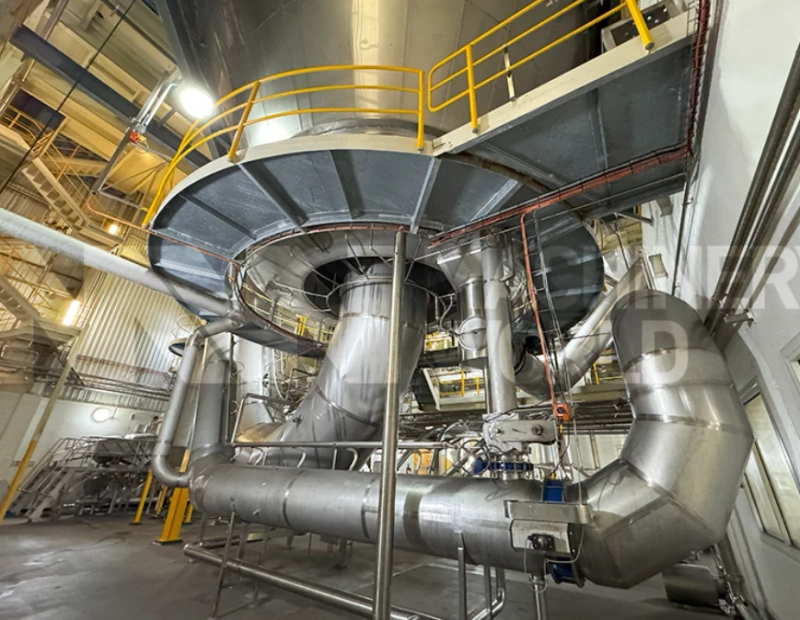
The global demand for infant nutrition has accelerated the advancement of food processing technology. Today’s consumers expect baby milk powders that are safe, nutritionally consistent, and produced under strict hygienic conditions. Manufacturers rely on sophisticated facilities designed to handle sensitive dairy processing to achieve this. A Baby Milk Powder Plant integrates a chain of highly engineered systems from evaporation and spray drying to packaging, ensuring that the final product retains nutritional quality and stability.
Such plants often have advanced technologies like MVR evaporators, TVR finishers, and large-scale spray dryers. These systems enable efficient water removal, precise thermal treatment, and the production of free-flowing milk powder that dissolves quickly and safely. Acquiring a reliable and certified processing line is critical for producers entering or scaling the infant nutrition market.
Key Components of a Baby Milk Powder Plant
A fully integrated Baby Milk Powder Plant includes several core elements, each vitally involved in transforming raw milk into stable powder form.
1. Evaporation Systems
● Multi-effect evaporators, often enhanced with MVR (Mechanical Vapor Recompression) and TVR (Thermal Vapor Recompression) units, are used to concentrate liquid milk.
● These systems reduce energy consumption by reusing vapor energy, making them both cost-efficient and environmentally friendly.
● The concentration stage ensures that water is removed before spray drying, lowering production costs while preserving product quality.
2. Spray Dryer Units
● Spray drying is the heart of powder production. Large-capacity dryers, such as Niro MSD spray dryers, are commonly used in baby milk processing.
● They allow precise control of particle size, moisture content, and flow properties.
● This ensures that the final powder dissolves easily, an essential factor for infant formula preparation.
3. Finisher Systems
● TVR finishers work with the evaporator to polish the concentration process, ensuring the milk is at the optimal solids before drying.
● Finishers ensure consistency in powder yield and quality by fine-tuning the evaporation process.
4. Auxiliary Equipment
● Heat exchangers, homogenizers, and filtration systems enhance milk's uniformity and microbiological safety.
● Stainless steel construction ensures hygienic operation and easy cleaning, both of which are critical for products consumed by infants.
5. Automation & Control
● Modern plants integrate digital monitoring systems that allow real-time temperature, humidity, and airflow control.
● This level of precision minimizes product losses and ensures repeatable quality across batches.
Pre-Owned Equipment: A Strategic Option
The dairy industry requires substantial capital investment, and new machinery can be prohibitively expensive for many processors. This is where pre-owned equipment offers an advantage. Many suppliers specialize in sourcing, testing, and refurbishing used evaporators, dryers, and complete processing lines.
Choosing pre-owned doesn’t mean compromising on quality. Certified machinery is rigorously tested, reconditioned, and prepared for immediate use. Certification ensures the plant maintains the highest safety and hygiene standards for baby milk powder applications, vital for infant nutrition products.
Capacity & Performance
High-performance baby milk processing plants often range in capacity from smaller pilot units to large-scale operations producing up to 5 tonnes of powder per hour. This scalability allows producers to choose equipment that matches their output requirements, whether they are entering the market or expanding global supply chains.
The efficiency of MVR evaporators and large spray dryers ensures that production is continuous, reliable, and capable of meeting the growing demand for infant formula worldwide.
Global Reach & Export Potential
One of the defining features of the baby milk powder industry is its global nature. Demand is not limited to local markets; producers often export to multiple countries, each with strict regulatory requirements.
Plants engineered and certified to meet international standards are particularly valuable. Buyers can benefit from suppliers who offer worldwide shipping, packaging support, and assistance with logistics, whether by sea, air, or road. For businesses in emerging markets, this makes it possible to acquire top-tier technology without prohibitive costs.
Service & Reconditioning Support
Operating a Baby Milk Powder Plant requires more than just machinery. Continuous service, reconditioning, and engineering support ensure long-term reliability. Skilled teams provide:
● On-site servicing: mechanical and electrical fault finding, welding, refrigeration work, and routine maintenance.
● Workshop reconditioning: complete overhauls of pre-owned equipment, ensuring they meet modern standards.
● Global support: technicians who can travel to provide repairs and installation.
This combination of equipment and after-sales service provides peace of mind to producers who must maintain uninterrupted production schedules.
Conclusion
Building or upgrading a Baby Milk Powder Plant is more than a technical project; it invests in quality, safety, and trust. Every element contributes to reliable infant nutrition production, from advanced evaporation and spray drying systems to certified pre-owned machinery and global service support. Whether a company is starting small or expanding to global markets, the right plant ensures they can meet demand while maintaining the highest food safety standards.