



If you feel the pressure of rapid change, start with A Complete Guide to Business Analytics and then explore focused courses in business analytics to build practical skills that hiring managers respect.
You’re not imagining it, businesses are using data, AI, and machine learning to move faster than ever. If you want a career that grows with that change, the right courses in business analytics are the most efficient way to get there. In this post, I’ll walk you through what these courses deliver, how to choose them, and a clear plan to turn learning into a job win.
Why courses in business analytics matter right now
You see job descriptions shifting: employers want people who can turn messy data into clear business decisions. That’s where courses in business analytics pay off. They teach the mix of technical skills (like SQL and Python) and the business judgment employers prize , the exact combination that accelerates promotions and opens doors to roles such as business analyst and data scientist.
Taking targeted courses in business analytics lets you move from theory to applied work quickly. Instead of learning isolated tools, you learn to answer business questions, test hypotheses, and present recommendations that leaders can act on. That’s what separates a résumé candidate from a hire.
What strong courses in business analytics teach you
A quality program will combine tools, thinking, and proof:
- Practical technical foundations: SQL for data retrieval, Excel for quick analysis, Python basics for data cleaning and simple models.
- Business-first problem solving: framing questions, choosing metrics, and aligning analyses to outcomes.
- Storytelling and visualization: making insights clear to non-technical stakeholders.
- Project-based portfolio pieces: real datasets and capstone projects you can show in interviews.
- Pathways to credentialing: many learners pair courses in business analytics with a professional certification to validate skills.
When you evaluate options, prioritise the ones that emphasize project work and real-world case studies — those are the courses in business analytics that translate to interviews.
Types of courses in business analytics, which suits you?
There isn’t a single best course. Choose by where you’re starting and where you want to go.
For beginners and students
Short foundation courses covering statistics, Excel, and basic business analytics thinking. These are ideal if you’re just getting started and want confidence to handle datasets.
For aspiring business analysts
Intermediate courses that add SQL, Python for data manipulation, dashboarding, and a capstone project. These prepare you to step into roles labeled business analyst or analytics associate.
For professionals aiming at data science
Advanced courses that teach predictive modeling, supervised learning, and end-to-end data science workflows. These are the next step if you want to move toward a data scientist or machine learning track.
For managers and domain experts
Short executive courses that focus on interpreting models, asking the right questions of data teams, and integrating analytics into strategy — helpful if you’ll partner with analytics teams rather than doing the modeling yourself.
How to evaluate any course (my mentor checklist)
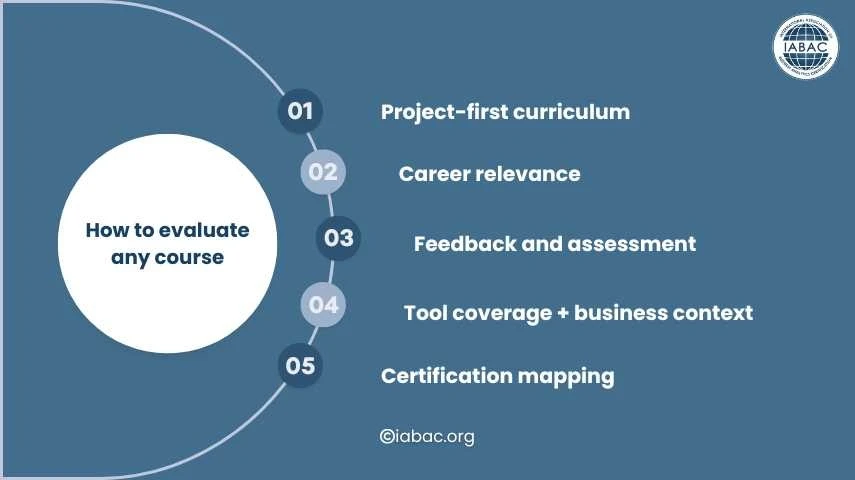
When I review a course, I ask whether it will move your career forward. Use this checklist:
- Project-first curriculum — Does the course include capstones or real datasets?
- Career relevance — Are skills taught tied to business analyst or data scientist job descriptions?
- Feedback and assessment — Will you get mentor reviews or graded assignments?
- Tool coverage + business context — SQL and Python taught with business problems, not only syntax.
- Certification mapping — Does it map to recognized credentials like Business Analytics Foundation, Certified Business Analytics Expert, Certified Visual Analytics Expert, or Certified Business Analytics for Managers?
If the course checks those boxes, it’s one of the courses in business analytics that’s likely to produce measurable results.
Evidence that employers care about practical skills
Across industries, employers consistently ask for SQL, data-wrangling experience, and the ability to present insights. That’s not anecdote — hiring trends show demand for analytics, AI, and machine learning skills growing rapidly. Courses in business analytics that focus on those exact abilities give you leverage during interviews, and real projects let you demonstrate impact rather than just recite concepts.
A realistic 6–9 month learning roadmap
This compact path works even with a full-time job:
Months 1–2 — Foundations: Basic stats, Excel for analysis, and business-problem framing.
Months 3–4 — Core technical skills: SQL for data queries, Python for data cleaning and simple visualization. Build mini-projects.
Months 5–6 — Storytelling & dashboards: Create dashboards and slide decks that communicate recommendations.
Months 7–9 — Capstone: End-to-end project that simulates a business case: gather data, analyze, optionally build a predictive model, and present a concise recommendation.
Stack these with short, focused courses in business analytics that guarantee project outcomes. That “learn → build → show” loop is what hiring teams notice
Certifications — when they help and when they don’t
Certifications are useful when they validate demonstrable skills. A certification that maps to your projects — for example, a pathway through Business Analytics Foundation to Certified Business Analytics Expert , supports your claims in interviews. But remember: a certificate alone won’t replace a portfolio of real work. Treat credentialing as validation for the work you’ve already completed.
If you want to explore certification options in business analytics, you can review the Business Analytics certification page to understand which credential aligns with your career goals, or visit IABAC to learn more about its role in certification standards and professional governance.
About the IABAC Authorized Training Provider (ATP) program
The IABAC Authorized Training Provider (ATP) program builds a global network of education partners to deliver industry-aligned training in Data Science and Business Analytics. Based on the EDISON framework, it helps providers align curricula with IABAC standards through academic and industry-driven guidelines..
This ensures high-quality knowledge sessions in data science and related courses aligned with the international syllabus. ATPs are certified to teach IABAC certification courses.
Including courses in business analytics delivered by certified ATPs can be a strong signal of quality when you choose where to invest your time.
Quick, practical plan to start this week
- Pick a small business problem that matters to you (a campus dataset, sales sample, or personal finances).
- Enroll in one project-focused course and commit to finishing one capstone within 6–8 weeks.
- Publish your work (PDF, GitHub notebook, or short presentation). Share it in applications and interviews.
- Pair a certification that maps to your portfolio — for example, moving from Business Analytics Foundation to Certified Business Analytics for Managers — to validate your learning.
This simple sequence — learn, build, publish, validate — is the pragmatic path people who get hired follow.
Common learner questions and next steps
How long will it take me to get a junior role?
For most people with focused effort and a portfolio, 6–9 months is realistic.
Do I need to be a coder?
No — many courses in business analytics start with low-code tools and Excel, then gradually introduce Python.
Which role should I target first?
Start as a business analyst to learn domain thinking, then pivot to data science if you want to build models.
You don’t have to wait to be ready. The right courses in business analytics combine practical skills, real projects, and a credible certification path — and they put you in the driving seat of your career. Choose a focused course, complete a capstone, and use that work to tell a clear story in interviews. That’s the difference between watching change happen and leading it. Ready to make one concrete move? Pick a project, enroll in a project-first course today, and let your portfolio do the talking.