



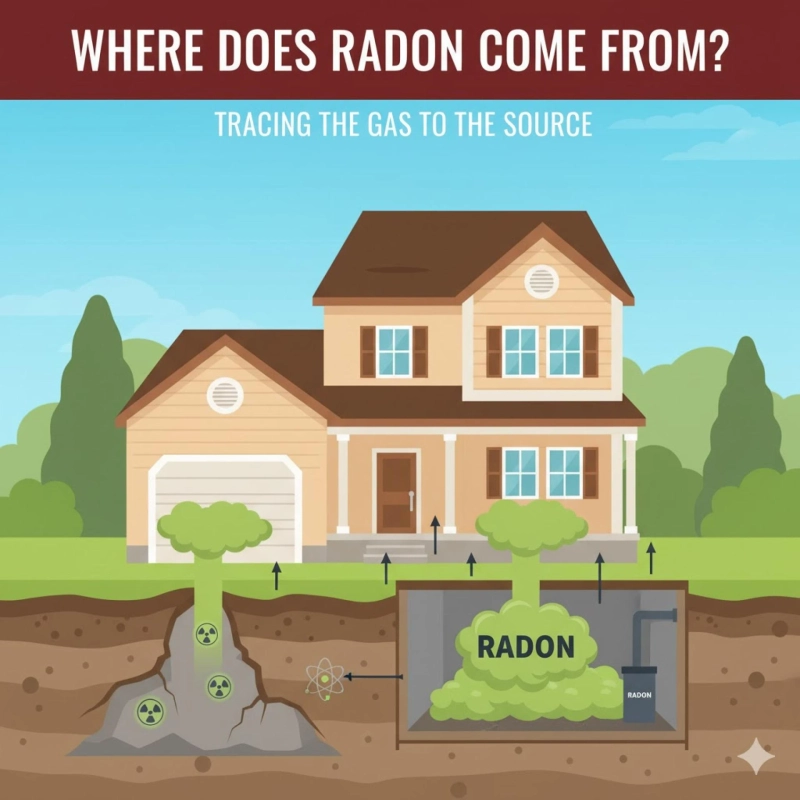
Have you ever wondered where radon gas actually comes from and how it ends up inside your home? You’re not alone. Many homeowners hear about radon during a home inspection or real estate transaction, but few understand what it is, where it originates, or why it poses such a serious health risk.
The truth is, radon is everywhere—in the ground, in the air, and sometimes even in the water. It’s invisible, odorless, and tasteless, but over time, it can silently accumulate to dangerous levels inside your home.
In this article, we’ll trace radon back to its natural origins, explore how it enters your living spaces, and explain what you can do to keep your family safe.
What Exactly Is Radon?
Radon is a naturally occurring radioactive gas that forms when uranium—a common element found in rocks, soil, and groundwater—breaks down over time. This decay process produces radium, which then decays further to form radon gas.
Because it’s a noble gas, radon doesn’t react easily with other elements or compounds. Instead, it moves freely through the soil and air, eventually finding its way into homes and buildings through even the tiniest openings.
Once indoors, radon can become trapped and accumulate—especially in basements, crawl spaces, and other low-ventilated areas.
The Radioactive Chain Reaction Behind Radon
To understand where radon comes from, it helps to look at the radioactive decay chain that produces it:
- Uranium-238, found naturally in the Earth’s crust, breaks down slowly over millions of years.
- One of its decay products, radium-226, continues to release radiation as it transforms.
- Eventually, radium decays into radon-222, a gas that can easily escape into the surrounding soil and air.
This process happens continuously and naturally. The problem begins when radon gas seeps upward through the soil and finds pathways into human-made structures.
Where Radon Comes From in the Environment
Radon is everywhere because uranium exists almost everywhere—though concentrations vary depending on the geology of the area. The main environmental sources of radon include:
1. Soil and Rocks Beneath Your Home
This is the primary source of radon gas. When uranium and radium decay underground, radon moves through the pores and cracks in the soil. If your home’s foundation has openings—even tiny ones—radon can enter and become trapped indoors.
2. Groundwater and Wells
In some areas, especially where groundwater flows through uranium-rich rock, radon can dissolve into water supplies. When you use that water for showers, dishwashing, or laundry, the gas can be released into your home’s air.
3. Building Materials
Some natural materials, like granite, shale, or concrete, can emit small amounts of radon. While this is usually minimal compared to soil gas, poorly ventilated homes with large stone features can show slightly elevated levels.
4. Outdoor Air
Even the outdoor atmosphere contains radon—though at extremely low levels that typically pose no threat. The danger arises when the gas becomes concentrated indoors without proper ventilation.
How Radon Gets Into Your Home
Radon doesn’t need a large opening to enter your home—it only needs a path of least resistance. It moves from high-pressure soil beneath your home to the lower-pressure air inside. Common entry points include:
- Cracks in concrete foundations and basement floors
- Gaps around pipes, drains, and utility penetrations
- Construction joints and wall-floor intersections
- Crawl spaces or unsealed sump pits
- Porous concrete or cinder block walls
Even brand-new homes with perfect construction aren’t immune. In fact, airtight modern homes can sometimes trap radon more easily than older, draftier structures.
Why Radon Concentrations Vary by Location
Not every region has the same radon risk. The geology beneath your home plays the biggest role. Areas with uranium-rich bedrock—such as granite, shale, or phosphate deposits—tend to have higher radon emissions.
The U.S. Environmental Protection Agency (EPA) divides the country into radon zones:
- Zone 1: Highest potential (expected average > 4 pCi/L)
- Zone 2: Moderate potential (2–4 pCi/L)
- Zone 3: Low potential (< 2 pCi/L)
However, it’s important to remember that radon levels can vary dramatically from house to house—even on the same street. The only reliable way to know your home’s risk is to test it directly.
Radon and Groundwater: The Hidden Source
If your home uses well water, you may face another potential radon pathway. Radon can dissolve in groundwater as it flows through uranium-bearing rock formations.
When that water is pumped into your home and used for showers or washing, the gas escapes into the air. While this source usually contributes less radon than soil gas, it can still raise indoor levels, especially in rural areas that rely on private wells.
To check for this, you can request a radon-in-water test, especially if your air tests show elevated levels and you rely on groundwater.
When Radon Becomes a Health Risk
Radon itself isn’t immediately toxic, but its radioactive decay products—called radon progeny or daughters—can attach to dust and particles in the air. When inhaled, they lodge in your lungs, where they release radiation that damages cells and tissues over time.
According to the EPA, long-term radon exposure is responsible for about 21,000 lung cancer deaths each year in the United States.
The danger grows with:
- Prolonged exposure over many years
- High radon levels (above 4.0 pCi/L)
- Smoking, which multiplies the risk of lung cancer
That’s why both homeowners and renters should take radon seriously, even if no one in the household smokes.
How to Find Out If Your Home Has Radon
The only way to know if radon is present in your home is to test for it. You can choose between:
- Short-term test kits – Provide results within 2 to 7 days.
- Long-term test kits – Measure radon levels over 90 days or more for more accurate readings.
- Professional testing – Certified specialists use precise equipment and can interpret results accurately.
Testing is recommended:
- When buying or selling a home
- After major renovations or foundation work
- Every two to three years as part of routine maintenance
If your results are 4.0 pCi/L or higher, it’s time to call a radon mitigation professional.
Reducing Radon at the Source: Mitigation Strategies
If testing shows high levels, don’t panic—radon problems are fixable. The goal of radon mitigation is to prevent gas from entering your home and remove what’s already inside.
Common Radon Mitigation Techniques:
- Sub-slab depressurization: A fan-driven system draws radon from beneath your foundation and vents it safely outside.
- Sealing foundation cracks: Reduces pathways for radon entry.
- Crawl space encapsulation: Adds a vapor barrier to block radon rising through the soil.
- Improved ventilation: Helps dilute radon concentration, especially in basements.
These systems are highly effective and can reduce radon levels by up to 99% when properly installed by certified professionals.
Why Professional Mitigation Is the Best Option
While DIY solutions may seem tempting, radon mitigation requires specialized equipment and knowledge. Certified radon experts can:
- Identify the specific entry points in your home
- Design a custom system based on your foundation type
- Ensure proper ventilation and fan operation
- Conduct post-installation testing to confirm success
Professional mitigation isn’t just about lowering numbers—it’s about long-term safety and peace of mind.
Conclusion: Radon Starts in the Ground—but It Doesn’t Have to Stay in Your Home
Radon begins deep within the Earth, formed from the slow decay of uranium found in soil, rocks, and groundwater. From there, it travels upward—sometimes ending up inside homes, where it can silently pose health risks for years.
But here’s the good news: radon problems are completely manageable. With regular testing and professional mitigation from Fort Collins Radon Mitigation, you can keep your home safe and your air clean.
So, the next time someone asks, “Where does radon come from?” you’ll know the answer—it comes from the ground beneath our feet. But with the right awareness and action, it doesn’t have to threaten the home above it.