



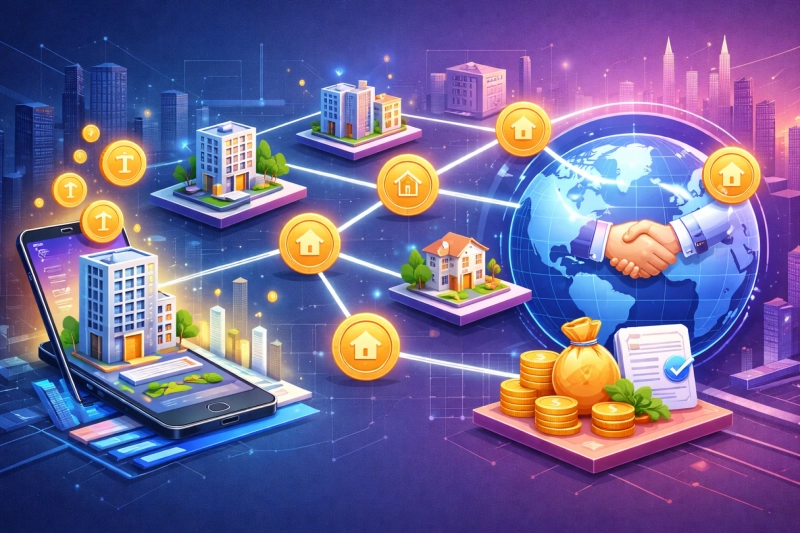
The global real estate industry is undergoing one of the most profound transformations in its history. For decades, property investment remained largely illiquid, capital intensive, slow to transact, and accessible mainly to institutional investors or high net worth individuals. Today, that reality is rapidly changing. Tokenized real estate platforms are emerging as a powerful force that is redefining how property assets are owned, traded, financed, and managed across borders.
This sudden boom is not a coincidence or a short term trend. It is the result of multiple technological, economic, regulatory, and investor driven forces converging at the same moment. From blockchain maturity and shifting investor behavior to macroeconomic pressures and the search for more efficient asset models, tokenized real estate platforms are becoming a core pillar of the future financial ecosystem.
This article explores the deeper forces driving the global surge in tokenized real estate platforms, why adoption is accelerating across regions, and what this transformation means for investors, developers, and the broader property market.
Understanding Tokenized Real Estate Platforms
At its core, a tokenized real estate platform enables physical property assets to be digitally represented as tokens on a blockchain. Each token corresponds to a fraction of ownership or economic rights associated with a real estate asset. These tokens can be bought, sold, or transferred more efficiently than traditional property ownership structures.
Unlike conventional real estate models that rely heavily on intermediaries, paperwork, and long settlement cycles, tokenized platforms introduce automation, transparency, and programmability. Smart contracts handle ownership records, revenue distribution, compliance rules, and transaction execution, significantly reducing friction in property transactions.
What makes these platforms particularly powerful is not just digitization but fractionalization. Investors can gain exposure to premium real estate assets with much smaller capital commitments, opening the market to a broader and more diverse investor base.
Global Liquidity Challenges Fueling Innovation
One of the most significant drivers behind the boom of tokenized real estate platforms is the growing liquidity challenge in global property markets. Traditional real estate is notoriously illiquid. Selling a property or exiting an investment can take months or even years, especially during economic uncertainty.
As global markets face rising interest rates, inflationary pressure, and capital tightening, both investors and asset owners are seeking more flexible liquidity options. Tokenized real estate platforms address this need by enabling fractional ownership and secondary trading opportunities, allowing investors to enter and exit positions with greater ease.
This liquidity advantage is particularly appealing in regions where real estate prices have surged beyond the reach of average investors. Tokenization offers a pathway to unlock trapped capital while preserving asset value and income potential.
Democratization of Real Estate Investment
Another powerful force driving adoption is the democratization of access to real estate investments. Historically, real estate wealth creation has been concentrated among institutional investors, developers, and affluent individuals with access to large amounts of capital.
Tokenized real estate platforms break down these barriers by allowing:
- Smaller investment ticket sizes
- Global participation without geographic constraints
- Access to diversified property portfolios
- Exposure to premium commercial and residential assets
This shift is attracting a new generation of investors who are digitally native, comfortable with blockchain based assets, and eager to diversify beyond traditional stocks and bonds. Younger investors, in particular, are embracing tokenized real estate as a bridge between tangible assets and digital finance.
Institutional Interest and Validation
While early adoption of tokenized real estate was driven largely by startups and crypto native investors, the recent boom is being fueled by growing institutional participation. Asset managers, private equity firms, real estate funds, and financial institutions are increasingly exploring tokenization as a strategic tool rather than an experimental concept.
Institutional involvement brings credibility, scale, and regulatory discipline to the ecosystem. As large players begin launching tokenized property funds or partnering with tokenization platforms, confidence in the model increases across the market.
This institutional validation is accelerating adoption worldwide, encouraging regulators, developers, and investors to take tokenized real estate platforms more seriously as long term infrastructure rather than speculative innovation.
Maturation of Blockchain Technology
The rapid advancement and stabilization of blockchain technology itself is another critical factor behind the sudden boom. Earlier blockchain networks struggled with scalability, high transaction costs, and limited enterprise readiness. Today, infrastructure has evolved significantly.
Modern blockchain ecosystems offer:
- Faster transaction processing
- Lower operational costs
- Enhanced security and immutability
- Advanced smart contract functionality
- Interoperability between platforms
These improvements make it feasible to support large scale real estate tokenization without compromising performance or user experience. As technology barriers fall, adoption naturally accelerates.
Regulatory Progress Across Key Markets
Regulatory uncertainty once posed one of the biggest obstacles to tokenized real estate adoption. However, the global regulatory landscape is gradually becoming clearer and more supportive.
Many jurisdictions are now developing frameworks that recognize digital securities, tokenized assets, and blockchain based ownership structures. While regulations vary by region, the overall trend is moving toward greater clarity rather than restriction.
This progress is encouraging platform developers and investors to move forward with confidence. Regulatory alignment also enables cross border investment flows, further amplifying the global reach of tokenized real estate platforms.
Demand for Transparent and Trustless Systems
Transparency has long been a challenge in traditional real estate transactions. Opaque ownership structures, delayed reporting, and reliance on intermediaries can create inefficiencies and mistrust.
Tokenized real estate platforms address these issues through blockchain based transparency. Ownership records, transaction histories, and revenue distributions are recorded on immutable ledgers, reducing the risk of disputes and manipulation.
This level of transparency is particularly attractive to international investors who may not have local market expertise. By reducing information asymmetry, tokenized platforms make global real estate investment more accessible and trustworthy.
Rise of Alternative Investment Strategies
Global investors are increasingly seeking alternative assets to hedge against market volatility, inflation, and currency risk. Real estate has long been viewed as a stable store of value, but traditional entry barriers limited its role in diversified portfolios.
Tokenized real estate platforms allow investors to integrate property exposure into modern investment strategies more easily. Fractional ownership enables diversification across asset types, locations, and risk profiles without requiring massive capital commitments.
As portfolio strategies evolve, tokenized real estate is emerging as a natural fit for investors seeking both stability and innovation.
Acceleration of Cross Border Investment
Cross border real estate investment has historically been complex due to legal, tax, and operational challenges. Tokenized platforms significantly reduce these frictions by standardizing ownership structures and automating compliance processes.
Investors can now gain exposure to international property markets without navigating local intermediaries or complex paperwork. This global accessibility is driving rapid adoption in emerging markets, where real estate growth potential is high but access was previously limited.
The ability to pool global capital efficiently is transforming how property development and financing are approached worldwide.
Real Estate Developers Seeking New Capital Models
Developers are increasingly turning to tokenized real estate platforms as alternative fundraising mechanisms. Traditional financing routes such as bank loans or private equity often involve high costs, lengthy negotiations, and restrictive terms.
Tokenization offers developers a more flexible and transparent way to raise capital while maintaining greater control over their projects. By offering fractional ownership or revenue sharing tokens, developers can attract a broader investor base and accelerate project timelines.
This shift is especially appealing in markets where traditional financing has tightened or become more expensive.
Automation and Operational Efficiency
Operational inefficiency has long plagued the real estate sector. Manual processes, paper based contracts, and fragmented systems increase costs and slow down transactions.
Tokenized real estate platforms introduce automation at multiple levels:
- Smart contracts execute transactions automatically
- Rental income and dividends are distributed programmatically
- Ownership transfers occur in near real time
- Compliance rules are embedded into token logic
These efficiencies reduce administrative overhead and improve scalability, making real estate operations more attractive to both investors and asset managers.
Growing Awareness and Education
The surge in educational content, industry discussions, and successful pilot projects has significantly increased awareness of tokenized real estate platforms. As more real world use cases emerge, skepticism is giving way to curiosity and adoption.
Investors who once viewed tokenization as complex or risky are now seeing tangible benefits and measurable performance. This growing awareness is creating a positive feedback loop that fuels further growth.
Economic Uncertainty and Asset Reallocation
Periods of economic uncertainty often drive innovation. As global markets face geopolitical tensions, inflationary pressure, and shifting monetary policies, investors are reassessing asset allocation strategies.
Tokenized real estate platforms provide a compelling solution by combining the perceived stability of physical assets with the flexibility of digital finance. This hybrid appeal is resonating strongly in uncertain times, contributing to rapid adoption worldwide.
Network Effects and Platform Ecosystems
As more assets, investors, and service providers join tokenized real estate platforms, network effects begin to accelerate growth. Larger ecosystems offer better liquidity, improved pricing, and enhanced services, attracting even more participants.
This compounding effect is one of the reasons the boom appears sudden. Once critical mass is reached, adoption scales rapidly across markets and regions.
The Road Ahead for Tokenized Real Estate Platforms
The global boom in tokenized real estate platforms is not a temporary spike but a structural shift in how property assets are managed and traded. While challenges remain, including regulatory harmonization and investor education, the momentum is unmistakable.
As technology continues to mature and institutional participation deepens, tokenized real estate platforms are likely to become a foundational layer of the global property market. They offer a more inclusive, efficient, and transparent model that aligns with the digital economy of the future.
Conclusion
The sudden rise of tokenized real estate platforms worldwide is the result of multiple forces aligning at the same time. Liquidity constraints, investor demand for accessibility, institutional validation, regulatory progress, and technological maturity have collectively reshaped the real estate landscape.
What was once an exclusive and rigid asset class is evolving into a dynamic, programmable, and globally accessible investment opportunity. Tokenized real estate platforms are not merely digitizing property ownership but redefining its economic potential.
As adoption accelerates across regions, industries, and investor segments, one thing is clear. Tokenized real estate platforms are no longer on the fringe of innovation. They are rapidly becoming central to the future of global real estate investment.