




Return on Investment (ROI) for local service businesses is technically defined as the ratio of net profit to the cost of the investment. If a Vancouver, WA plumbing company spends $1,000 on a digital campaign and generates $5,000 in gross profit from those leads, the calculation seems simple. However, for service-based industries like HVAC, spray foam insulation, and plumbing, true ROI involves more than a simple cash-in, cash-out equation. It encompasses lead quality, customer lifetime value, and brand positioning within the local market.
Business owners often focus on vanity metrics such as clicks or impressions, mistaking activity for profitability. A high number of clicks means nothing if those clicks do not turn into booked appointments. This article examines the financial and operational realities of marketing investments for service companies in the Pacific Northwest. It breaks down how to calculate real returns, why local market factors in Vancouver matter, and how to distinguish between a marketing expense and a revenue-generating asset.
Moving Beyond the Basic Formula
Most general ROI formulas fail to account for the specific dynamics of the service industry. A contractor does not sell a static product on a shelf. They sell time, expertise, and solutions to urgent problems. Therefore, the return on marketing spend must be evaluated based on the quality of the jobs secured, not just the quantity of leads generated.
The Hidden Value of Brand Authority
When a homeowner in Vancouver faces a burst pipe or a failing furnace, they rarely choose a company at random. They choose a name they recognize or a business that appears at the top of search results with strong reviews. Marketing services that build this authority generate a compounding return.
An initial investment in Search Engine Optimization (SEO) might not result in immediate cash flow in month one. Over time, however, owning the top spot for "emergency plumber Vancouver WA" significantly reduces the cost per lead. The business stops paying for every single click and starts receiving organic traffic. This shift from renting attention (ads) to owning attention (organic rank) represents the highest form of marketing ROI.
Search Visibility in the Pacific Northwest
The digital space in Southwest Washington is competitive. Businesses must differentiate themselves not just from local competitors but also from larger aggregators. A strong marketing strategy ensures that when local customers search for services, they find a local expert rather than a national directory.
Customer Lifetime Value (CLV) vs. One-Off Jobs
Calculating ROI based on a single transaction often leads to poor decision-making. A marketing campaign might cost $300 to acquire a customer who only spends $200 on a minor repair. On the surface, this looks like a loss.
Suppose that same customer signs up for an annual maintenance plan or calls back three years later for a complete system replacement, the math changes. The initial $300 investment secured a customer worth thousands of dollars over five years. Clever marketing focuses on acquiring these high-value, recurring clients rather than chasing the lowest cost per lead.
Why Retention Matters for Contractors
Service businesses thrive on repeat buyers and referrals. A marketing strategy that brings in customers who leave positive reviews adds a secondary layer of ROI. Those reviews attract new customers for free.
Bonus Tip: Tracking Recurring Revenue
Service businesses should tag leads in their CRM based on the original marketing source. Reviewing this data annually reveals which channels bring in loyal customers versus one-time bargain hunters.
Regional Factors Affecting ROI in Vancouver
Marketing in Vancouver, WA, requires a different approach than marketing in Portland or Seattle. The local economy and distinct community identity influence how residents select service providers. Understanding these nuances prevents wasted ad spend on audiences that will never convert.
Local Competition and Market Saturation
Vancouver operates as both a suburb of Portland and a distinct city with its own commercial center. Service businesses here face competition from Portland-based companies trying to expand north across the river. However, many Vancouver residents prefer to hire locally to avoid traffic delays and support their immediate community.
Marketing content emphasizing "locally owned and operated in Vancouver" often yields a higher conversion rate. The ROI improves when the messaging aligns with the local sentiment of supporting Clark County businesses.
Seasonal Fluctuations in the Pacific Northwest
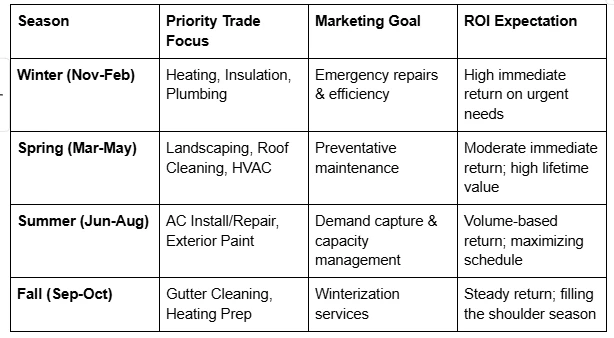
The weather in the Pacific Northwest dictates the demand for many service industries. ROI fluctuates naturally with the seasons. An HVAC company will see different returns on ad spend during a heatwave compared to during a mild, rainy season.
The following table illustrates how marketing focus should shift throughout the year to maintain positive ROI for local trades.
Internal Prerequisites for Marketing Success
Business owners often rush into marketing contracts without setting the proper groundwork. A few internal factors can make or break the success of an external marketing campaign.
Setting Realistic Timelines
Digital marketing is rarely a quick fix. Pay-Per-Click (PPC) ads can turn on traffic instantly, but SEO and reputation management take months to mature. A business expecting a 500% return in the first thirty days will likely be disappointed and may cancel a campaign just before it starts to gain traction. Patience and consistent investment usually yield the best long-term results.
Budget Allocation for Maximum Impact
Spreading a small budget across too many channels dilutes its effectiveness. It is often better to dominate one channel, such as local search, before expanding into social media ads or radio. A focused budget enables sufficient data collection to optimize the campaign and improve ROI month over month.
Bonus Tip: The 5% Rule
A standard benchmark for service businesses looking to grow is to reinvest 5% to 10% of gross revenue into marketing. Companies looking to maintain their current size can often hold steady
with 3% to 5%.
Measuring Success Beyond the Cash Register
Financial profit is the ultimate goal, but other metrics indicate whether a marketing strategy is healthy and sustainable.
Lead Quality Over Quantity
Ten leads that convert into eight jobs are far more valuable than fifty leads that convert into five jobs. High-volume, low-quality leads waste administrative time and frustrate sales teams. A marketing service delivers actual value when it filters out tire-kickers and delivers prospects who are ready to buy.
Attribution Models
Knowing exactly where a lead came from allows businesses to cut wasteful spending. If a company spends money on billboards, flyers, and Google Ads simultaneously, they need to know which one caused the phone to ring. Call tracking and digital analytics provide this clarity. Without proper attribution, a business owner might accidentally cut the one channel that was driving their most profitable jobs.
Common Questions About Marketing Investment
Is it better to hire a freelancer or an agency? Freelancers often cost less upfront but may lack the breadth of skills needed for a complete strategy. Agencies typically provide a team of experts, writers, SEO specialists, and technical staff, which can deliver greater stability and more comprehensive results.
Does social media work for plumbers and HVAC techs? Social media builds brand awareness but rarely drives immediate emergency calls. It works best for visual trades like remodeling or landscaping, or for staying top of mind with past customers. It should usually be a secondary priority after search marketing.
Why do marketing costs vary so much? Costs depend on the scope of work. A service that posts only to Facebook will be cheap but offer a low ROI. A service that handles technical SEO, content creation, and reputation management requires more labor and expertise, justifying a higher investment.
Frequently Asked Questions
How long does it take to see a positive ROI from SEO?
Most businesses in competitive markets like Vancouver start seeing significant organic movement between months four and six. The ROI compounds over time as the site gains authority and maintains rankings without requiring additional ad spend for every click.
What is a good ROI for a local service business?
A 5:1 ratio is a strong benchmark. This means for every $1 spent on marketing, the business generates $5 in revenue. Margins vary by industry, but anything above 3:1 is generally considered profitable, while ratios above 10:1 indicate highly efficient campaigns.
Should I stop marketing when I am too busy?
Stopping marketing altogether creates a "feast or famine" cycle. When the current backlog of work clears, the phone may stop ringing. It is smarter to adjust the budget or switch focus to higher-margin services rather than shutting down lead generation entirely.
How does website speed affect my marketing ROI?
A slow website kills conversion rates. If a user clicks an ad but the page takes five seconds to load, they will leave. This means the business paid for the click but lost the customer. Fast, mobile-friendly sites maximize the value of every marketing dollar.
Making the Final Calculation
Understanding ROI requires looking at the complete picture of a business's health. It involves analyzing acquisition costs, retention rates, and the long-term value of a brand within the Vancouver community. Business owners who view marketing as an investment in their future capability to earn revenue, rather than just a monthly expense, tend to make smarter decisions. They focus on data, prioritize quality leads, and adjust their strategies based on seasonal and regional realities.
Getting Expert Guidance
Calculating these figures and executing a strategy can be complex for busy business owners. Genius Marketing. specializes in helping service businesses clarify their numbers and build systems that generate consistent returns. They provide transparent reporting and tailored strategies for the local market.
For a detailed analysis of your current marketing performance, contact them at info@geniusmarketingco.com or call (360) 519-5100. Their team helps contractors move beyond guesswork to build predictable growth.
Author: Spencer Hart
Spencer Hart, founder of Genius Marketing, has more than 25 years of experience in marketing and local SEO for service businesses. He helps spray foam, HVAC, plumbing, and other local companies bring in more leads and grow their revenue. Spencer is a serial entrepreneur and father of twins who leads a team focused on practical SEO and steady digital growth.
Reviewer: Jordan Lee
Jordan Lee is a marketing and local SEO specialist with more than 6 years of hands-on experience helping small and mid-size service businesses improve their online reach and steady lead flow.}