



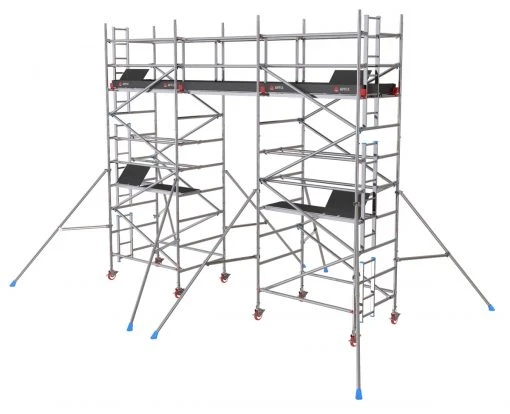
Construction activity across Saudi Arabia faces intense environmental pressure. Heat, dust, and shifting site conditions demand equipment that adapts quickly without compromising safety or efficiency. Mobile aluminium scaffold for sale in Saudi Arabia continues to attract attention as contractors seek durable and climate-resilient access systems for demanding project environments.
Mobile scaffolding stands out as a practical solution in these conditions. Its structure, material composition, and mobility directly address the challenges posed by extreme weather and large-scale construction demands.
Climate Conditions That Shape Equipment Performance
Saudi Arabia’s climate creates a unique operating environment for contractors. Equipment must perform reliably under stress factors that affect both materials and workers.
Key Environmental Challenges
- High temperatures exceeding 45°C in many regions
- Frequent dust storms and airborne sand
- Strong sunlight causes material degradation
- Dry conditions are accelerating wear and tear
- Large open construction zones with limited shade
These factors influence how scaffolding systems behave over time. Equipment that fails to adapt increases safety risks and operational delays.
Why Mobile Scaffolding Fits Harsh Weather Conditions?
Mobile scaffolding offers advantages that align well with these environmental demands. Its design focuses on simplicity, mobility, and resilience.
Unlike heavy mechanical systems, mobile scaffolding relies on fewer moving parts. This characteristic reduces the risk of failure in extreme heat and dusty conditions.
Contractors benefit from:
- Reduced dependency on electrical or hydraulic systems
- Easier maintenance in remote or exposed locations
- Consistent performance without complex servicing
This simplicity proves valuable in regions where environmental stress affects equipment reliability.
Heat Resistance and Material Strength
Temperature plays a major role in equipment performance. Materials expand, weaken, or degrade under prolonged heat exposure.
Aluminum mobile scaffolding performs well in high temperatures due to its natural properties:
- High resistance to corrosion
- Ability to withstand heat without structural deformation
- Lightweight composition that prevents excessive heat retention
Steel scaffolding, in contrast, absorbs and retains more heat, making it uncomfortable and sometimes unsafe for workers. Aluminum structures remain more manageable during peak daytime conditions.
Dust and Sand Resilience
Dust and sand create operational challenges across construction sites in Saudi Arabia. Fine particles infiltrate mechanical systems, causing wear and reducing efficiency.
Mobile scaffolding avoids many of these issues because:
- It does not rely on engines or hydraulic systems
- It requires minimal lubrication
- Its open design prevents the accumulation of debris
Compact access machines often struggle in such environments due to clogged filters and increased maintenance requirements. Mobile scaffolding reduces downtime caused by these factors.
Mobility Across Expansive Job Sites
Construction projects in Saudi Arabia often cover large areas, especially in infrastructure and industrial developments.
Mobile scaffolding provides a clear advantage in such environments. Workers move the structure easily across different sections without dismantling it.
This mobility leads to:
- Faster task transitions
- Reduced labor fatigue
- Improved workflow continuity
Contractors avoid delays that typically occur when repositioning fixed scaffolding systems.
Worker Comfort and Safety in Extreme Heat
Worker safety remains a priority, especially under intense sunlight and high temperatures.
Mobile scaffolding supports safer working conditions through:
- Stable platforms that reduce unnecessary movement
- Guardrails that prevent falls
- Quick repositioning to shaded areas when possible
Although no equipment eliminates heat exposure, mobile scaffolding helps teams adapt their working position more efficiently.
Efficiency Gains Under Climate Pressure
Environmental conditions often slow down construction progress. Equipment that minimizes delays becomes essential.
Mobile scaffolding enhances efficiency by:
- Allowing quick setup without complex tools
- Supporting uninterrupted work cycles
- Reducing dependency on power sources
Contractors maintain productivity even when environmental conditions limit the use of advanced machinery.
Cost Advantages in Harsh Conditions
Climate affects not only performance but also cost. Equipment that requires frequent repairs or replacements increases operational expenses.
Mobile scaffolding helps control costs through:
- Long service life despite exposure to harsh conditions
- Minimal maintenance requirements
- Reduced need for specialized technicians
Cost Benefits at a Glance
- Lower repair frequency compared to mechanical systems
- No fuel or power consumption costs
- Reduced downtime due to fewer breakdowns
- Extended usability across multiple projects
These factors contribute to a stronger return on investment over time.
Adaptability Across Different Project Types
Saudi Arabia’s construction sector includes a wide range of projects, from residential buildings to industrial facilities.
Mobile scaffolding adapts easily to different applications:
- Exterior finishing on buildings
- Maintenance work in industrial plants
- Installation tasks in open environments
- Short-term repair projects
Its flexibility allows contractors to use the same system across various tasks without significant modifications.
Transport and Storage Benefits
Logistics become challenging in large and remote construction sites. Equipment must be easy to transport and store.
Mobile scaffolding offers practical advantages:
- Lightweight components simplify handling
- Compact design reduces storage space
- Easy assembly and disassembly improve mobility
Contractors reduce transportation costs and improve operational efficiency.
Reduced Mechanical Dependency
Mechanical systems often struggle in extreme climates due to overheating and component wear.
Mobile scaffolding eliminates many of these concerns by relying on manual operation. This approach ensures consistent performance without:
- Engine failures
- Battery limitations
- Hydraulic system issues
This reliability becomes critical in remote areas where technical support may not be readily available.
Environmental Sustainability Considerations
Sustainability plays an increasing role in construction planning. Equipment that reduces environmental impact offers additional value.
Mobile scaffolding contributes to sustainability by:
- Eliminating fuel consumption
- Reducing emissions
- Supporting long-term reuse
Contractors align with environmental goals while maintaining operational efficiency.
Limitations to Keep in Mind
While mobile scaffolding offers strong advantages, contractors must consider its limitations.
- It may not reach the extreme heights required for certain projects
- It requires manual effort for repositioning
- It may not suit tasks needing precise vertical movement
Evaluating these factors ensures proper equipment selection.
Best Practices for Maximizing Performance
Contractors can enhance the benefits of mobile scaffolding by following effective practices.
Recommended Actions
- Conduct regular inspections to ensure structural integrity
- Train workers on proper assembly and movement
- Use appropriate safety accessories such as guardrails
- Store components properly to avoid unnecessary wear
These steps help maintain performance and extend equipment lifespan.
Strategic Value for Contractors
Mobile scaffolding offers more than operational convenience. It supports long-term business goals by improving efficiency and reducing costs.
Contractors gain advantages such as:
- Better project timelines
- Lower operational risks
- Increased equipment reliability
- Improved workforce productivity
These benefits strengthen competitiveness in a demanding construction market.
Future Relevance in Saudi Arabia
Construction activity in Saudi Arabia continues to expand across urban and industrial sectors. Equipment that performs well under environmental stress will remain essential.
Mobile scaffolding aligns with this need by offering durability, flexibility, and cost efficiency. As projects grow in scale and complexity, contractors will continue to rely on solutions that deliver consistent performance under challenging conditions.
Conclusion
Mobile scaffolding provides a practical response to the environmental challenges faced in Saudi Arabia. Its design supports durability, efficiency, and safety in high temperatures and dusty conditions.
Contractors who prioritize reliable and adaptable equipment gain better control over project execution. Mobile scaffolding enables smoother workflows, reduced downtime, and improved cost management across a wide range of construction activities.
Its ability to perform consistently in harsh climates makes it a valuable asset for contractors aiming to maintain productivity and protect long-term investments.