



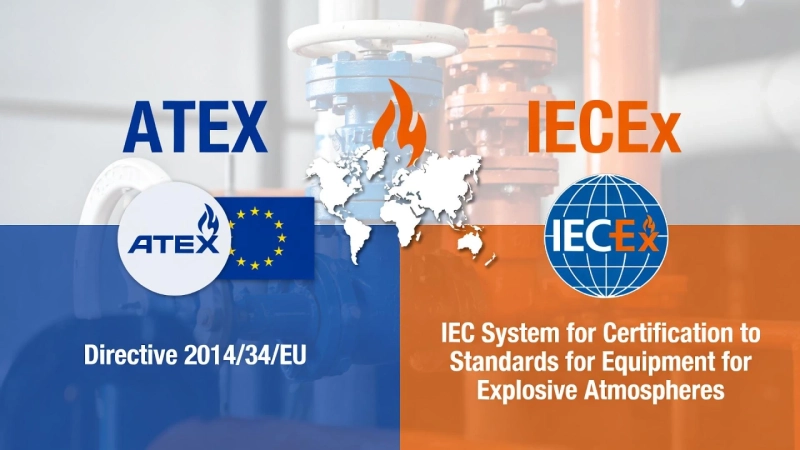
Equipment manufacturers targeting international markets face confusion about whether they need ATEX, IECEx, or both certifications. European customers request ATEX while Middle Eastern projects specify IECEx.
Companies waste money obtaining inappropriate certifications for their target markets. Engineers struggle to understand if technical requirements differ between the systems or if one automatically qualifies for the other.
This confusion leads to delayed market entry, inefficient spending, and sometimes selling equipment without proper certification. Understanding the differences enables smart decisions about certification investments.
ATEX is the European Union's mandatory certification for explosive atmosphere equipment sold in EU markets. IECEx is an international voluntary certification scheme recognized across over 35 countries worldwide.
ATEX focuses on regulatory compliance within Europe using EU directives. IECEx emphasizes international harmonization using IEC standards that countries voluntarily recognize.
Both reference similar technical standards (IEC 60079 series), meaning design requirements largely align. However, certification processes, geographic acceptance, and regulatory standing differ significantly.
What Exactly is ATEX Certification?
ATEX derives its name from the French "Atmosphères Explosibles" and consists of two EU directives. The equipment directive (2014/34/EU) mandates certification for products sold in European markets.
ATEX certification is legally required, not optional, for equipment sold in the European Union and European Economic Area. You cannot sell explosive atmosphere equipment in these markets without valid ATEX certification.
This requirement applies regardless of where equipment is manufactured. Products made anywhere in the world need ATEX certification for European sales.
ATEX involves assessment by Notified Bodies—organizations designated by EU member states to conduct conformity assessments. These bodies evaluate equipment designs, conduct testing, and issue required certificates.
Manufacturers then affix CE marking with Notified Body identification numbers to certified equipment. This CE marking signals regulatory compliance to European authorities and customers.
The ATEX system covers both industrial equipment (Group II) and mining equipment (Group I). Protection concepts and zone classifications align closely with IEC 60079 standards.
What Exactly is IECEx Certification?
IECEx operates as an international certification scheme managed by the International Electrotechnical Commission. It provides voluntary certification recognized across participating countries worldwide.
Unlike ATEX's regulatory mandate within Europe, IECEx certification represents a consensus-based international system. Countries voluntarily participate and recognize certificates through mutual agreements.
The IECEx system includes equipment certification, quality assessment, service facility certification, and personnel competence schemes. This comprehensive approach addresses equipment, facilities, and people.
IECEx bases all requirements directly on IEC standards, particularly the IEC 60079 series, without regional modifications. This direct application promotes truly international harmonization.
Equipment certified under IECEx meets identical technical specifications whether sold in Australia, Malaysia, South Africa, or Brazil. The system operates through accredited certification bodies and testing laboratories distributed globally.
This global reach particularly benefits manufacturers in Asia, Africa, and the Americas where ATEX Notified Bodies have limited presence. Regional access to certification services reduces costs and timelines.
Which Countries Accept ATEX vs IECEx?
ATEX applies specifically to European Union and European Economic Area markets including 30 European countries. It provides legal market access only in Europe.
IECEx provides recognition across over 35 countries spanning all continents. Member countries include Australia, Canada, China, India, Japan, South Korea, Singapore, Brazil, and many others.
Beyond formal member countries, many additional nations accept IECEx through regulatory frameworks referencing IEC standards. Middle Eastern countries increasingly adopt IECEx as preferred standards.
The geographic coverage difference means manufacturers targeting global markets benefit more from IECEx. Those selling exclusively to Europe require ATEX regardless of other considerations.
Many manufacturers pursue both certifications to maximize global coverage. Since technical requirements align, obtaining both typically requires only additional administrative processes, not equipment redesign.
Understanding IECEx vs ATEX which one you need depends entirely on your target markets. Strategic analysis of customer locations drives certification decisions.
How Do Certification Requirements Differ?
Regulatory status fundamentally differs between systems. ATEX certification is legally mandatory for EU market access, backed by enforcement and potential penalties.
IECEx certification remains voluntary in most jurisdictions, required only when clients or specifications demand it. However, major operators increasingly specify IECEx, making it practically mandatory for certain markets.
Certification marking differs visibly between systems. ATEX-certified equipment displays CE marking with Ex designation and Notified Body numbers.
IECEx-certified equipment shows the IECEx symbol, certificate number, and explosion protection marking. No CE marking appears since that's specific to European regulations.
Personnel competence represents another distinction. IECEx includes comprehensive personnel certification schemes like CoPC verifying individual competence for installation and maintenance work.
ATEX focuses primarily on equipment with less formalized personnel certification frameworks. European training standards exist separately but aren't integrated into ATEX like IECEx integrates personnel schemes.
Are Technical Requirements the Same?
Despite organizational differences, ATEX and IECEx share substantial technical common ground. Both systems reference IEC 60079 standards for technical requirements.
European harmonized standards (EN 60079 series) directly correspond to IEC 60079 standards. This ensures technical alignment between ATEX and IECEx requirements.
Equipment designed to meet one system typically satisfies the other's technical requirements with minimal modifications. Explosion protection concepts have identical definitions across both systems.
Zone classifications align perfectly between systems. Zone 0, Zone 1, and Zone 2 designations carry identical meanings in ATEX and IECEx frameworks.
Testing procedures and acceptance criteria follow the same protocols. Laboratory tests for temperature, electrical safety, and mechanical strength use identical methods whether conducted for ATEX or IECEx.
This technical similarity means equipment meeting ATEX requirements typically also meets IECEx technical specifications. However, certification processes remain distinct requiring separate applications.
Which Certification Do UAE and KSA Companies Need?
The United Arab Emirates and Saudi Arabia predominantly recognize and require IECEx certification rather than ATEX. Major operators including ADNOC and Saudi Aramco specify IECEx in procurement standards.
This preference reflects strong connections to international oil and gas companies that standardized on IECEx globally. Equipment suppliers come from diverse international sources making IECEx's broader recognition more practical.
Neither UAE nor Saudi Arabia maintains EU market access as a concern since equipment stays in-region. Consequently, ATEX certification provides limited value unless specifically targeting European exports.
However, some European manufacturers supplying Middle Eastern markets hold only ATEX certification. End users must understand that ATEX alone doesn't automatically satisfy IECEx requirements.
Projects specifying IECEx certification should verify quoted equipment holds actual IECEx certificates. Don't assume ATEX certification suffices even though technical specifications align.
Companies occasionally encounter European contractors who specify ATEX out of familiarity. Understanding that IECEx-certified equipment meets equivalent technical requirements helps negotiate compliant alternatives.
Key Takeaway
- ATEX is mandatory EU certification; IECEx is voluntary international certification
- ATEX covers 30 European countries; IECEx recognized in 35+ countries worldwide
- Both reference IEC 60079 standards ensuring technical compatibility
- ATEX uses CE marking; IECEx uses distinctive IECEx symbols
- UAE and KSA markets predominantly require IECEx, not ATEX
- Technical requirements align closely despite different certification processes
- Global manufacturers often pursue both for maximum market coverage
- Equipment meeting one system typically satisfies the other technically
- Certification choice depends on target markets and business strategy
Need guidance on which certification suits your business strategy? Extrainings offers expert consultation on certification planning, helping companies navigate ATEX and IECEx requirements while optimizing investments for maximum market access.