



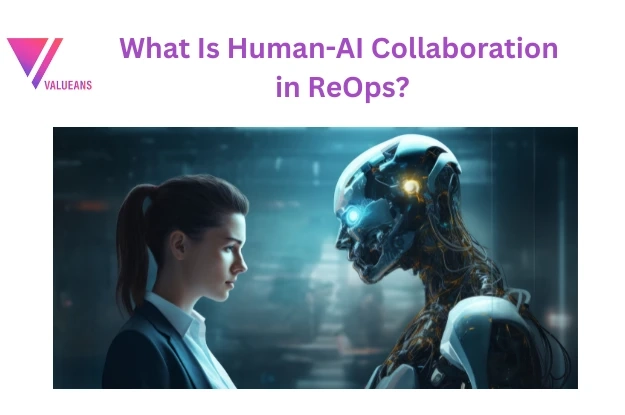
Human-AI collaboration refers to the partnership between people and artificial intelligence systems to optimize tasks, decision-making, and innovation. In ReOps (Reuse Operations) — a new evolution of DevOps focused on reusing proven operational patterns — AI acts as an intelligent layer that analyzes, predicts, and automates repetitive tasks.
If you’ve explored how ChatGPT Atlas and intelligent systems reshape ReOps, you can check out this related read on ChatGPT Atlas and Intelligent Software Development to understand the foundational shift AI brings to modern development.
Why Is AI Collaboration Crucial in ReOps Environments?
ReOps emphasizes reusing reliable code components, workflows, and automations to accelerate software creation.
AI enhances ReOps by learning from these reusable components, predicting bottlenecks, and enabling proactive operations.
For example, AI tools can analyze build data, detect performance drops, and automatically trigger reuse of an optimized code segment — all without manual input. This synergy results in fewer redundancies and faster releases.
When implemented through professional AI Development Services, teams can gain intelligent automation, adaptive learning models, and contextual insights throughout the development lifecycle.
How Does ReOps (Reuse Operations) Empower AI Development Services?
ReOps offers a foundation for scalable AI deployment. Its principle of reusing functional modules perfectly complements how AI models learn from past data and refine performance over time.
Here’s how AI and ReOps strengthen each other:
- Reuse of successful AI workflows: Streamlines integration and reduces time-to-market.
- Continuous feedback loops: Allow AI to self-optimize deployment processes.
- Dynamic resource allocation: Enables ReOps to assign resources based on AI predictions.
- Improved reliability: Minimizes repetitive testing through reusable AI-validated components.
This intelligent fusion allows an AI Development Company to create agile, learning-driven systems with high accuracy and scalability.
What Are the Key Benefits of Human-AI Collaboration for Businesses?
1. Smarter Decision-Making
AI processes vast operational data while humans provide contextual judgment, leading to balanced, data-driven outcomes.
2. Accelerated Development
AI-powered ReOps automates testing, deployment, and maintenance, speeding up Custom Software Development Services by over 40% in some cases.
3. Consistency and Reuse
ReOps ensures the reuse of stable workflows, while AI keeps them continuously optimized, maintaining product quality.
4. Enhanced Creativity
By offloading repetitive operations to AI, human developers can focus on Custom AI Solutions, product innovation, and UX improvements.
What Are the Real-World Applications of AI in ReOps?
Several industries already use AI-powered ReOps to enhance productivity and resilience:
- Finance: Automated risk modeling and predictive compliance.
- Healthcare: AI-enabled ReOps pipelines that reuse verified algorithms for diagnostics.
- Retail: Adaptive inventory systems that reuse best-performing models for seasonal forecasting.
According to industry studies, AI-based ReOps reduces manual intervention by up to 55%, improving uptime and software delivery accuracy.
What Challenges Arise in Human-AI ReOps Integration?
While AI offers intelligent automation, businesses face challenges such as:
- Data privacy risks — especially when integrating third-party AI tools
- Skill gaps — teams must learn how to collaborate effectively with AI systems.
- Trust issues — human operators may hesitate to fully rely on AI-driven decisions.
By addressing these areas, enterprises can create a more transparent and secure ReOps ecosystem.
How Can Enterprises Implement Human-AI Collaboration Effectively?
For large-scale success, organizations should:
- Adopt explainable AI tools to ensure decision transparency.
- Create AI-human feedback cycles where humans validate and refine AI outcomes.
- Integrate ReOps frameworks into existing CI/CD environments for seamless reuse.
- Partner with trusted providers for scalable enterprise software development — like Valueans’ Enterprise Software Development Services.
These practices help companies unlock the full potential of AI-driven ReOps while maintaining control and flexibility.
What Is the Future of Human-AI Collaboration in ReOps?
The next phase of ReOps will rely on autonomous AI agents that can detect, resolve, and optimize operations without human intervention. However, the human role will evolve from executor to strategic supervisor, ensuring that AI aligns with business ethics, goals, and compliance standards.
AI for Business Automation will increasingly merge with ReOps strategies, forming intelligent ecosystems where every workflow learns and improves itself.
Summary
Human-AI collaboration in ReOps represents the future of AI Development Services — a partnership where humans provide creativity and oversight while AI ensures precision, speed, and scalability.
By combining the reuse principles of ReOps with the learning capabilities of AI, businesses can achieve adaptive, cost-efficient, and innovative software solutions that evolve continuously.
The organizations that embrace this human-AI synergy today will define the next era of intelligent automation tomorrow.