



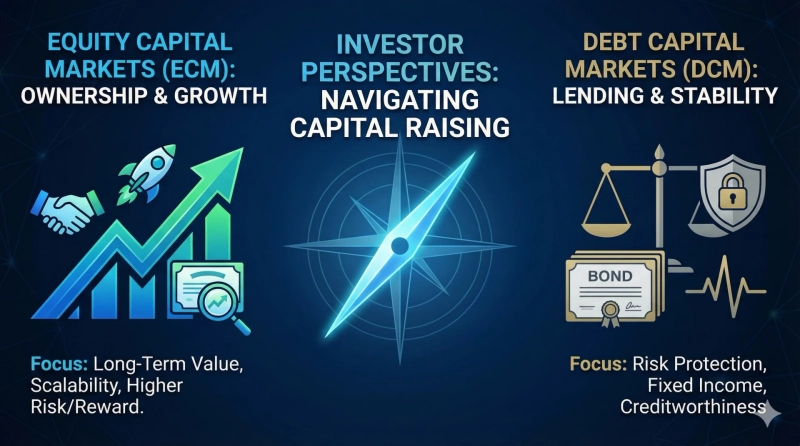
Equity capital markets (ECM) as well as debt capital markets (DCM) pertain to different investor needs, despite enabling the same corporate goal for raising capital. The investor analyzes an ECM and DCM deal from different perspectives. The measures of valuation, creditworthiness, and storytelling have different importance in these markets. This insight assists corporates in marketing their deals.
How Investor Objectives Differ in ECM and DCM
ECM investors concentrate on ownership and long-term value creation. They analyze how a business can enhance earnings, bolster its market share, and optimize its shareholders’ return in the long run. Besides, investors using equity capital markets solutions do not mind higher risk for greater rewards.
The investors in DCM focus on risk protection and income generation. They provide finance to businesses and receive their interest and return on investment on time. However, risk protection is of importance over return on investment.
For instance, when startups such as Uber or Snowflake tapped the equity markets, the investors were keen on scalability. However, when Apple decides to issue bonds, the fixed-income investors will examine its balance sheet.
What Investors Look for in ECM and DCM Deals
1. Valuation Sensitivity in Equity Deals
ECM transactions involve valuation to understand how much equity a firm surrenders in order to get capital in return. Investors make use of various valuation ratios, such as the price-to-earnings ratio, in valuation. In fact, valuation ratios make comparisons achievable for different companies in their respective industries.
Equity investors also analyze the growth assumptions in the valuation process. A lofty valuation means a certain level of confidence in the ability of the revenue base and margin to grow. Investors in IPOs of the likes of Arm Holdings focused on the demand in the semiconductor market.
Conditions in the market also affect sensitivity to valuation. During times of market volatility, stock investors require valuation discounts as a form of compensation for risk exposure.
2. Credit Quality and Risk Assessment in DCM
Credit quality is the basis for decision-making across DCM services for investment banks and other investors. It represents the ability of a firm to meet its debt liabilities. Investors make use of the credit ratings issued by Moody’s, S&P Global, and Fitch Ratings agencies.
Leverage ratios, interest coverage ratios, and cash flows are the focus of DCM investors. Resilience of earnings during an economic downturn is also evaluated. For instance, the cash flows of utility and telecom companies, such as Verizon Communications, generate significant interest.
Bond covenants are also important. Covenants refer to conditions that are provided to protect lenders from risky actions. Well-designed covenants can positively impact investment confidence and bond prices.
3. The Role of the Corporate Story
Both ECM and DCM involve storytelling, but the highlight in each is different. In ECM, storytelling revolves around strategies for growth, competitive advantage, and vision. Credibility on the part of the management assumes immense importance. There is a need to know how the capital will help in expanding the business.
In the case of DCM, the story relates to management’s focus on stability and discipline. Investors seek assurance that management’s focus is on maintaining a stable balance sheet. Proceeds, particularly for refinancing or infrastructure investments, are areas that require attention.
Microsoft succeeds in both spaces by offering a different message. Equity investors are told of innovation and cloud revenue. Debt investors are told of steady revenues and prudence in financial management.
Conclusion
Successful capital raising is achieved through structuring that is supportive of their needs and priorities. ECM is a challenging segment requiring astute valuation positioning and a convincing growth story. DCM is a transparent segment requiring a transparent credit story and a disciplined approach to finances.
Those corporations that are able to grasp such differences are better equipped to engage with investors. This means that there will be greater demand and better prices in the equity and debt markets.