



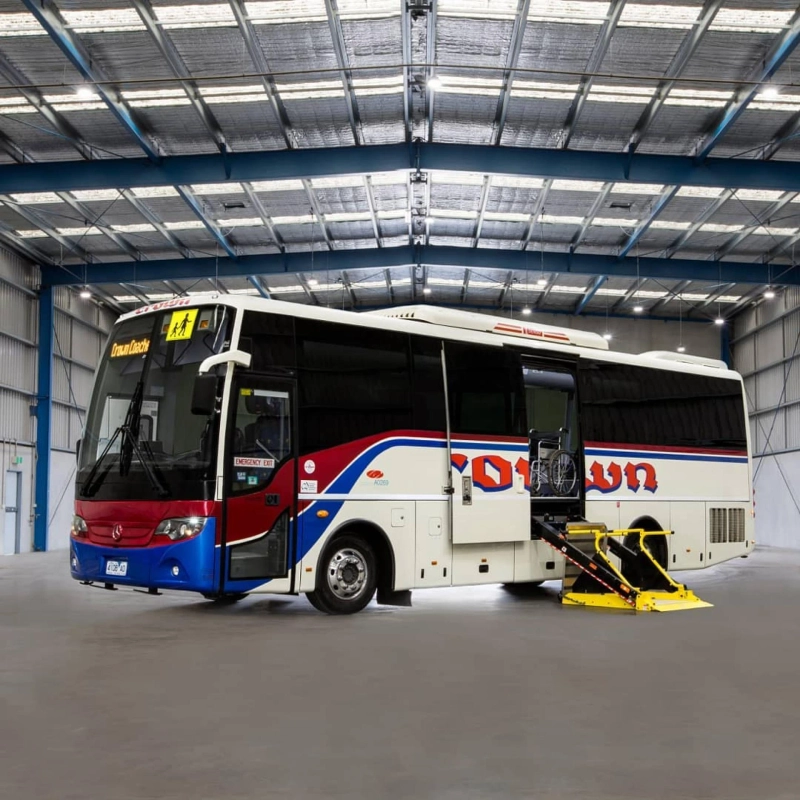
I’ve spent enough early mornings behind a big steering wheel to know this: most school run risks don’t arrive with a warning. They show up as a car that brakes late in the drop-off zone, a pedestrian stepping out from between parked vehicles, or a slick patch of road after overnight rain. You can do everything right and still be forced into a split-second decision.
One incident stays with me. A sedan shot out of a side street, nose first, while I was creeping through a 40 km/h school zone. I was already covering the brake and scanning mirrors, but it still felt abrupt. Nothing happened — because there was space, and because the bus responded exactly as it should. That moment shifted my focus from “a bus is a bus” to the details that help prevent the near-miss becoming the phone call no one wants to make.
That’s why I take modern school bus services seriously, especially when they’re built around safety systems like Autonomous Emergency Braking (AEB), electronic stability control, and onboard CCTV. These aren’t gimmicks. They’re the sort of safeguards families expect in their own cars — and they belong in student transport too.
AEB: braking help when seconds disappear
When people ask what AEB does, I describe it as an extra set of eyes that doesn’t get tired. On a school bus melbourne route, you’re watching traffic flow, checking mirrors, managing blind spots, and anticipating what kids might do at the kerb. AEB adds another layer by monitoring what’s happening ahead and reacting faster than a human can when something suddenly stops or cuts in.
The practical benefit is simple: it can reduce the severity of a collision or stop one from happening. That matters in the exact places school buses operate — low speeds, frequent stops, unpredictable movement near crossings and driveways. Even with an attentive driver, there are moments when a vehicle in front brakes hard, or a delivery van noses out without looking. AEB helps close that tiny gap between “I saw it” and “I’m on the brakes”.
It also supports smoother driving. Knowing the bus has forward monitoring encourages consistent following distances and measured braking, rather than sharp stops that can throw standing passengers off balance. The goal isn’t to rely on technology; it’s to stack the odds in favour of safety when the unexpected turns up.
Stability control: keeping a heavy vehicle composed
A bus behaves differently to a car. It’s heavier, longer, and carries a moving load — students shifting in seats, bags in aisles, and sometimes wet sports gear making floors slippery. Add Melbourne weather into the mix, plus roundabouts, speed humps, and quick lane changes when traffic compresses, and you can see why stability control matters.
Electronic stability control works by detecting when the vehicle isn’t following the driver’s intended path — for example, if traction drops in the rain or the bus begins to yaw in a sudden evasive move. The system can apply braking to individual wheels and reduce engine power to help bring the bus back in line. In plain terms: it helps stop a skid from becoming a loss of control.
This is one of the reasons I’m cautious about any decision that treats student transport as a basic commodity. When schools consider bus hire for schools, it’s worth asking what stability systems are fitted, how they’re maintained, and whether the operator can explain how the technology works in real-world driving. Price matters, but so does the ability to handle a wet road, a sharp bend, or an emergency manoeuvre without drama.
Stability control also plays a role in passenger comfort. Less swaying and fewer harsh corrections mean fewer bumped knees, fewer dropped phones, and fewer kids arriving at school already rattled. It’s not about luxury; it’s about keeping the vehicle calm and predictable.
CCTV: safer behaviour, clearer accountability
CCTV often gets reduced to “security cameras”, but on a school bus it does a lot more than record footage. It changes behaviour. When students know there’s a camera, the rowdiness that can build in the back seats tends to settle. It’s not perfect, but it helps set expectations — and that supports the driver, who can’t turn around to referee without taking attention off the road.
From my side of the seat, CCTV is also about clarity. If a parent reports a missing item, if there’s a complaint about bullying, or if someone alleges unsafe driving, footage helps confirm what happened. That protects students and staff because decisions can be based on evidence rather than rumours or half-heard stories.
It also improves incident response. If something does happen — a slip while boarding, a bag snagging near a door, a sudden stop that causes a fall — CCTV can help a school and operator understand the sequence of events quickly. That can lead to practical changes, like adjusting loading procedures, changing a stop location, or reinforcing rules about staying seated.
Of course, CCTV needs sensible handling. Clear signage, secure storage, limited access, and retention policies that follow Australian privacy expectations are non-negotiable. The point isn’t surveillance for its own sake; it’s a safer environment where behaviour is easier to manage and issues can be resolved fairly.