



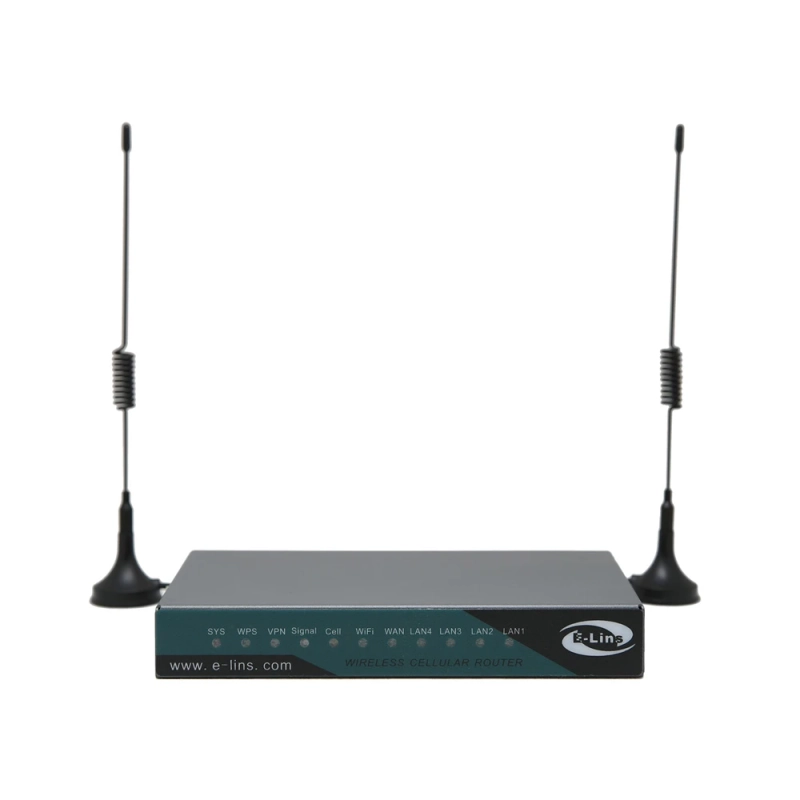
At its core, an industrial router performs the same fundamental function as the one in your home: it routes data between different networks. However, the comparison ends there. Think of it as the difference between a family sedan and an armored, all-terrain vehicle. Both get you from A to B, but one is built for a comfortable commute, while the other is engineered to conquer the most challenging environments and ensure mission-critical deliveries.
Industrial routers are characterized by their:
Ruggedized Hardware: Built with robust, metal casings and components rated for extended temperature ranges (e.g., -40°C to 75°C).
Wide Voltage Input: They can handle power fluctuations common in industrial settings (e.g., 9-36 VDC or 85-264 VAC).
Redundant Power Supplies: Many models feature dual power inputs to ensure continuous operation even if one power source fails.
Industrial-Grade Certifications: They carry certifications like UL, CE, and often specific ones for hazardous environments (ATEX, IECEx).
Key Reasons Your Operation Needs One
1. Unmatched Reliability in Harsh Environments
The single most important reason is reliability. Downtime in an industrial setting costs thousands of dollars per minute. A plastic consumer router will fail if exposed to freezing cold, sweltering heat, or high humidity. An industrial router is sealed and hardened against these elements, ensuring your data flows continuously, whether it's monitoring sensor data on an oil rig or controlling robotic arms on an assembly line.
2. Robust Security for Critical Infrastructure
Industrial networks are prime targets for cyberattacks. Consumer routers often have known vulnerabilities and lack advanced security features. Industrial routers are built with security as a core principle. They typically include:
Integrated Firewalls: To segment and protect your Operational Technology (OT) network from your Information Technology (IT) network.
VPN Tunnels (IPsec, OpenVPN, WireGuard): For encrypting all data transmitted over public networks (e.g., from a remote site to headquarters).
SSH/HTTPS Encryption: For secure device management.
VPN Redundancy (VRRP): To ensure a secure connection is always available.
3. Flexible and Redundant Connectivity
What happens when your primary wired internet connection fails? For a business relying on real-time data, it's a disaster. Industrial routers provide crucial connectivity redundancy. Most come with built-in cellular modems (4G/LTE, 5G) that can automatically failover if the main WAN connection is lost. This ensures that your SCADA system, video surveillance, and critical alarms remain online no matter what. This multi-WAN capability also allows for load balancing, optimizing bandwidth usage.
4. Centralized Management for Scalability
Managing dozens or hundreds of remote devices is a logistical nightmare if you have to configure each one individually. Industrial routers support centralized management platforms using protocols like TR-069 or vendor-specific cloud solutions. This allows IT managers to deploy, configure, monitor, and update firmware for an entire fleet of routers from a single dashboard, dramatically reducing operational overhead and ensuring consistency.
Please visit E-Lins Technology for more information.