



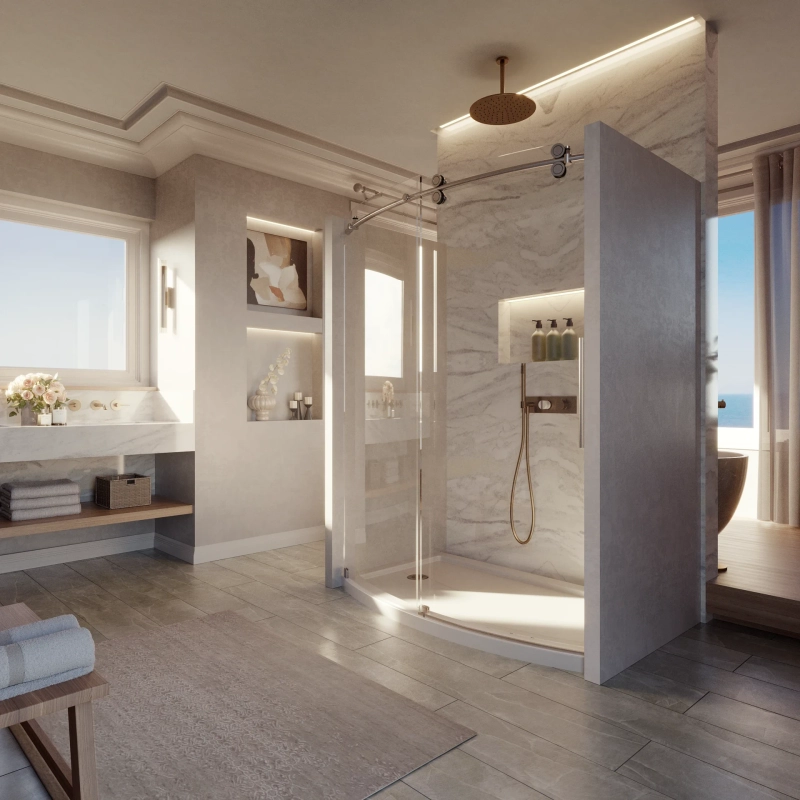
When selecting a luxury shower door, most homeowners focus on glass style, hardware finish, and door configuration. However, one technical detail often overlooked but critically important is out-of-plumb tolerance. This specification determines how forgiving a shower door is when walls are not perfectly straight, a common condition in both new construction and renovations.
At Aston, shower doors are engineered with thoughtful adjustment ranges to ensure precise installation and long-term performance. Understanding what ± adjustment really means on a spec sheet can help you choose the right door, avoid installation challenges, and achieve a clean, seamless finish.
1. What Does “Out-of-Plumb” Actually Mean?
In simple terms, a wall is considered out of plumb when it is not perfectly vertical. Even small deviations often just a few millimeters can affect how a shower door fits, seals, and operates.
These variations occur due to:
- Settling of a home over time
- Uneven tile installation
- Structural inconsistencies behind finished walls
Because frameless shower doors rely on precision alignment, even slight wall irregularities must be accounted for during design and installation.
2. Decoding ± Adjustment on a Shower Door Spec Sheet
The ± symbol on a shower door specification sheet refers to the amount of adjustment built into the hardware or frame to compensate for uneven walls. For example, a ±10 mm tolerance means the door system can adapt to walls that are up to 10 mm out of vertical without custom modification.
This adjustment is typically achieved through:
- Wall channels with built-in flexibility
- Adjustable brackets or clamps
- Telescoping rails in sliding systems
Doors like the Aston SENZA Frameless Shower Door incorporate subtle yet effective adjustment mechanisms that maintain visual minimalism while allowing installers to fine-tune alignment.
3. Why Out-of-Plumb Tolerance Matters in Frameless Designs
Unlike framed enclosures that can visually hide imperfections, frameless doors expose every line and angle. Without proper adjustment, even minor wall deviations can result in uneven gaps, water leakage, or doors that don’t close smoothly.
A well-engineered tolerance range ensures:
- Tight, consistent glass-to-wall contact
- Smooth operation of hinges or rollers
- Proper sealing without excessive silicone
The Aston VERO Hinged Shower Door, for example, uses precision hardware that accommodates wall variation while preserving clean sightlines and structural integrity.
4. How Adjustment Ranges Differ by Door Type
Not all shower door styles offer the same level of adaptability. Understanding how tolerances vary helps set realistic expectations during installation.
Hinged Frameless Doors:
Hinged designs rely on exact hinge placement and wall alignment. While some adjustment is possible, these doors require relatively straight walls. Products like the VERO Hinged Shower Door provide refined adjustability but still benefit from professional assessment before installation.
Sliding Systems:
Sliding doors generally allow more flexibility due to their rail-based structure. The Aston LANGHAM Frameless Sliding Shower Door uses adjustable rails and roller assemblies that help compensate for wall inconsistencies while maintaining smooth, quiet motion.
This adaptability makes sliding systems a popular choice in remodels where walls may not be perfectly plumb.
5. Specialty Designs and Curved Applications
Curved or bowfront enclosures introduce additional complexity. The geometry of the glass must align precisely with surrounding walls and floors, making adjustment tolerances especially important.
A Frameless Bowfront Sliding Shower Door is engineered with specialized hardware and alignment systems that account for curvature while still allowing fine-tuning during installation. These designs highlight why understanding tolerance specifications is essential before selecting a door style.
6. The Role of Wall Channels and Brackets
Wall channels play a key role in accommodating out-of-plumb conditions. While frameless doors minimize visible metal, discreet channels are often used to create adjustment without compromising aesthetics.
The Aston CASCADIA Frameless Shower Door uses slim-profile channels that allow vertical alignment correction while remaining visually unobtrusive. This approach delivers a clean finish while maintaining installation flexibility.
7. Installation Accuracy vs. Adjustment Capability
It’s important to note that adjustment tolerance does not replace proper preparation. While Aston doors are designed to adapt to real-world conditions, installers must still ensure:
- Walls are structurally sound
- Tiles are properly bonded
- Floors are level
Tolerance ranges are intended to fine-tune alignment, not compensate for major structural issues. This balance between precision engineering and responsible installation ensures long-term durability and performance.
8. Why Spec Sheets Matter More Than You Think
Spec sheets are more than technical paperwork they are roadmaps for successful installation. Reviewing adjustment ranges before purchase helps avoid costly surprises and ensures the chosen door matches site conditions.
Doors like the Aston CORINTH Semi-Frameless Shower Enclosure clearly outline adjustment allowances, giving homeowners and installers confidence that the product will fit as intended.
9. Making the Right Choice for Your Bathroom
When choosing a shower door, consider:
- The age and condition of your bathroom walls
- The door style and hardware type
- The stated ± adjustment range on the spec sheet
Sliding options, hinged designs, and fixed panels all perform differently depending on wall conditions. Selecting a system engineered with adequate tolerance ensures a seamless, watertight, and visually refined result.
Conclusion:
Out-of-plumb tolerance plays a vital role in how a shower door fits, functions, and looks once installed. Understanding the ± adjustment listed on a spec sheet helps ensure your chosen door can adapt to real-world wall conditions without compromising performance. With precision-engineered options like SENZA, VERO, LANGHAM, CASCADIA, and CORINTH, Aston delivers shower doors that combine flexibility, accuracy, and refined design for a flawless final result.