



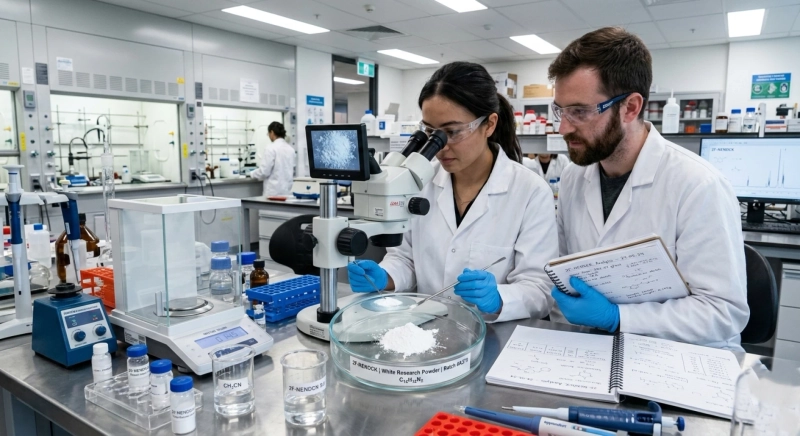
Scientific laboratories around the world continue to explore new chemical compounds to better understand molecular structures, analytical techniques, and experimental methodologies. In controlled research environments, chemists study various synthetic molecules to examine their properties, stability, and analytical behavior.
The Role of Analytical Chemistry in Modern Research
Analytical chemistry plays a central role in identifying and understanding compounds in laboratory environments. Researchers rely on advanced instruments such as mass spectrometers, chromatographs, and nuclear magnetic resonance NMR systems to determine chemical composition.
These parameters allow researchers to confirm compound identity and ensure consistency in experimental procedures. For instance, compounds referenced in experimental databases often include information like 2F-NENDCK formula C13H13FN2O, which helps researchers accurately identify the molecule in scientific documentation and analytical reports.
Importance of Molecular Identification
In chemical research, identifying a compound correctly is essential before any form of analysis begins. Molecular formulas describe the exact number and type of atoms present in a molecule. A formula like the 2F-NENDCK formula C13H13FN2O provides a clear representation of the compound’s atomic composition. From this information, scientists can determine the compound’s molecular weight, structural possibilities, and expected fragmentation patterns in spectrometry.
Understanding Molar Mass in Laboratory Analysis
Another essential parameter used in chemical studies is molar mass. Molar mass represents the mass of one mole of a compound and is usually expressed in grams per mole.For example, documented laboratory references may list 2F-NENDCK molar mass 242.27 g/mol, which allows chemists to precisely measure and prepare samples for testing.
Accurate molar mass data supports many analytical techniques, including quantitative analysis and calibration procedures. Without reliable molar mass values, it would be difficult to maintain reproducible experimental conditions.
Research Applications of Specialized Compounds
Compounds studied in analytical laboratories often serve as reference materials for instrument testing, calibration, and methodological research. During such studies, scientists may also analyze related substances or structural analogs to understand variations in molecular behavior.
Some laboratories also evaluate compounds such as dpDMC in comparative studies to examine structural similarities, stability, or analytical responses across different molecules.
Laboratory Safety and Responsible Research
Handling specialized chemical compounds requires strict adherence to laboratory safety guidelines. Professional research facilities follow regulated protocols to ensure safe storage, handling, and disposal of all substances used in experiments.
Companies and research providers associated with 2F-NENDCK often emphasize responsible laboratory use, highlighting that such compounds are intended strictly for controlled analytical or scientific research settings.
The Importance of Accurate Scientific Documentation
In chemical science, accurate documentation supports collaboration and reproducibility. Researchers depend on reliable data when sharing experimental results, writing research papers, or contributing to chemical databases. Information such as molecular structure, formula, and mass ensures that experiments can be verified and repeated by other laboratories.
Conclusion
The 2F-NENDCK study of synthetic compounds in controlled laboratory environments continues to play an important role in scientific progress. Through analytical methods, researchers examine molecular structures, confirm chemical identities, and refine detection techniques used across multiple scientific fields. As chemical research evolves, responsible scientific practices and accurate documentation will remain essential in ensuring safe, reliable, and meaningful laboratory discoveries.
For more details, visit: https://www.2fnendck.com/
#dpDMC
#2FNENDCKformulaC13H13FN2O
#2FNENDCKmolarmass242.27g/mol