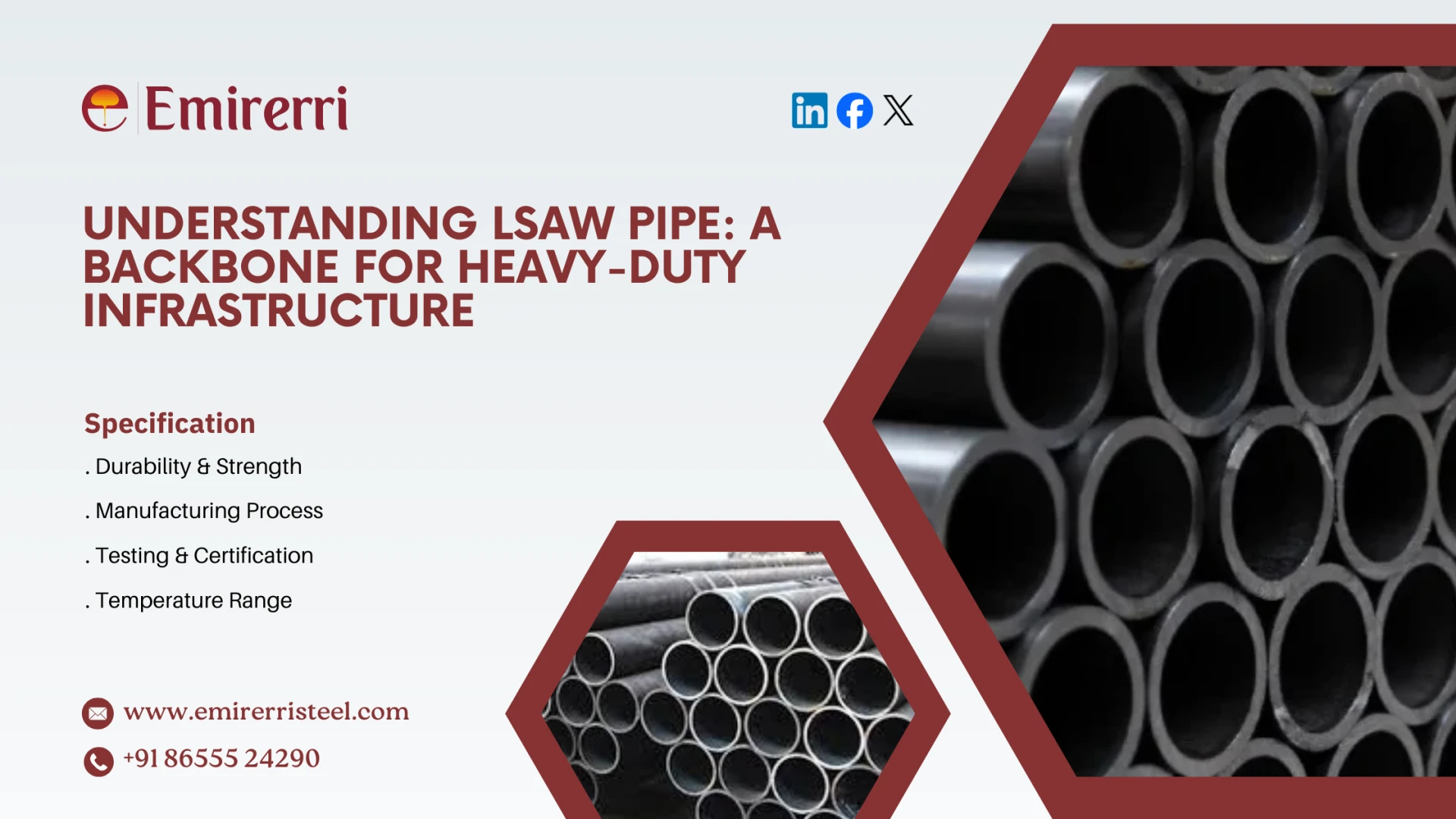
In the modern world of energy, water transport, and heavy construction, pipeline integrity and cost efficiency matter more than ever. Among the many pipeline technologies available, LSAW pipe (Longitudinal Submerged Arc Welded pipe) has established itself as a go-to solution when large diameters, high strength, and reliable performance are required. At Emirerri Steel, the LSAW pipe line is a flagship product category, delivering solutions tailored for demanding applications.
What Is an LSAW Pipe?
An LSAW pipe is produced by longitudinally welding steel plates (rather than spirally welding). The process involves bending a flat steel plate into a cylindrical shape and then applying submerged arc welding (SAW) along the longitudinal seam. Because the seam runs lengthwise, the pipe exhibits excellent mechanical performance and uniformity across the length. Emirerri describes their manufacturing route as including edge preparation, forming (using UOE or JCOE methods), internal and external welding, followed by sizing, heat treatment, and rigorous inspection.
Compared with spiral welded pipes, the single straight seam tends to reduce stress concentration, especially in high-pressure or high fatigue settings. The result is a pipe product that is dimensionally accurate, with strong weld integrity and high toughness.
Carbon Steel LSAW Pipe: The Workhorse Material
One of the most common variants offered by Emirerri is carbon steel LSAW pipe. This type balances cost, strength, and versatility, making it particularly attractive for oil & gas pipelines, structural piping, and general water transmission systems. In many applications, carbon steel’s mechanical properties are more than sufficient, and its fabrication and procurement cost advantages make it the preferred choice.
Emirerri classifies its LSAW products by application and material class, noting that carbon steel LSAW pipe is widely used in structural and pipeline systems. Their product line also includes stainless steel versions (for corrosive environments) and API-grade LSAW pipes that meet the stringent standards of the oil & gas sector
Key material benefits of carbon steel LSAW pipe include:
- High strength and ability to handle internal pressure
- Simpler metallurgy than alloyed steels, easing welding and repair
- Availability in many standard grades (e.g. API, ASTM, EN)
- Lower raw material cost per ton compared to more exotic alloys
Emirerri ensures their carbon steel LSAW pipe products meet global specifications such as API 5L (PSL1 and PSL2), ASTM/ASME standards, EN/ISO codes, and more.
The Manufacturing Journey
Producing a high-quality LSAW pipe involves a tightly controlled multi-step process. Here is a breakdown of the key stages as practiced at Emirerri:
- Plate Selection – Choose steel plates with the right chemical composition, thickness, and quality.
- Edge Milling – Bevel or shape the edges to prepare for fusion welding.
- Forming – Use a forming technique (UOE or JCOE) to bend plates into a cylindrical shell.
- Welding – Conduct internal welding and external welding under submerged arc conditions to ensure full penetration and a smooth seam.
- Heat Treatment – Apply post-weld heat treatments (PWHT) to relieve residual stresses and improve toughness.
- Sizing / Expansion – Pass the pipe through sizing machines and, if needed, expand it to meet precise diameters and tolerances.
- Testing & Inspection – Use hydrostatic testing, ultrasonic testing, X-ray radiography, and mechanical testing to validate structural integrity and compliance.
This rigorous process ensures that each LSAW welded pipe meets performance expectations in demanding environments
Applications: Where LSAW Pipes Shine
Thanks to their robustness and size capabilities, LSAW pipes serve many industries. Emirerri highlights the following key sectors:
- Oil & Gas Transmission — Long-distance pipelines moving crude oil, natural gas, or refined products.
- Water Supply & Infrastructure — Large diameter pipelines for municipal or industrial water distribution.
- Offshore & Subsea — Pipelines connecting offshore platforms or undersea tie-backs.
- Construction & Structural — Piling, bridge supports, foundation caissons, and structural frameworks.
- Power Generation — Boilers, cooling water, and high temperature conduits.
Because Emirerri’s LSAW pipes comply with international standards and can be customized by diameter, length, coating, and grade, they are viable in a global context.
Advantages & Differentiators of Emirerri’s LSAW Pipe Offerings
When selecting a pipeline supplier, buyers look for reliability, technical quality, flexibility, and service. In the case of Emirerri’s LSAW line, several advantages stand out:
- High Strength & Durability — Capable of handling high pressures, external loads, and demanding service conditions.
- Large Diameter Range — Emirerri claims capacity up to 56 inches diameter for their LSAW line.
- Uniform Weld Seam — The internal and external SAW welds are smooth and consistent, minimizing stress risers.
- Precise Dimensional Control — Good roundness and tight tolerances mean better fit and assembly in the field.
- Global Standards Compliance — Their pipes meet API, ASTM, EN, ISO, DIN standards.
- Customization Options — Buyers can choose grades, coatings, wall thicknesses, and lengths suited to their projects.
- Stringent Testing & Quality Assurance — Every pipe is subjected to advanced inspection techniques to ensure reliability.
One of the underpinning values in Emirerri’s presentation is that their LSAW pipes aren’t generic “off-the-shelf” items; they are engineered and verified for project-level demands.
The “Saw for Pipe” Angle & Keyword Integration
While the phrase “saw for pipe” might at first glance seem tangential, it connects to how LSAW (Longitudinal Submerged Arc Welding) is carried out. The “SAW” in LSAW literally stands for Submerged Arc Welding, where a submerged welding flux is used in the welding of pipes. In effect, an LSAW pipe is built by “welding (sawing) for pipe,” i.e. using a continuous welding process to fuse the edges of the steel plate. Thus, one may consider that “saw for pipe” is metaphorically built into the name and process.
Moreover, when fabricating or installing pipeline segments, field joints are occasionally cut or trimmed with saws or specialized cutting tools before re-welding. In that sense, a saw for pipe is also a practical tool used in the handling and custom fitting of pipes—though not part of Emirerri’s core LSAW product page, it is adjacent in context.
By weaving lsaw pipe, carbon steel lsaw pipe, and saw for pipe into the narrative, the article stays anchored in both technical substance and search relevance.
Conclusion
To sum up, LSAW pipe offers a combination of size, strength, structural integrity, and weld reliability that makes it indispensable in major infrastructure and energy projects. Among the manufacturers in the global space, Emirerri Steel positions itself strongly by offering carbon steel LSAW pipe, stainless and API variants, full customization, strict quality control, and adherence to international standards.
Whether your project is about laying a major oil conduit, building a large-scale water network, or erecting structural supports, LSAW pipes from a trustworthy source like Emirerri can deliver the mechanical performance, safety, and longevity you need. And in the broader scheme, the very name LSAW (literally “Longitudinal Submerged Arc Welded”) implies a built-in link to the welding (“saw for pipe”) process that gives these pipes their strength.