



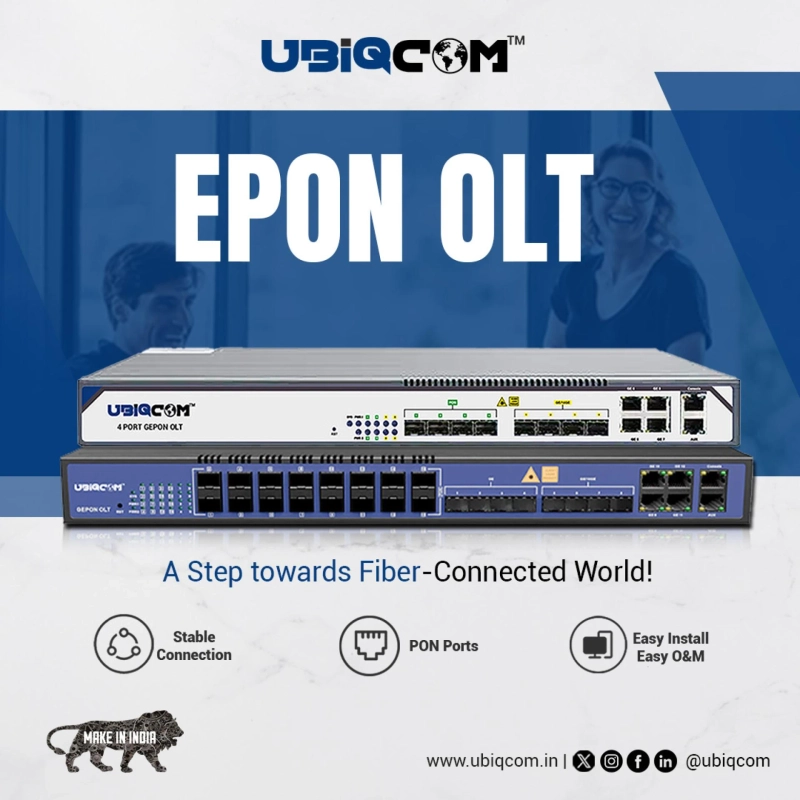
As internet usage continues to grow exponentially, service providers are under immense pressure to deliver fast, reliable, and cost-effective broadband solutions. One of the technologies making this possible is EPON OLT (Ethernet Passive Optical Network Optical Line Terminal). It is a critical component of modern FTTH (Fiber-to-the-Home) networks, enabling service providers to extend high-speed internet to households and businesses efficiently.
The EPON OLT serves as the central hub of a passive optical network, connecting the provider’s core network to multiple Optical Network Units (ONUs) or Optical Network Terminals (ONTs) installed at customer premises. This allows operators to provide seamless, high-bandwidth connectivity over a shared infrastructure while keeping deployment and maintenance costs under control.
What is an EPON OLT?
An EPON OLT is a network device installed at the service provider’s central office or data center. Its main function is to manage and transmit data signals between the provider’s backbone network and the connected ONUs at the user’s location. Unlike traditional copper-based systems, EPON OLT leverages fiber optics, which ensures higher bandwidth, lower latency, and greater reliability.
EPON (Ethernet Passive Optical Network) itself is based on Ethernet standards, making it compatible with existing IP-based networks. This allows service providers to integrate EPON OLT solutions into their existing infrastructure without significant complexities.
Key Functions of EPON OLT
The EPON OLT plays several vital roles in the network ecosystem:
- Signal Transmission and Reception
- The OLT converts electrical signals from the core network into optical signals for downstream transmission.
- It also receives upstream optical signals from ONUs and converts them back into electrical signals for routing within the provider’s network.
- Bandwidth Allocation
- EPON OLT uses Dynamic Bandwidth Allocation (DBA) to ensure fair and efficient distribution of available bandwidth among multiple subscribers.
- This ensures that users experience consistent performance even during peak usage hours.
- Network Management and Monitoring
- It monitors the health of ONUs, detects faults, and supports remote configuration and troubleshooting.
- This reduces operational costs and minimizes downtime.
- Quality of Service (QoS) Support
- By prioritizing voice, video, and data services, EPON OLT ensures that latency-sensitive applications like VoIP and IPTV run smoothly.
Benefits of Deploying EPON OLT
The adoption of EPON OLT provides several advantages for service providers and end-users alike:
- High Bandwidth Capacity: With support for gigabit-level speeds, EPON OLT can handle modern applications such as HD video streaming, cloud computing, and IoT.
- Cost Efficiency: Passive optical networks eliminate the need for powered equipment between the OLT and ONUs, significantly reducing infrastructure and energy costs.
- Scalability: EPON OLT supports a large number of users on a single fiber, making it easier for providers to scale services as demand grows.
- Reliability: Fiber optic connections are less prone to interference, ensuring stable and consistent internet performance.
- Future-Proof Technology: With the growing demand for higher bandwidth, EPON OLT offers an upgrade-ready platform for evolving broadband needs.
EPON OLT vs. GPON OLT
While EPON OLT and GPON OLT are both widely used in FTTH deployments, they differ in terms of technology standards:
- EPON OLT is based on Ethernet and transmits data in variable-length packets, making it ideal for IP-based services.
- GPON OLT, on the other hand, uses fixed-length packets and supports higher split ratios, which may benefit large-scale deployments.
The choice between EPON and GPON largely depends on the service provider’s requirements, existing infrastructure, and cost considerations.
Applications of EPON OLT
EPON OLT technology finds wide applications in various sectors:
- Residential Broadband: Enables high-speed internet, IPTV, and VoIP services for homes.
- Enterprise Connectivity: Provides reliable, high-bandwidth solutions for businesses with large data demands.
- Smart Cities: Supports applications like CCTV surveillance, smart traffic systems, and public Wi-Fi.
- Educational Institutions: Facilitates e-learning platforms and digital classrooms through seamless internet access.
Future of EPON OLT
With the rapid rise in data consumption, the role of EPON OLT will only expand further. Next-generation EPON technologies such as 10G-EPON are already being deployed, offering ten times the bandwidth of traditional EPON systems. This evolution ensures that EPON OLT remains a future-ready solution for ISPs and enterprises aiming to meet the increasing demand for high-speed internet.
Conclusion
EPON OLT is the backbone of modern fiber optic networks, bridging the gap between service providers and end-users. With its high bandwidth, cost efficiency, and scalability, it has become the preferred choice for delivering FTTH broadband solutions. Whether for homes, businesses, or smart infrastructure, EPON OLT is enabling faster, more reliable connectivity and laying the foundation for the digital future.