



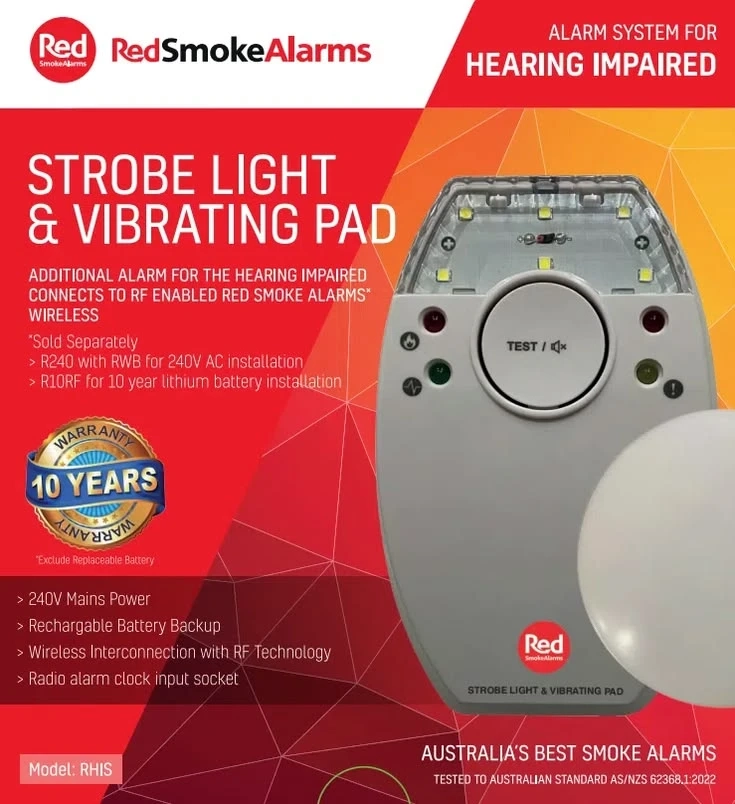
If you or someone you love is deaf or hard of hearing, a standard smoke alarm simply isn't enough. The good news: today's hearing impaired smoke alarms use powerful vibration, intense strobe lighting, and smart connectivity to deliver life-saving alerts, even in deep sleep. Here's everything you need to know to choose the right system.
Why Standard Smoke Alarms Fall Short for the Deaf and Hard of Hearing
Most smoke alarms rely entirely on a loud audible siren, typically 85 decibels or more. For people with mild-to-moderate hearing loss, that sound may be muffled or missed entirely, especially at night when hearing aids are removed. For those who are profoundly deaf, a standard alarm is effectively silent.
This isn't a minor inconvenience. It's a genuine life-safety gap. According to fire safety research, people who are deaf or hard of hearing face a disproportionately higher risk of fire-related fatalities, largely because they don't receive a timely warning. That's why specialized smoke detection systems exist, and why understanding your options is so important.
Seq Smoke Alarms has built its product line around this exact problem: ensuring that every individual, regardless of hearing ability, has access to reliable, proven fire detection technology.
The Three Main Types of Hearing Impaired Smoke Alarms
1. Vibrating Smoke Alarms (Under-Pillow and Bed Shakers)
Vibration-based alerting is one of the most effective methods for waking someone who is deaf or hard of hearing from sleep, which is statistically the most dangerous time to be unaware of a fire.
These systems work by connecting a smoke detector to a vibrating pad or "bed shaker" that is placed under the mattress or pillow. When the alarm triggers, a powerful motor vibrates the pad intensely enough to rouse a sleeping person. Most systems produce vibrations far stronger than a typical phone alert, closer to a strong sustained pulse that is nearly impossible to sleep through.
How vibrating systems are typically configured:
A central smoke alarm unit detects smoke and sends a wireless or wired signal to the vibrating pad. Some systems bundle multiple alerts, vibration, strobe, and sound, into a single coordinated response. The best units are designed to work even when the sleeper is wearing noise-cancelling earbuds or when a fan or white noise machine is running.
Vibrating smoke alarms are particularly well-suited for bedrooms, since nighttime fires are the deadliest. Seq Smoke Alarms offers bed shaker-compatible units that integrate seamlessly with their broader detection ecosystem, so every room in your home can be protected cohesively.
Who benefits most: Individuals who are profoundly deaf, those who sleep without hearing aids, and heavy sleepers with moderate hearing loss.
2. Flashing and Strobe Light Smoke Alarms
Visual alerting through strobe or flashing lights addresses a different challenge: awareness during waking hours when someone may be in another room, focused on a task, or simply not facing the direction of a sound source.
Strobe smoke alarms use high-intensity flashing lights, typically at a rate of 1–3 flashes per second, to create a visible, unmistakable alert signal. Some units use white strobes, while others use red or amber flashing. The brightness and flash rate matter significantly: units designed to meet accessibility standards are engineered to be visible even in bright daylight or in large open-plan rooms.
Key considerations when evaluating strobe alarms:
The candela (cd) rating of the strobe tells you how bright the flash is. For a bedroom, most accessibility guidelines recommend a minimum of 177 cd at the bed level. In larger living areas or open-plan spaces, higher-output units or multiple strobes may be needed to ensure coverage from any angle in the room.
Placement is equally important. A strobe positioned behind furniture, tucked in a corner, or mounted too high may fail to catch a person's peripheral vision. Effective installation places strobes in the line of sight for the most commonly occupied areas of each room.
Seq Smoke Alarms designs its strobe-enabled units with wide-angle light distribution, reducing the need for multiple units in standard-sized rooms while still meeting recognized accessibility thresholds.
Who benefits most: People with mild-to-moderate hearing loss, those who are frequently in noisy environments (workshops, kitchens with appliances running), and those who rely primarily on visual cues throughout the day.
3. Smart Smoke Alarm Systems with Smartphone Alerts
Smart smoke alarm technology has transformed home fire safety, and for people who are deaf or hard of hearing, it offers a layer of protection that neither vibration nor strobe alone can fully provide.
Smart systems connect your smoke detectors to your home Wi-Fi network and send real-time push notifications to your smartphone, smartwatch, or tablet the moment an alarm is triggered. This matters enormously for several reasons. First, it provides an alert even if you are in a part of the home where the strobe or vibrating pad isn't installed. Second, it enables caregivers, family members, or neighbors to be notified simultaneously, so someone can check on you even if you don't immediately see or feel the alert. Third, most smart systems include location-specific alerts, telling you precisely which detector triggered and whether it's smoke, carbon monoxide, or another hazard.
What sets a smart system apart:
The best smart smoke alarms offer two-way integration: your phone alerts you, but you can also use your phone to check alarm status, test units remotely, and receive low-battery notifications before a detector fails silently. Some advanced systems integrate with smart home platforms like Amazon Alexa, Google Home, or Apple HomeKit, allowing connected smart lights to flash in an emergency, effectively turning your entire home's lighting into an alert system.
Seq Smoke Alarms has developed smart-enabled detectors that pair with a dedicated app, allowing households to monitor every room from a single dashboard. For families with a deaf or hard-of-hearing member, this means everyone stays informed in real time, not just the person in the room where the alarm is.
Who benefits most: Anyone who lives alone and needs remote monitoring, households with mixed hearing ability levels, people who travel frequently between rooms or floors, and those who already use smartwatch or smartphone technology throughout the day.
Combining Systems: Why Layered Protection Is the Gold Standard
No single alert method covers every scenario equally well. Vibration is unmatched during sleep; strobe is essential for daytime visual coverage; smart alerts extend protection to wherever you and your phone are. The most robust approach, and the one consistently recommended by fire safety organizations, is a layered system that uses all three.
A well-designed layered setup might look like this: interconnected Seq Smoke Alarms units throughout every room, strobe lights in the bedroom, living area, and kitchen, a vibrating bed shaker for nighttime alerting, and smart notifications pushed to a smartphone and smartwatch simultaneously. Each method acts as a backup for the others, closing the gaps that any single technology would leave open.
This kind of redundancy is especially important because fires don't follow predictable patterns. A fire starting in a room without a strobe is still covered by the smartphone alert. A dead phone battery is covered by the bed shaker. A power outage affecting smart connectivity is covered by the audible alarm and strobe on battery backup.
What to Look for When Buying a Hearing Impaired Smoke Alarm
Before purchasing any unit, it's worth checking a few key specifications and certifications to ensure it meets recognized safety and accessibility standards.
The alarm should carry a listing from a nationally recognized testing laboratory, in most countries, this means UL (Underwriters Laboratories) or an equivalent body. For strobe units, look for compliance with accessibility standards relevant to your region (such as ADA guidelines in the United States, or BS 5839 in the UK), which specify minimum brightness and flash rates.
Battery backup is non-negotiable. Any smart or wired system should have a battery backup that activates during a power outage, because fires and power failures frequently occur together. Opt for units with sealed long-life lithium batteries where possible, since they eliminate the risk of a forgotten battery replacement leaving you unprotected.
Interconnectivity is another critical feature. When one alarm detects smoke, all alarms in the home should trigger simultaneously. This is especially important in multi-story homes or large floor plans where a fire in one room might not immediately spread visible smoke to other areas.
Seq Smoke Alarms builds interconnectivity into every unit in its hearing-impaired product range, ensuring that a trigger in the kitchen activates the bed shaker, the bedroom strobe, and the smartphone notification at exactly the same moment.
Installation Tips for Maximum Effectiveness
Even the best hearing impaired smoke alarm won't perform at its best if it's poorly installed. A few practical guidelines make a significant difference.
Smoke detectors should be installed on the ceiling or high on a wall in every bedroom, outside each sleeping area, on every level of the home, and in the kitchen (though positioned away from cooking appliances to reduce false alarms). Strobe units should be positioned where they can be seen from multiple angles, not blocked by furniture or curtains. Bed shakers work best when placed under the mattress at roughly torso level, where the vibration is most noticeable.
Always test the entire system, including all linked strobes, bed shakers, and smart notifications, after installation and at regular intervals thereafter. Most manufacturers recommend monthly testing.
Final Thoughts: Hearing Safety Is Non-Negotiable
Hearing loss doesn't have to mean a higher fire risk. Vibrating smoke alarms, strobe light detectors, and smart connected systems each offer powerful, proven ways to ensure that no one is left unprotected when seconds count most. The right combination depends on your living situation, the severity of hearing loss, and how you move through your home, but the answer is almost always a layered approach.
Seq Smoke Alarms was built on the belief that life-saving technology should work for everyone. If you're ready to assess your home's hearing-accessible fire detection coverage, their product specialists can help you identify the right configuration, one that fits your home, your lifestyle, and the people you're protecting.
Because the right alarm doesn't just make noise. It makes sure you know.