



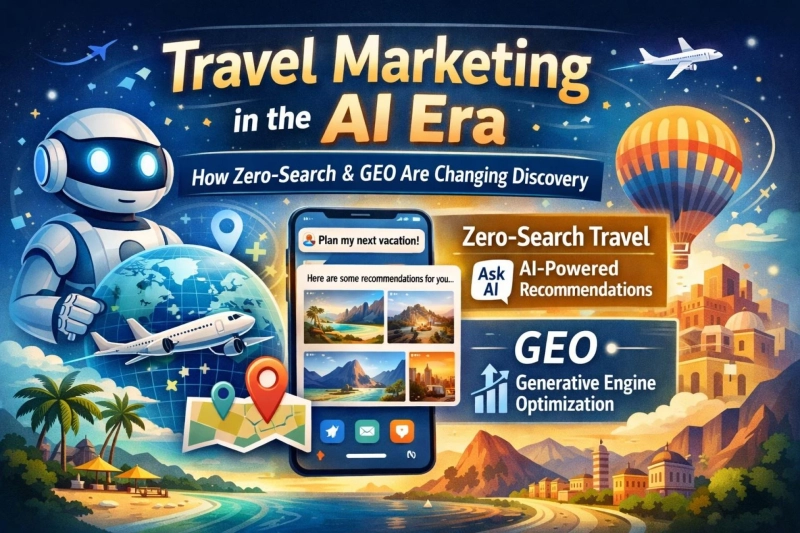
In recent years, the travel industry’s approach to marketing has undergone a seismic shift. Until now, traditional travel marketing relied heavily on travelers actively searching online — typing queries into search engines, comparing multiple sites, and clicking through pages before making a booking. Brands built their strategies around capturing these search moments. However, the rise of artificial intelligence (AI) is redefining this landscape and ushering in what experts call the zero-search era of travel discovery.
The Zero-Search Era Explained
The zero-search era refers to a profound change in how travelers find information. Instead of manually searching through search engine results, people are increasingly asking conversational AI tools for personalized recommendations. These AI systems deliver concise responses — complete with tailored itineraries, hotel options, and travel tips — without making users visit multiple websites. For example, a traveler might simply ask: “Plan a romantic honeymoon in Bali under $3,000 in April,” and receive a full plan with flights, accommodations, suggested activities, and packing tips. From the traveler’s perspective, the search process feels complete from a single interaction.
This shift doesn’t mean search engines like Google are gone, but it does signal that AI sits between the traveler and traditional search, synthesizing scattered online content into direct, clear recommendations. As AI becomes more sophisticated, the relevance and precision of results improve, making zero-search behavior more common in travel planning.
What This Means for Travel Discovery
AI’s impact on travel discovery manifests in two major ways. First, major search platforms now integrate AI-generated suggestions directly into results pages. These include destination highlights, suggested itineraries, and hotel or activity recommendations — all without the traveler needing to click further. Second, conversational tools such as ChatGPT and other AI planners allow travelers to interact in natural language, refining results through follow-up queries based on budget, weather, interests, or companion preferences.
Behind the scenes, these AI systems aggregate and interpret data from websites, reviews, booking platforms, and travel content to provide relevant guidance. In essence, AI now transforms raw travel information into actionable decisions, which profoundly alters how travelers discover and choose travel options.
Why Travel Is Leading the Zero-Search Shift
Travel planning is inherently complex. It involves balancing factors like timing, pricing, destination appeal, accommodation quality, and travel logistics — all variables that influence each other. Because travelers seek integrated guidance rather than standalone facts, AI tools fit naturally into this ecosystem. Rather than needing separate searches for each factor, AI pulls everything together and presents a cohesive travel plan.
However, this does not diminish the value of content. Instead, content plays an evolving role in travel marketing. Historically, content focused primarily on attracting organic search traffic. Today, its function extends to feeding AI systems with information they can extract and use to generate recommendations.
The Rise of GEO: A New Optimization Imperative
With zero-search on the rise, traditional search engine optimization (SEO) alone is no longer sufficient. Travel brands now must adopt Generative Engine Optimization (GEO) — a strategy that ensures content is optimized not just for algorithms, but for AI systems that will interpret and output travel recommendations.
Key elements of GEO include:
- Answer Real Questions, Not Just Keywords: Write content that directly responds to traveler needs, such as “Best family-friendly beaches in Thailand in summer,” instead of generic terms like “Thailand beaches.”
- Be Clear and Authoritative: AI systems favor content that explicitly conveys who the experience is for and why it matters.
- Structure for AI Extraction: Use clear sections, headings, and direct explanations so AI can parse and reference the content easily.
- Shift from Inspiration to Guidance: Travelers want practical recommendations that help them make decisions quickly.
- Redefine Success Metrics: Beyond clicks and page views, measure how often your content appears in AI responses and recommendations.
Looking Ahead
The future of travel marketing lies in integrating traditional search strategies with AI-friendly content that anticipates how travelers will seek and receive information. Brands that succeed will be those that make their content easy for AI platforms to interpret and confidently recommend. In this new environment, being recommended by AI with clarity and authority is more valuable than simply ranking first in search results.