



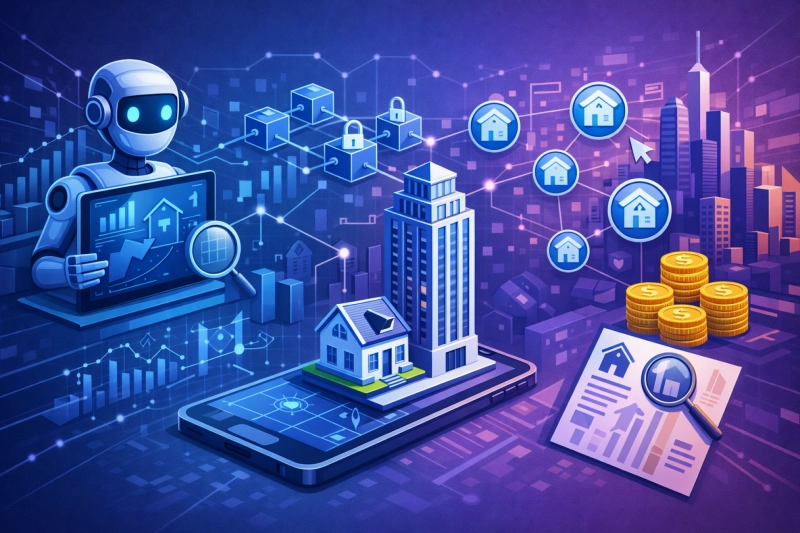
The global real estate market is undergoing a structural transformation driven by the convergence of blockchain and artificial intelligence. Traditional property investment models, long constrained by illiquidity, high capital barriers, manual processes, and opaque decision making, are being reimagined through tokenized real estate platforms. These platforms convert physical assets into digitally represented ownership units while embedding intelligence into every stage of the investment lifecycle. As markets become increasingly data driven and investors demand greater transparency, speed, and flexibility, AI and blockchain together are emerging as the foundational technologies shaping the next generation of real estate investment.
This shift is not incremental. It represents a fundamental redesign of how property assets are valued, accessed, managed, and traded. Tokenized real estate platforms are no longer experimental concepts. They are rapidly evolving into scalable investment infrastructures capable of supporting institutional grade portfolios, cross border participation, and real time performance insights.
Understanding Tokenized Real Estate Platforms in the Modern Context
A tokenized real estate platform enables property assets to be represented as digital tokens on a blockchain network. Each token corresponds to a fractional ownership stake or economic right associated with the underlying asset. Unlike traditional real estate syndication or REIT structures, tokenization introduces programmability, instant settlement, and granular ownership at a much deeper level.
What differentiates modern platforms from early tokenization attempts is the integration of AI powered intelligence layers. Blockchain provides the trust infrastructure, immutability, and transactional backbone, while AI drives valuation accuracy, risk assessment, investor matching, and portfolio optimization. Together, they create a self reinforcing system where data continuously improves decision making across the platform.
Why Blockchain Is the Backbone of Tokenized Real Estate
Blockchain technology solves some of the most persistent challenges in real estate investing. At its core, blockchain introduces a single source of truth for ownership records, transaction history, and asset provenance. Every token issuance, transfer, or compliance check is recorded in a tamper resistant ledger that can be audited in real time.
Smart contracts play a critical role in automating processes that traditionally require multiple intermediaries. Rental income distribution, dividend payouts, escrow settlements, and compliance enforcement can all be executed automatically based on predefined rules. This reduces administrative overhead, eliminates reconciliation delays, and significantly lowers transaction costs.
Another key advantage is fractional liquidity. Blockchain enables assets to be divided into smaller ownership units without compromising legal clarity. Investors who previously lacked access to premium real estate markets can now participate with smaller capital commitments while maintaining clear rights and traceable ownership.
The Expanding Role of AI in Smart Real Estate Investing
Artificial intelligence transforms tokenized real estate platforms from passive marketplaces into intelligent investment ecosystems. AI algorithms analyze vast datasets that include historical pricing trends, rental yield patterns, macroeconomic indicators, demographic shifts, and localized demand signals. This enables more accurate asset valuation and forward looking performance forecasting.
AI driven analytics also enhance due diligence. Instead of relying solely on static reports and manual assessments, investors gain access to dynamic risk profiles that update as market conditions evolve. Predictive models can identify early warning signs related to occupancy risk, regulatory changes, or neighborhood level economic shifts.
For platform operators, AI optimizes asset onboarding and portfolio structuring. Properties can be matched with the most suitable investor segments based on risk tolerance, investment horizon, and income expectations. This intelligent matching improves capital efficiency and reduces friction across the investment lifecycle.
AI Powered Valuation Models and Market Intelligence
One of the most transformative trends within tokenized real estate platforms is the use of AI for real time property valuation. Traditional appraisal processes are often slow, expensive, and backward looking. AI based valuation models continuously ingest new data points, allowing asset prices to reflect current market realities more accurately.
These models account for factors such as local supply and demand dynamics, interest rate fluctuations, infrastructure development, and tenant behavior. By combining structured financial data with unstructured data such as zoning updates or economic sentiment indicators, AI produces valuation insights that are both granular and adaptive.
For investors, this means improved price discovery and reduced information asymmetry. Token pricing becomes more closely aligned with underlying asset fundamentals, supporting healthier secondary market activity and more rational investment decisions.
Enhancing Liquidity Through Intelligent Token Markets
Liquidity has historically been one of the greatest limitations of real estate investing. Tokenized platforms address this challenge by enabling secondary market trading of property tokens. AI further enhances liquidity by optimizing market making mechanisms, identifying price inefficiencies, and forecasting demand patterns.
Machine learning algorithms can recommend optimal pricing strategies for token issuers and sellers based on market conditions and investor behavior. AI can also identify periods of heightened liquidity risk and suggest interventions such as staggered token releases or incentive adjustments.
As token markets mature, these intelligent liquidity management systems play a crucial role in maintaining stability while supporting continuous market participation.
Risk Management and Compliance Automation
Risk management is a central concern for institutional and retail investors alike. Tokenized real estate platforms leverage AI to continuously monitor portfolio risk exposure across multiple dimensions. These include geographic concentration, tenant diversification, regulatory compliance, and macroeconomic sensitivity.
AI driven compliance engines automatically assess investor eligibility, jurisdictional constraints, and transaction limits. This ensures that token transfers and ownership structures remain aligned with evolving regulatory requirements without introducing operational bottlenecks.
Blockchain reinforces these controls by providing immutable audit trails and transparent reporting. Together, AI and blockchain reduce compliance costs while increasing trust among investors, regulators, and platform participants.
Personalized Investment Experiences at Scale
Another defining trend is the personalization of investment journeys. AI enables tokenized real estate platforms to deliver tailored insights, recommendations, and portfolio strategies based on individual investor profiles. Instead of generic listings, investors receive curated opportunities aligned with their goals and risk preferences.
Behavioral analytics track engagement patterns and investment outcomes, allowing platforms to refine recommendations over time. This creates a feedback loop where investor satisfaction and platform performance improve in parallel.
Personalization also extends to reporting and communication. Investors can access customized dashboards that highlight metrics most relevant to their strategy, whether income stability, capital appreciation, or diversification benefits.
Institutional Adoption and Portfolio Integration
Institutional investors are increasingly recognizing the strategic value of tokenized real estate platforms. AI driven analytics and blockchain based transparency align well with institutional requirements for governance, reporting, and risk control. Tokenized assets can be integrated into broader portfolio management systems, enabling real time performance tracking alongside traditional asset classes.
For asset managers, tokenization introduces operational efficiencies and new capital formation models. Funds can be structured with greater flexibility, enabling dynamic rebalancing and targeted exposure adjustments without lengthy restructuring processes.
As institutions adopt these platforms, standards around data interoperability, security, and governance continue to mature, accelerating broader market adoption.
Cross Border Investment and Global Accessibility
Tokenized real estate platforms significantly reduce barriers to cross border investment. Blockchain facilitates secure, transparent transactions across jurisdictions, while AI assists in navigating regional market complexities. Currency risk modeling, local regulatory analysis, and geopolitical scenario planning can all be managed through intelligent systems.
This global accessibility expands the investor base and increases capital inflows into previously underserved markets. At the same time, it enables investors to diversify geographically with greater precision and confidence.
As regulatory clarity improves, cross border tokenized real estate investment is expected to become a mainstream allocation strategy for globally diversified portfolios.
Data Driven Asset Management and Operational Efficiency
Beyond investment entry and exit, AI enhances ongoing asset management within tokenized platforms. Predictive maintenance models optimize operational costs by anticipating repairs and reducing downtime. Tenant behavior analysis improves retention strategies and revenue stability.
Blockchain ensures that operational data is securely recorded and shared among authorized stakeholders. This transparency improves accountability and supports data driven decision making across property managers, investors, and service providers.
The result is a more efficient, resilient asset management model that aligns operational performance with investor expectations.
Security, Trust, and Platform Resilience
Security remains a critical consideration as tokenized real estate platforms scale. Blockchain provides strong cryptographic protections for ownership records and transactions. AI enhances security further by monitoring network activity for anomalies, potential fraud patterns, and system vulnerabilities.
Continuous threat detection and adaptive security protocols help maintain platform resilience in an increasingly complex digital environment. This layered approach to security is essential for building long term trust among participants.
Trust is also reinforced through transparency. Investors can independently verify ownership, transaction history, and asset performance without relying solely on centralized intermediaries.
Future Outlook: From Smart Platforms to Autonomous Investment Ecosystems
Looking ahead, tokenized real estate platforms are evolving toward increasingly autonomous investment ecosystems. AI agents may soon handle asset selection, portfolio rebalancing, and liquidity management with minimal human intervention. Blockchain will continue to serve as the governance and settlement layer that ensures accountability and fairness.
As interoperability improves, tokenized real estate assets could seamlessly interact with other digital asset classes, enabling more sophisticated multi asset strategies. The convergence of AI and blockchain positions these platforms not just as alternatives to traditional real estate investing, but as foundational infrastructure for the future of capital markets.
Conclusion: A New Era of Intelligent Real Estate Investment
Tokenized real estate platforms represent a paradigm shift in how property assets are accessed, managed, and monetized. Blockchain delivers transparency, security, and efficiency, while AI injects intelligence into every decision point. Together, they create investment environments that are more inclusive, data driven, and responsive to market dynamics.
As adoption accelerates, these platforms are reshaping investor expectations and redefining what smart investing means in the real estate sector. For investors, developers, and institutions alike, understanding and embracing these trends is no longer optional. It is essential for staying competitive in a rapidly evolving financial landscape.