



In the fast-paced world of interior design, trends can feel ephemeral. One minute, minimalism and stark white walls are the height of sophistication; the next, we are embracing "maximalism" with bold wallpapers and cluttered, cozy aesthetics. Amidst this constant flux, it can be difficult for homeowners to choose fixtures that won't look dated in five years. This anxiety is particularly acute when it comes to permanent installations like heating systems. Unlike a rug or a cushion, you cannot simply swap out a radiator every time the wind changes.
This desire for longevity has led to a fascinating shift in the market. Rather than chasing the ultra-futuristic, many designers and architects are looking backward, finding inspiration in the industrial and Victorian eras. There is a growing appreciation for objects that feel substantial, authentic, and engineered to last. This movement has revived specific design elements that were once considered obsolete, proving that true style is cyclical.
Nowhere is this revival more evident than in the incredible popularity of Column Radiators. These fixtures have transcended their humble origins to become the darling of the interior design world. Whether you are walking into a converted warehouse apartment in the city or a lovingly restored country cottage, you are likely to find these distinctive, tubular heaters taking pride of place. They manage to strike a rare balance: they possess enough character to stand out, yet their repetitive, symmetrical lines offer a simplicity that blends seamlessly with almost any décor.
The Architecture of Heat
To understand the appeal of the column style, we have to look at its structure. Unlike the flat, single-surface panel radiators that became ubiquitous in the 1970s and 80s, column models are built from rows of vertical tubes connected at the top and bottom.
This design isn't just an aesthetic choice; it is a masterclass in engineering. The "multi-column" structure drastically increases the surface area of the radiator. Instead of a single flat sheet, you have multiple tubes, each radiating heat outwards and allowing air to circulate freely between them. This creates a powerful convection effect. Cold air is drawn up from the floor, warmed between the columns, and projected into the room.
Because of this high surface area, these radiators are capable of generating significant heat outputs relative to their wall footprint. A thick, 4-column deep radiator can produce the same amount of warmth as a much wider single-panel radiator, making them an excellent solution for rooms where wall space is scarce but heat demand is high.
Versatility: The Chameleon of Heating
The true genius of this design lies in its versatility. It is rare to find a home product that looks equally at home in a 19th-century drawing room and a 21st-century open-plan kitchen.
In period properties, they reinforce the historical narrative. If you have high ceilings, cornicing, and original floorboards, a flat modern panel can look jarringly cheap. A column radiator, with its echoes of the cast-iron era, feels respectful of the building's age. It adds weight and permanence to the room.
Conversely, in modern "industrial chic" settings—think exposed brick, metal conduit, and concrete floors—the tubular steel construction mirrors the raw, functional aesthetic of the space. When finished in a clear lacquer or a raw metal varnish, they look like pieces of industrial machinery, celebrating the "nuts and bolts" of the home rather than hiding them.
Material Evolution: Steel vs. Iron
While they mimic the look of traditional cast iron, the majority of modern column radiators are manufactured from mild steel. This distinction is important for several reasons.
- Weight: Steel is significantly lighter than iron. This means these radiators can often be wall-mounted without the need for heavy-duty wall stays or reinforced floors. This opens up installation possibilities in upper-floor apartments or partition walls where cast iron would be too risky.
- Responsiveness: As discussed in previous posts regarding aluminium, the thermal mass matters. Steel heats up faster than cast iron. While it doesn't retain heat quite as long as iron, it offers a more controllable heat curve, which is better suited to modern lifestyles where we might only need heating for a few hours in the morning and evening.
- Finish Quality: The smooth surface of steel allows for an incredibly high-quality paint finish. There is no pitting or roughness (unless desired), resulting in a clean, crisp look that appeals to modern sensibilities.
The Colour Revolution
One of the most exciting developments in this sector is the move away from "Traffic White." While white will always be a classic, the column radiator has become a canvas for colour.
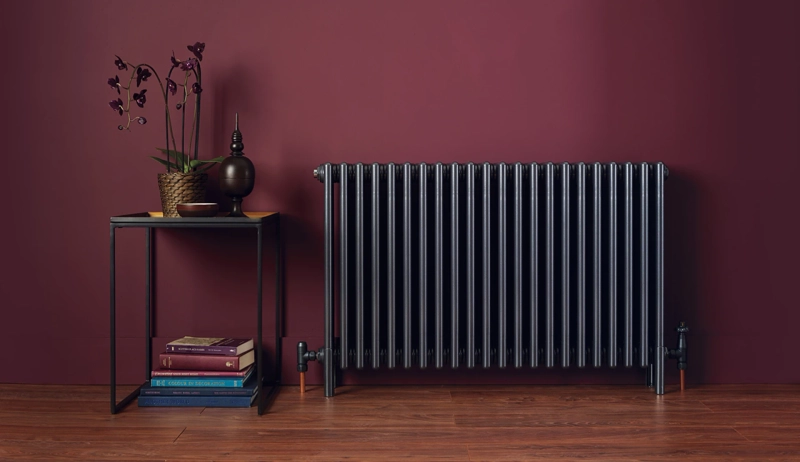
Dark and Dramatic: Anthracite, graphite, and matte black are currently dominating the market. A dark radiator against a light wall creates a graphic, monochrome look. Alternatively, placing a dark radiator against a dark blue or green wall allows it to blend in, adding texture without breaking the colour block.
Pop of Colour: For the brave, bold colours like mustard yellow, teal, or even signal red are becoming popular. In a child's bedroom or a neutral hallway, a brightly coloured radiator becomes a sculptural feature—a piece of pop art that also keeps you warm.
Metallic Finishes: Beyond paint, bare metal finishes are huge. "Raw metal" or "lacquered steel" shows the weld marks and the manufacturing process. This "wabi-sabi" approach, celebrating the imperfections of the construction, adds a layer of authenticity that is impossible to fake.
Solving the "Dead Space" Problem
Every home has them: those awkward narrow strips of wall that seem useless. Perhaps it’s the pillar between a bay window and the corner of the room, or the slice of wall behind a door.
Vertical column radiators have revolutionized how we use these spaces. By flipping the orientation, manufacturers have created tall, slim heating towers. A vertical model can produce a massive amount of BTUs while taking up only 300mm or 400mm of horizontal wall space.
This is a game-changer for kitchens, where wall space is usually sacrificed for cabinetry. By placing a tall column radiator on a narrow strip of wall, you free up the rest of the room for cupboards and appliances. It draws the eye upward, emphasizing the height of the room and making small spaces feel airier.
Maintenance and Practicality
While beautiful, these radiators do require a slightly different approach to maintenance than a flat panel. The very gaps that allow for such great air circulation can also trap dust.
However, cleaning them is straightforward. Special "radiator brushes"—long, thin, flexible dusters—are designed specifically to slide between the columns. It is a small trade-off for the aesthetic gain.
From a plumbing perspective, they are generally easy to install. Most come with standard connections. However, because they are often deeper than standard panels, you need to pay attention to the "pipe centres" (the distance of the pipe from the wall). You may need slightly longer radiator tails or to adjust your pipework to accommodate the depth of a 3 or 4-column model.
The "Buy It Once" Philosophy
We live in a disposable culture, but our homes should be an exception. When you install a high-quality steel column radiator, you are investing in a product with a long lifespan. Unlike cheap, thin-gauge panels that might rust through or leak after a decade, a well-made column model is robust.
This durability makes them a sustainable choice. While the initial carbon footprint of steel production is a factor, the longevity of the product offsets this. If a radiator lasts 20 or 30 years, its environmental impact per year is significantly lower than a cheaper alternative that needs replacing three times in the same period.
Conclusion: The Confidence of Classics
There is a reason why certain designs survive for a century or more. The column radiator is one of those designs. It works because it makes sense—thermodynamically, structurally, and aesthetically.
It refuses to try too hard. It doesn't have the flashy screens of high-tech gadgets or the ornate, fussy detailing of the baroque. It is simple, honest, and effective.
By choosing to install these fixtures in your home, you are making a statement that you value quality over novelty. You are creating a foundation for your interior design that is solid and adaptable. Whether you change your wall colour, your furniture, or your entire flooring next year, your column radiators will remain, standing quietly by the wall, looking as elegant and relevant as the day they were installed. In a world of constant change, that kind of permanence is a true luxury.