



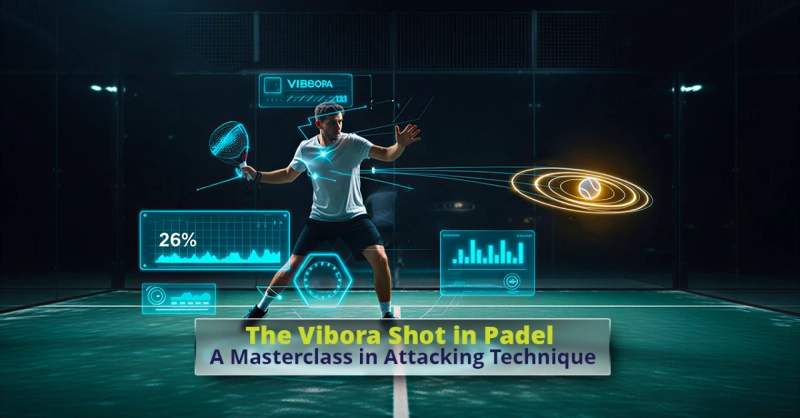
The vibora (Spanish for “viper”) is one of the most feared and effective attacking shots in padel.
This overhead smash is a heavy sidespin that forces opponents to scramble and often results in an easy finish at the net. The vibora’s unique side-spin makes it a favorite among advanced players looking to dominate the net.
What is the Vibora Shot?
The vibora is a powerful overhead shot performed with a side-spin. It’s essentially an aggressive version of the bandeja (a backhand overhead shot with slice), but with added spin and a different preparation.
When executed correctly, the vibora creates a low, fast ball that bounces unpredictably off the side wall. The side-spin causes the ball to curve and bounce at an odd angle, which is extremely difficult for the opponent to return cleanly.
Many advanced players consider the vibora a “must-have” shot to keep pressure on the opponent and control the point from the net.
When and Why to Use the Vibora
The vibora is an attacking shot, so it should be used when you have the opportunity to end a point or keep pressure on the opponent. Here are some key scenarios where the vibora is particularly effective:
After a short lob:
If your opponent hits a short lob that lands in the middle of the court, it’s an ideal situation to hit a vibora. This forces them to scramble to retrieve it and gives you time to move back into position at the net. The vibora will land deep and low, making it very hard for them to hit an attacking shot in return.
When you’re close to the net:
The vibora is most effective when you are near the net and have good height on the ball. It allows you to finish off points by hitting a powerful shot without leaving the net. If you find yourself at the net after a serve or a quick rally, the vibora can be a devastating way to win the point immediately.
To keep the opponent pinned:
Even if you don’t intend to end the point on the vibora, hitting it can be a strategic way to keep your opponents on the back foot. A well-placed vibora will land deep and at an angle, forcing your opponents to hit from the back of the court. This keeps the ball away from the net, giving you time to reposition and set up the next attack.
How to Hit the Vibora: Step-by-Step
- Positioning:
- Move quickly toward the net as the ball approaches.
- Stay near the center or slightly toward the ball’s landing side.
- Get in position before the ball bounces too high.
- Face the side wall, ready to hit.
- Grip & Preparation:
- Use a continental grip for control and spin.
- Bring the racket behind your head, elbow bent, racket face angled to the side wall.
- Extend your non-dominant arm for balance.
- Turn your body sideways (shoulders perpendicular to the side wall) for side-spin.
- Contact & Follow-Through:
- Hit the ball around eye level, slightly to the side of your body.
- Brush the side of the ball to generate strong side-spin.
- Follow through fully toward the side wall, finishing near your left shoulder (for right-handed players).
- Body rotation enhances spin and power.
- Target & Placement:
- Aim for the corner near the side and back walls.
- Make the ball bounce off the side wall, then back wall, landing deep in the corner.
- Forces your opponent to scramble, reducing the chances of a clean return.
- Versatility:
- It can be played as a forehand or a backhand overhead.
- Keep elbow high and racket angled for side-spin regardless of hand.
- Especially effective after short lobs, letting you finish at the net.
Common Mistakes and How to Avoid Them
Mastering the vibora takes time, and beginners often make common mistakes.
- Hitting the ball too early can make it fly high and short, so wait for it to reach chest or shoulder height before striking.
- Not using enough side-spin makes the shot easy to return, so brush the side of the ball to create spin.
- Over-hitting can cause you to lose control, so focus on placement in the corner rather than pure power.
- Stopping your follow-through too soon reduces spin and balance, so complete your motion with your arm extended and body turned.
- Finally, being unprepared and moving late can make you miss the shot, so anticipate the lob and get to the net early.
Training Drills to Master the Vibora
Mastering the vibora takes regular practice. Start with a wall drill: aim at a target on the side wall to improve accuracy, timing, and side-spin.
Then practice with a partner, having them lob short balls while you stay near the net, gradually increasing speed and varying placement. Include the vibora in point play by starting with a short lob and using the shot to pin your opponent before finishing at the net.
Pro tip: you can find padel partners that matches your skill level in Mocion App.
Repetition drills, hitting 10–15 viboras in a row, build muscle memory and help refine spin and placement. After each set, check your form and adjust as needed. Begin with slow, controlled shots, then increase speed and difficulty over time. With consistent practice, the vibora becomes a natural, powerful shot, giving you better control of the net and more chances to win points.