



We are living in an age of profound, and often conflicting, domestic ambitions. We demand that our homes be sanctuaries of personal expression, curated with minimalist aesthetics and bold architectural forms. Simultaneously, we insist they be hyper-functional, seamlessly integrated ecosystems of "smart" technology that respond to our voices and predict our needs in an instant. And layered over all of this is a new, non-negotiable imperative: our homes must be sustainable, treading lightly on the planet with a responsible eco-footprint. For decades, these three ideals Design, Digital, and Ecology were a frustrating compromise. A "smart" home was often an ugly one, cluttered with plastic gadgets. A "designed" home often used rare, resource-intensive materials. And an "eco" home was frequently a home of deliberate sacrifice.
Finding a solution that could satisfy this trifecta, this three-pronged challenge of the 21st century, seemed impossible. In the world of domestic comfort, the traditional systems were a perfect example of this conflict. They were heavy, slow, unattractive, and inefficient. They were "dumb" objects in an increasingly "smart" world. The revolution, when it came, did not arrive from a high-tech lab or a new-age polymer. It came from a re-imagining of one of the most common and versatile elements on earth. The rise of aluminium in home heating is not just the story of a better radiator; it is the story of a single material finally solving the trifecta, delivering instantaneous smart-home integration, total design freedom, and a truly circular, sustainable lifecycle, all at once.
The Physical Catalyst for a Digital World
For the last decade, we have been sold the promise of the "smart home." We were promised a world of geofencing, where our homes would prepare for our arrival. We were promised algorithmic learning, where our thermostats would intuitively understand our schedules. We were promised the simple, futuristic luxury of voice commands. Yet, for many, this promise has fallen flat, feeling sluggish, unresponsive, and, ultimately, a little bit "dumb." The failure was not in the software; it was in the hardware. The digital brain was, in most cases, connected to a primitive, analog body. A smart thermostat, no matter how advanced, is rendered a placebo when it is commanding a heating system with high "thermal inertia." It can send the "on" command, but the homeowner still has to wait an hour for a heavy, high-mass system to slowly and laboriously warm up. This massive lag makes "smart" commands feel pointless.
This is where the unique material science of aluminium radiators provided the missing link, the physical catalyst that the digital world was waiting for. Aluminium’s primary virtue in this context is its near-zero thermal inertia. It is a phenomenal conductor, not a storage vessel. It is designed to transfer heat from water to air with breathtaking speed, a process amplified by its modern, "low-water-content" design. This means the lag between a digital command and a physical, haptic response is reduced from an hour to mere minutes. This is the difference between programming your heat and commanding it. This instantaneous responsiveness is the only thing that truly unlocks the potential of a smart home. It means "geofencing" actually works; your home can genuinely start to heat up when you are five minutes away. It means "zoning" becomes practical; you can heat just one room, right now, without wasting energy on the rest of the house. This material property is the enabler. It is the bridge that finally connected the speed of our digital lives to the physical reality of our domestic comfort, making the "smart" promise a tangible reality.
The Liberation of Form: Heat as Architectural Sculpture
For more than a century, interior design was held hostage by the radiator. The objects themselves, typically cast from heavy, dense materials, were a structural liability. They were immensely heavy, meaning they were almost exclusively floor-bound, demanding placement on a reinforced floor, typically against a structural, exterior wall. This was not a "design choice"; it was a structural necessity. Architects and designers were forced to compose their rooms around this immovable, utilitarian object. The radiator became the "problem" under the window, an item to be hidden behind covers, painted into obscurity, or begrudgingly tolerated. It was a fixed, immovable point of compromise in an otherwise creative process.
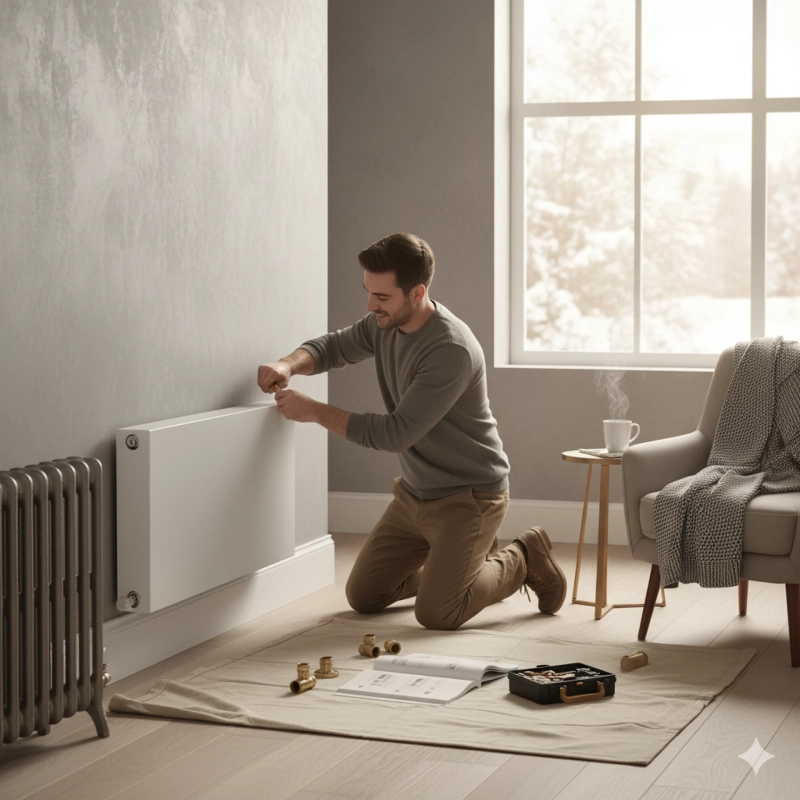
The adoption of aluminium was, first and foremost, an act of liberation. Its most obvious property, its lightness, was a revolutionary gift to architects. Suddenly, the radiator was unburdened from the floor. Weighing a fraction of its predecessors, it could be securely and safely mounted on any wall, including simple drywall partitions. This simple fact completely rewrote the rules of interior design. But the second property, its manufacturability, is what turned this freedom into an art form. Unlike heavy metals, which must be cast in rigid, simple molds, aluminium can be extruded. This process, pushing the material through a shaped die, is like giving a sculptor a new, infinitely flexible clay. It allows for the creation of forms that are simply impossible to achieve through casting. This technical freedom led to an aesthetic explosion. The radiator was no longer just a horizontal block. It could be a sleek, vertical column, drawing the eye upward and creating a sense of height. It could be a slender, minimalist panel that seamlessly blends with a modern wall. It could even be a bold, geometric, or waved sculptural piece, a true focal point that challenges the boundary between utility and art. This material did not just offer a "new look"; it offered a new philosophy. The radiator was elevated from a functional burden to a piece of deliberate, functional sculpture, a true architectural feature.
The Closed-Loop Promise: A Cleaner Conscience
The final, and perhaps most critical, hurdle of the modern trifecta is ecology. The 20th-century definition of a "sustainable" product was one that "lasted forever." This narrative of longevity, while valuable, is a deeply incomplete picture. It ignores the massive "embodied carbon" required to create that product in the first place the immense energy needed to mine, smelt, and cast heavy, virgin materials. It also ignores the "end-of-life" problem: what happens when the building is finally renovated? In this old model, longevity just delayed the inevitable trip to the landfill. The modern, 21st-century definition of sustainability is not just longevity; it is the "circular economy," a closed-loop system where a product is born from recycled materials and returns to that same loop at the end of its life.
This is where aluminium's lifecycle becomes its most profound advantage. First, its "birth": it is one of the most recycled materials on earth. Unlike plastics, it can be recycled infinitely without any degradation in quality. As a result, the vast majority of aluminium products are already made from a high percentage of recycled content. This "secondary" aluminium requires a staggering 95% less energy to produce than "primary" aluminium mined from the earth. This means the product is "green" from the moment of its conception, with a tiny fraction of the embodied carbon of its predecessors. Second, its "life": this material's high conductivity and low-water-content design make it the perfect partner for high-efficiency, low-temperature systems, such as modern condensing boilers and, crucially, air-source heat pumps. It provides its rapid, responsive heat while consuming far less energy on a daily basis. Finally, its "death": at the end of its exceptionally long life, it is 100% recyclable. It is not "junk" or "scrap"; it is a valuable commodity that is simply melted down and reformed, perhaps as another radiator, a car part, or a drink can. This "closed-loop" promise a green birth, an efficient life, and a renewable death is the definitive answer to the modern ecological imperative.
Conclusion: The Unifying Element
We are the first generation to demand everything from our homes. We demand the instant, predictive intelligence of a digital assistant. We demand the clean, curated beauty of a design magazine. And we demand the clear, responsible conscience of an environmentalist. We are a generation that rejects compromise, and we have been searching for materials that can keep pace with our ambitions. The home of the past was a place of "either/or." You could have it fast, or you could have it beautiful, or you could have it responsible. You could rarely, if ever, have it all.
The story of the lightweight radiator is the story of a "both/and" solution. It is a rare example of a single material that, through its intrinsic properties, provides the perfect answer to all three of our greatest modern demands. It is the physical hardware that makes our digital lives possible. It is the blank, sculptural canvas that makes our design ambitions tangible. And it is the circular, efficient, and responsible partner that makes our ecological conscience clean. It is not just a better way to heat a room; it is the physical embodiment of a home that is finally, and truly, modern.