



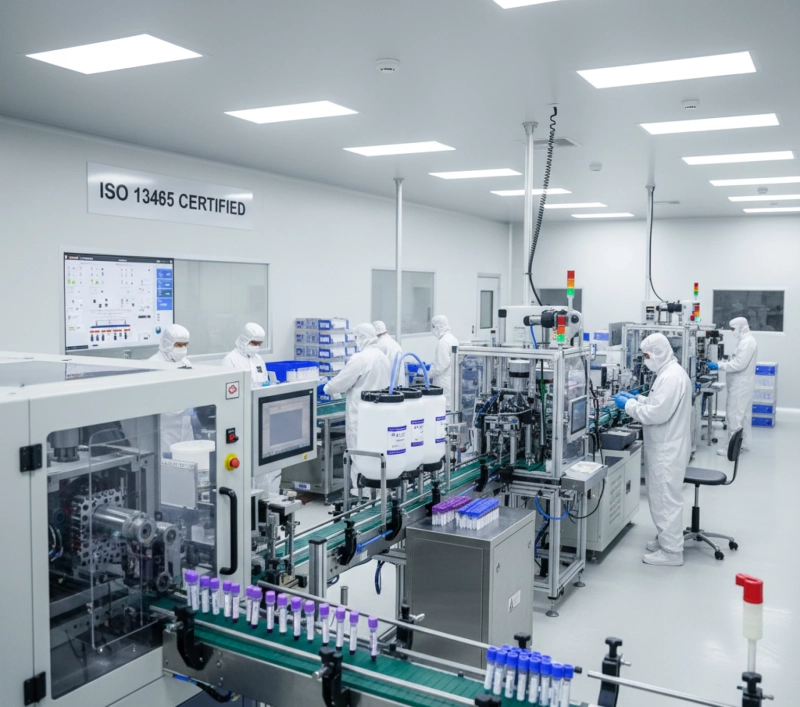
In the sophisticated landscape of In-Vitro Diagnostics (IVD), the blood collection tube is far more than a simple storage vessel. It is a precision-engineered medical device designed to preserve the biochemical and cellular integrity of a human specimen from the moment of phlebotomy to the point of analysis. As diagnostic technology advances toward high-sensitivity molecular assays, the requirements for consistency in blood collection tube manufacturing have reached an all-time high.
For manufacturers and regulatory professionals, these devices represent a unique challenge: they must be produced at an massive scale while maintaining microscopic tolerances in vacuum pressure and chemical additive concentrations. A failure in the tube’s performance doesn’t just mean a lost sample; it can lead to misdiagnosis, unnecessary treatments, or skewed clinical data.
The Pre-Analytical Foundation of Diagnostics
The vast majority of laboratory errors occur in the pre-analytical phase. This makes the role of vacuum blood collection tubes critical to the healthcare ecosystem. By automating the draw volume through a pre-defined internal vacuum, these tubes eliminate the human error associated with manual syringe draws.
Standardization is the core objective. Whether the tube is used for hematology, immunology, or coagulation studies, the internal environment must be meticulously controlled. This ensures that the blood-to-additive ratio remains constant, preventing issues like hemolysis (the rupture of red blood cells) or micro-clotting that could interfere with automated laboratory analyzers.
Diversity of Design: Additives and Tube Types
Manufacturing facilities must be equipped to handle a wide range of chemical formulations, usually distinguished by internationally recognized color-coded caps:
- EDTA (Purple): Used primarily for whole blood counts; it prevents clotting by chelating calcium.
- Sodium Citrate (Blue): Essential for coagulation testing, requiring a strict 1:9 additive-to-blood ratio.
- Serum Separators (Gold/Red): These utilize clot activators and thixotropic gels to isolate serum during centrifugation.
- Heparin (Green): Often used for emergency chemistry panels to provide rapid plasma separation.
The Engineering Lifecycle: Manufacturing Process Overview
The production of these devices is a high-speed, multi-step process that must be conducted under cleanroom conditions to prevent environmental contamination.
The initial stage involves the high-precision injection molding of the tube barrel. Most modern manufacturers have transitioned from glass to Polyethylene Terephthalate (PET) because of its clarity, shatter resistance, and superior gas barrier properties. Maintaining the vacuum over the product's shelf life requires a polymer that is nearly impermeable to atmospheric gases.
Following molding, the tubes enter the additive dosing stage. This is a critical point in the blood collection tube manufacturing process, where specialized nozzles apply a fine, uniform mist of reagents to the interior walls. For tubes requiring separation gels, a high-precision dispenser must place the gel at the bottom of the tube with perfect centering to ensure it migrates correctly during centrifugation.
Finally, the tubes are capped with bromobutyl rubber stoppers, and the air is evacuated. The level of vacuum is calibrated according to the intended draw volume and adjusted for the atmospheric pressure of the destination market to ensure accuracy upon arrival at the clinic.
Material Science and Component Selection
Quality begins with the selection of medical-grade raw materials. Each component must be tested for biocompatibility and chemical inertness:
- PET Resins: Must be free of lubricants or additives that could leach into the blood sample.
- Bromobutyl Rubber: Specifically chosen for its low permeability and self-sealing properties after needle penetration.
- Surfactants: Often used to coat the interior of the tube to prevent blood cells from sticking to the walls, ensuring a clean separation.
Quality Control and Validation Protocols
In the IVD industry, repeatability is the benchmark of success. Implementing a comprehensive medical device quality control system is essential for regulatory approval and market trust. Every batch of tubes must undergo rigorous testing:
- Vacuum Stability: Accelerated aging tests ensure the tube retains its draw volume throughout its labeled shelf life.
- Dimensional Testing: Tubes must fit perfectly into various centrifuge rotors and laboratory racks without breaking or jamming.
- Centrifugation Testing: Tubes are spun at high Relative Centrifugal Force (RCF) to verify that the separation gel creates a stable barrier and the plastic does not crack.
- Additive Efficacy: Testing with blood analogs to ensure that clotting or anticoagulation occurs within the specified timeframes.
Sterilization and Regulatory Frameworks
While not all blood collection tubes are required to be sterile internally, many high-stakes applications—such as those used for molecular diagnostics or blood cultures—demand it. Gamma irradiation is the preferred method, as it penetrates the final packaging and the tube itself without leaving chemical residues or compromising the vacuum.
Navigating the global market requires strict adherence to IVD manufacturing standards, specifically ISO 13485 (Medical Devices – Quality Management Systems). In the United States, the FDA regulates these as Class II devices, while in Europe, the In-Vitro Diagnostic Regulation (IVDR) has introduced more stringent requirements for technical documentation and post-market surveillance.
Companies often seek the expertise of specialized consulting firms like Operon Strategist to align their manufacturing layouts and technical files with these evolving global expectations. This ensures that the facility is not just producing a product, but a validated medical device that meets international safety benchmarks.
Common Manufacturing Challenges and Risk Mitigation
Despite high levels of automation, several challenges can arise in blood collection tube manufacturing. One of the most frequent issues is "short draws," where the tube fails to pull the required volume of blood. This is often traced back to microscopic flaws in the injection molding or seal integrity. Manufacturers mitigate this by using 100% automated vision inspection systems that check every tube for physical defects and correct stopper placement.
Another risk is additive cross-contamination. If traces of an anticoagulant end up in a serum tube, it can lead to false laboratory results. Strict segregation of production lines and validated cleaning procedures between batches are the primary defenses against such risks.
The Shift Toward Quality-Driven Systems
As laboratories become increasingly automated, they demand higher levels of physical consistency from collection tubes. A tube that is slightly out of dimension can cause a mechanical jam in an expensive analyzer, leading to significant downtime.
A quality-driven manufacturing system focuses on reducing variability. By integrating real-time data monitoring into the production line, manufacturers can identify trends—such as a slight drift in vacuum levels or a change in plastic wall thickness—before they result in non-conforming products. This proactive approach is what separates industry leaders from those merely fulfilling a commodity need.
Educational Summary
The production of blood collection tubes is a complex synthesis of material science, atmospheric physics, and chemical engineering. From the selection of high-barrier PET resins to the precise calibration of the internal vacuum, every step of the process is designed to protect the patient's biological sample. By adhering to international quality standards and implementing rigorous validation protocols, manufacturers ensure that the first step in the diagnostic journey is a reliable one. Success in this field is measured by the consistency of the results that these devices help to produce, supporting accurate diagnosis and better patient outcomes worldwide.
Would you like me to help you draft the technical specifications or a quality audit checklist for your manufacturing line?