



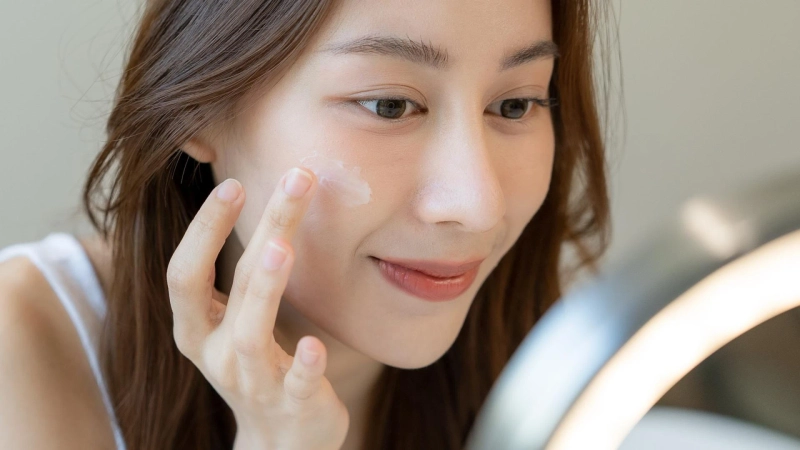
From being a simple way to express oneself, makeup has developed into a complex fusion of chemistry and art. Customers of today want products that last through long days, muggy weather, and countless selfies in addition to enhancing beauty. In the beauty industry, "long-lasting makeup" has become the gold standard, but what exactly makes it stay in place? There is an intriguing tale of chemistry, skin science, and material innovation behind each budge-proof eyeliner, transfer-resistant foundation, and smudge-proof lipstick. Let's examine the science that keeps your makeup looking perfect for hours on end.
The Chemistry of Staying Power
Pigments, oils, waxes, polymers, and emulsifiers are all delicately combined to create makeup. We must first comprehend the chemical foundation of long-lasting formulas in order to comprehend longevity.
a. Forming films Polymers
These are the unsung heroes of makeup longevity. Flexible substances known as "film-forming polymers" cover the skin to form a thin, imperceptible layer. This film prevents the product from transferring due to friction, perspiration, or oil. Silicone resins and acrylates copolymer are typical examples.
These polymers aid in the pigment's adhesion to skin cells in foundations, creating a layer that is both breathable and water-resistant. They produce a flexible layer in eyeliners and lipsticks that doesn't smudge, not even after eating or crying.
b. Magic with Silicone
Long-wearing makeup requires silicones such as dimethicone, cyclopentasiloxane, and trimethylsiloxysilicate. They serve as barriers as well as lubricants. Their molecular structure repels perspiration and water, and their slippery texture makes it possible for products to glide smoothly on the skin.
Additionally, silicones smooth out pores and fine lines, allowing pigments to adhere more evenly. Because silicone-based primers create a semi-occlusive layer that stops makeup from being removed too quickly by the skin's natural oils, they are very popular.
a. Oil Production and Makeup Breakdown
Sebum (skin oil) is one of the biggest enemies of long-lasting makeup. It dissolves pigments, breaks down emulsifiers, and causes foundation to slide off or separate. That’s why people with oily skin often struggle to keep their makeup intact. Modern long-wear products counter this by including oil-absorbing powders like silica, talc, or starch microspheres. These act like tiny sponges, absorbing excess sebum while maintaining a matte finish.
b. The pH Balance
The natural pH of the skin, which is between 4.5 and 5.5, influences how ingredients work together. While some pigments and polymers break down more quickly in alkaline environments, others bind better in slightly acidic ones. To guarantee stability and adherence on the skin's surface, premium formulations are pH-balanced.
Surface Texture and Preparation
Applying makeup correctly is just as important to its longevity as the formula. Patchiness and poor adherence can be caused by dryness, uneven texture, or dead skin cells. Exfoliation and priming are therefore crucial from a scientific standpoint. The skin's surface is smoothed by a primer containing silicone or microparticles, which increases pigment adherence and decreases friction for more even wear.
The Science of Foundations That Don’t Fade
Three essential components of a long-lasting foundation must be balanced: flexibility, oil control, and adhesion.
a. Pigment Suspension and Dispersion
Pigments are suspended in an emulsion of water and oils in foundations. In order to improve their adhesion to the skin and prevent oxidation, long-lasting formulas employ pigments that have been treated by coating them with silicones or amino acids. This keeps foundation from becoming orange or lifeless after a few hours. Read more