



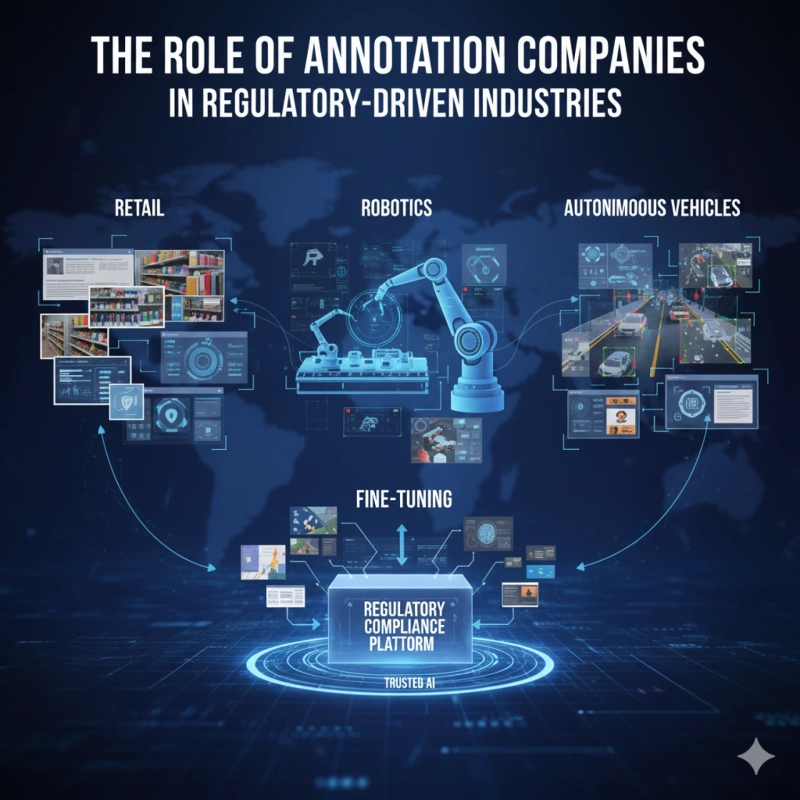
As artificial intelligence becomes deeply embedded across retail, robotics, and autonomous vehicle ecosystems, the quality of labeled data directly influences not only model performance but also regulatory compliance, operational safety, and end-user trust. Each of these industries operates under stringent oversight—whether it is safety protocols, data governance rules, or consumer-protection standards—and this regulatory landscape places exceptional pressure on organizations to ensure their training data is reliable, traceable, unbiased, and ethically sourced.
Annotation companies have emerged as critical partners in this environment. At Annotera, we see firsthand how specialized data annotation outsourcing enables enterprises to accelerate innovation while meeting regulatory expectations without compromise. From ensuring precise object detection in robotic systems to supporting audit-ready datasets for retail analytics and producing safety-critical annotations for autonomous driving models, the role of a trusted data annotation company has never been more pivotal.
This article assesses how annotation partners support compliance, governance, and risk mitigation across three industries reshaped by AI: retail, robotics, and autonomous vehicles.
Why Regulatory-Driven Industries Rely on Professional Annotation
While AI models learn from large volumes of labeled data, not all data is equal. In regulated sectors, annotations must be:
- Consistent: ensuring deterministic model behavior required by auditors and safety evaluators.
- Traceable: enabling organizations to track lineage, versions, and annotation sources.
- Bias-mitigated: satisfying fairness and ethical standards enforced by compliance bodies.
- Secure: meeting data protection mandates such as GDPR, SOC 2, and ISO 27001.
- Performance-validated: proving that training datasets meet defined accuracy thresholds.
These requirements significantly raise the bar for internal teams. Consequently, data annotation outsourcing allows companies to achieve scalable, repeatable, and compliant workflows that align with industry-specific mandates. Annotera brings structured processes, multi-tier quality assurance, domain-trained annotators, and governance frameworks that help enterprises meet these obligations.
1. Retail: Balancing Customer Data, Compliance, and Operational Efficiency
Retailers increasingly rely on AI for inventory management, demand forecasting, checkout automation, fraud detection, and personalized recommendations. But this sector is also governed by strict privacy and security frameworks, including GDPR for customer information, PCI-DSS for payment data, and regional consumer-protection statutes.
Annotation’s Role in Retail Compliance
A data annotation company like Annotera supports compliance and operational performance through:
- PII-Safe Data Preparation
- Retail datasets often contain personal identifiers such as faces, license plates, receipts, and payment details. Through secure data annotation for retail pipelines and controlled labeling environments, annotators remove or obfuscate sensitive elements while maintaining dataset usability for AI training.
- Accurate Product and Shelf Labeling
- Computer vision systems used in automated checkout or planogram compliance demand extremely precise bounding boxes, segmentation, and SKU-level categorization. Mislabeling can lead to inventory inaccuracies or regulatory violations related to pricing transparency.
- Fairness in Recommendation Systems
- Annotera helps retailers reduce bias in text and behavioral datasets, ensuring algorithms comply with emerging AI fairness guidelines and do not disadvantage demographic groups.
- Audit-Ready Documentation
- Regulators increasingly require proof of how training data was prepared. Annotation companies maintain version histories, QA reports, metadata documentation, and lineage records that support comprehensive audit trails.
2. Robotics: Safety, Precision, and Domain Expertise
Robotic systems—whether operating in warehouses, manufacturing lines, or commercial environments—must follow strict safety standards such as ISO 10218 or ANSI/RIA R15.06. These standards require robots to behave predictably, avoid hazards, and respond accurately to human presence or environmental signals.
Annotation’s Role in Robotics Governance
High-quality annotations underpin robotics vision and perception systems. Annotera supports robotics companies by delivering:
- Pixel-Level Accuracy for Safety Systems
- Robotics perception algorithms depend on highly detailed annotations such as instance segmentation, depth labeling, and pose estimation. These annotations determine whether a robot properly identifies humans, machinery, and obstacles.
- Specialized Domain Knowledge
- Warehouse, industrial, and commercial environments require annotators to understand domain-specific objects, workflows, and risk zones. Annotera provides trained teams with contextual expertise, reducing the chance of labeling errors that translate into operational hazards.
- Consistency for Deterministic AI Behavior
- Safety inspectors require evidence that a robot behaves reliably across diverse scenarios. Annotation companies implement multi-stage QA processes, tool-based conflict detection, and continuous calibration to maintain annotation uniformity across thousands of frames.
- Simulation and Synthetic Data Support
- Robotics companies frequently use synthetic data to test edge cases. Annotera supports blended workflows in which synthetic data annotations complement real-world datasets while still adhering to safety and compliance benchmarks.
3. Autonomous Vehicles: The Highest Stakes for Annotation Quality
No industry demonstrates the regulatory burden of AI more clearly than autonomous vehicles (AVs). With global safety standards, government testing requirements, and mandatory reporting of disengagements, AV companies must prove their systems are trained on top-tier, rigorously validated data.
How Annotation Companies Enable AV Regulatory Compliance
- High-Fidelity Sensor Data Labeling
- AV datasets include LiDAR, radar, multi-camera video, and telematics data. Annotera provides specialized teams trained for 3D point cloud labeling, sensor fusion annotation, lane marking detection, drivable area segmentation, and long-distance object classification.
- Support for Safety Case Documentation
- Governments require AV manufacturers to demonstrate how training data impacts model decisions. Annotation companies supply data lineage, quality metrics, reviewer credentials, and QA outcomes that feed into safety case reports.
- Edge Case Identification and Risk Mitigation
- AV systems are judged by how they perform in low-probability, high-risk scenarios. Annotera helps clients detect and label rare events—poor weather visibility, occlusions, irregular pedestrian behavior—ensuring coverage that meets regulatory scrutiny.
- Bias and Compliance Controls
- Datasets must represent geographic diversity, demographic variation, and environmental conditions. Annotation outsourcing ensures a structured approach to detecting skew and satisfying fairness requirements.
The Strategic Value of Data Annotation Outsourcing Across Regulated Sectors
Across retail, robotics, and autonomous vehicles, the incentive to outsource annotation extends beyond cost and efficiency. The strategic benefits include:
- Reliability: Professional annotation companies deliver predictable, measurable accuracy.
- Risk Reduction: Compliance-focused workflows minimize legal exposure.
- Operational Scale: Outsourcing supports rapid scaling without sacrificing governance.
- Specialization: Access to industry-specific annotation expertise elevates model performance.
- Security and Auditing: Data handling aligns with stringent regulatory and privacy requirements.
At Annotera, we combine secure infrastructures, domain-specific training, annotation tooling, and multi-layer QA mechanisms to help enterprises meet the dual mandate of innovation and compliance.
Conclusion: Annotation Partners Are Now Compliance Partners
As AI permeates regulated industries, annotation companies are becoming critical compliance enablers. Retailers must protect customer data, robotics teams must guarantee workplace safety, and autonomous vehicle manufacturers must prove model reliability under exhaustive regulatory review. None of this is achievable without clean, consistent, and traceable labeled datasets.
By choosing an experienced data annotation company like Annotera, organizations not only accelerate development but also reinforce their regulatory posture—positioning themselves to innovate responsibly and scale AI initiatives with confidence.