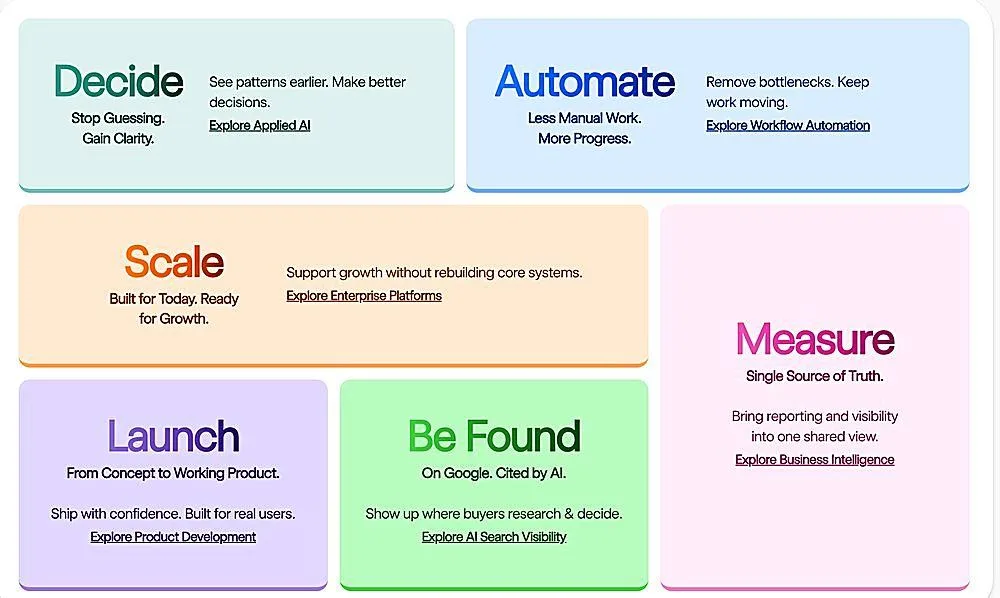

Artificial intelligence has moved from experimental projects to a central force in business strategy, and many organizations now engage external experts to guide that journey. AI consulting services help companies assess readiness, design responsible solutions, and accelerate measurable value from AI investments. This guidance is often the difference between pilots that stall and scaled programs that transform operations and customer experiences.
Why AI Matters Now?
Organizations are investing in AI at a scale unseen a few years ago. Surveys show that a large majority of companies report regular use of AI in at least one business function, with generative AI adoption expanding rapidly across departments. These trends reflect both the arrival of more capable models and the growing expectation that AI must deliver productivity gains, cost savings, or new revenue streams.
Key Areas of Impact
Customer Experience and Sales
AI can personalize interactions, shorten sales cycles, and automate routine support tasks. Firms using advanced language models deploy assistants that handle common queries, triage issues, or suggest next-best actions to sales teams. When these systems are designed with strong data pipelines and monitoring, they improve response times and free human teams to focus on complex problems.
Operations and Supply Chain
Predictive analytics and demand forecasting powered by machine learning help reduce stockouts and excess inventory. In manufacturing, AI supports quality inspection, predictive maintenance, and process optimization, which lowers downtime and operational cost.
Finance and Risk
AI tools enhance fraud detection, automate reconciliation, and provide scenario modeling for financial planning. These capabilities strengthen controls and improve the speed of decision making in high-stakes environments.
Product and Innovation
Embedding AI into products can create new user experiences and revenue models. Companies that turn data into product features gain a competitive edge by offering smarter, more adaptive services.
Adoption, Hurdles, and the Scaling Challenge
Adoption numbers are impressive, but achieving broad, measurable value remains hard. Industry research finds that while many organizations are experimenting with AI, only a small fraction have reached maturity in scaling solutions enterprise-wide. Barriers include fragmented data infrastructure, lack of executive alignment, talent shortages, and weak governance models. A recent report notes that most companies still struggle to move beyond pilot projects and capture sustained returns from AI investments.
Generative AI adoption grew sharply in a short period; however, experts caution that investment alone does not guarantee productivity gains. Companies must align AI initiatives with specific tasks and KPIs, and build the operational capability to integrate AI into daily workflows. Leaders who pair strategy with execution capability tend to extract the most value.
Economic Stakes and Strategic Imperative
Economic analyses find that AI could add trillions of dollars to global economic output over the coming decade. This prospective impact is a powerful incentive for boards and CEOs to treat AI as a strategic priority rather than a narrow technical project. The scale of the potential uplift—spanning productivity, product innovation, and new markets—drives competitive pressure to experiment and to move rapidly toward industrialized AI.
Trends Business Leaders Must Watch
Rapid Rise of Multimodal AI
Analysts predict that multimodal systems—models that handle text, images, audio, and video together—will become mainstream. This shift expands the types of business problems that AI can solve, from visual inspection to richer conversational interfaces, and it changes requirements for data management and model evaluation.
Executive Adoption and Skill Gaps
Senior leaders increasingly use AI tools, yet many organizations report a gap between leadership ambition and practical governance or operational readiness. Upskilling programs for managers and frontline workers, combined with clear governance, are essential to bridge this gap.
Focus on Responsible and Sustainable AI
As AI systems influence sensitive decisions, companies are investing in ethics, transparency, and climate-aware model choices. Responsible AI programs that include bias testing, human oversight, and energy-efficient deployments are becoming standard expectations for stakeholders.
How Organizations Succeed: Practical Steps
Start with Business Outcomes
Successful programs begin by defining clear outcomes—reduced processing time, improved conversion rates, lower maintenance costs—rather than chasing model benchmarks. Framing initiatives around measurable benefits helps maintain executive support and clarifies investment priorities.
Invest in Data and Platform Foundations
Reliable, well-governed data is the foundation of any AI solution. Companies that standardize data pipelines, adopt observability practices, and invest in scalable platforms find it easier to deploy models into production and monitor real-world performance.
Build Cross-Functional Teams
AI is not purely a technical discipline. Combining domain experts, data engineers, product managers, and compliance specialists enables solutions that are useful, safe, and aligned with business rules.
Govern Actively
Robust governance covers model risk, privacy, explainability, and continuous monitoring. Formalizing governance reduces deployment risk and builds trust with customers and regulators.
Measure, Learn, Repeat
Treat early deployments as learning cycles. Establish key metrics, collect feedback, and iterate quickly. Organizations that institutionalize learning accelerate improvement and de-risk scaling.
The Value of External Expertise
Many companies find that specialized external advisors accelerate the path from experimentation to industrialized AI. External advisors provide market-tested frameworks, experienced engineers, and governance playbooks that shorten time to value. When in-house teams lack deep experience with production ML, external partners can transfer knowledge while implementing robust pipelines and controls.
Case Examples and Sector Differences
Different industries show distinct adoption patterns. Financial services, technology, and retail lead in advanced use cases because of abundant data and clear ROI opportunities. Manufacturing and healthcare display strong potential, but they contend with regulatory constraints, higher requirements for explainability, and the need for rigorous validation. Regional variation also exists; some markets adopt new AI capabilities faster due to local investment, talent pools, or regulatory environments.
Risks and Ethical Considerations
AI projects carry real risk if governance is weak. Issues include biased outputs, privacy breaches, and model drift that degrades performance over time. Companies must maintain human oversight, enforce data privacy standards, and monitor models in production to ensure continued compliance and fairness.
Preparing for the Next Wave
Leaders should prepare for rapid change by making three foundational bets: invest in data platforms, create a governance and ethics framework, and develop people through training and focused hiring. Organizations that combine these capabilities will be better positioned to adopt emerging AI modalities, such as agentic systems or domain-specific foundation models, with lower operational friction.
Conclusion
AI is reshaping how businesses operate, compete, and innovate. The technology offers substantial economic upside, yet the path to sustained value requires focused strategy, operational rigor, and attention to ethics and governance. Companies that define clear outcomes, invest in data and platforms, and partner wisely to acquire missing capabilities will move beyond pilots and realize transformation at scale. The coming years will reward organizations that treat AI as an enterprise capability rather than a one-off experiment.