



Fintech companies love to talk about technology. Faster APIs, smarter fraud engines, better cloud infrastructure, cleaner UI, stronger encryption-on paper, everything looks world-class. Many fintech apps genuinely work well from a technical standpoint. They rarely crash, transactions usually go through, and compliance boxes are checked. Yet users still leave. Quietly. Gradually. Often without complaint. The real issue isn’t poor engineering. It’s what happens around the technology-how users are guided, informed, reassured, and supported at every step. This is where Robotic process automation with AI becomes relevant, not as a buzzword, but as a way to remove friction between systems, teams, and users. Because in fintech, users don’t churn when tech fails once-they churn when workflows fail every day.
This blog explains why fintech user loss is mostly a workflow problem, where those workflows break, and what strong fintech operations actually look like in 2025.
A. The Fintech Assumption That Breaks Retention
Most fintechs assume:
- If the product works, users will stay
- If compliance is strong, trust will follow
- If features are competitive, churn will reduce
In reality:
- Users judge clarity, not capability
- Trust comes from predictability, not promises
- Retention depends on how smoothly problems are handled
When workflows are unclear, even great technology feels unreliable.
B. Where Fintech Workflows Actually Break
Below are the most common failure points-seen across wallets, neobanks, lending apps, BNPL platforms, and payment gateways.
1. Onboarding Feels Like a Black Box
- Users submit documents but don’t know what’s pending
- Status stays “under review” without timelines
- Rejections lack explanation
- Re-uploads feel random
Technically, onboarding works. Experientially, it creates anxiety.
2. Transaction States Are Not Communicated Clearly
- “Processing” without context causes panic
- Delays aren’t proactively explained
- Users don’t know if money is stuck, failed, or reversed
- Support becomes the only source of clarity
Silence during money movement destroys trust faster than failure.
3. Support Teams Are Doing Workflow’s Job
- Most tickets ask for status updates, not help
- Agents manually check systems and reply
- Same questions repeat thousands of times
- Support cost rises without improving experience
This is not a support problem. It’s a workflow design problem.
4. Compliance Steps Are Poorly Orchestrated
- Necessary checks feel endless
- Users don’t understand why data is needed
- Timelines are unclear
- Requests arrive without guidance
Users don’t hate compliance. They hate confusion.
5. Internal Teams Operate in Silos
- Ops doesn’t see user frustration
- Risk teams don’t see churn impact
- Support lacks context from backend systems
- Engineering fixes issues without seeing user pain
When teams aren’t connected, users feel the gaps.
C. Why UX Is Not UI in Fintech
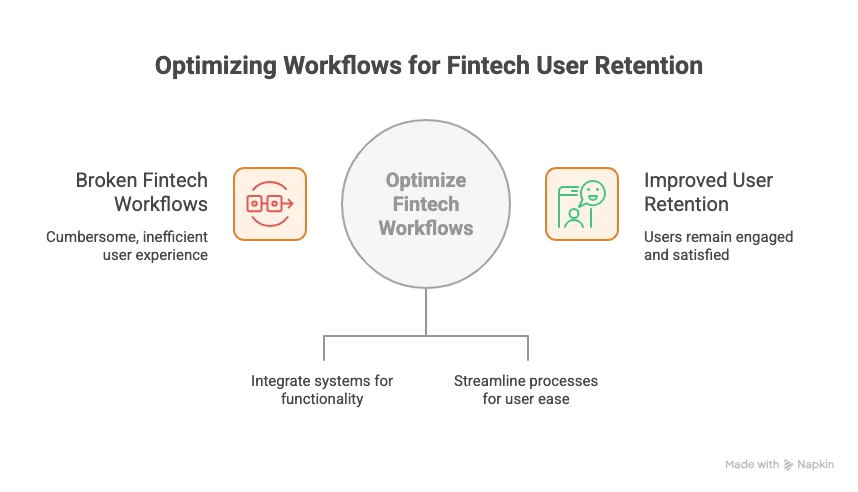
Many fintechs invest heavily in screens, animations, and dashboards. But UX is not how the app looks-it’s how the journey behaves.
Good fintech workflows answer:
- What’s happening right now?
- What happens next?
- How long will this take?
- Do I need to do anything?
This is where intelligent automation for enterprises plays a critical role-by connecting systems, triggering updates, and ensuring users are never left guessing, even when something goes wrong.
D. What Strong Fintech Workflows Look Like
Fintechs with high retention share common traits:
- Proactive communication
- Users get updates before they ask
- Delays are explained automatically
- Clear ownership
- Every step has accountability
- Users know who or what is handling their request
- Predictable timelines
- Even bad news is delivered clearly
- No endless “wait and see” states
- Minimal manual dependency
- Fewer handoffs
- Less agent-driven clarification
- Consistency across channels
- App, email, SMS, and support tell the same story
Strong workflows feel calm. Calm builds trust.
E. Business Impact of Fixing Workflows
When fintechs fix workflows instead of adding features, they see:
- Lower churn without increasing spend
- 30–50% reduction in support tickets
- Faster resolution of compliance issues
- Higher lifetime value per user
- Better app store reviews and brand trust
Most importantly, teams stop firefighting and start scaling.
Conclusion
Fintech does not fail because of bad technology. It fails when users feel lost, uninformed, or ignored during critical moments. Broken workflows turn even the most advanced systems into frustrating experiences. In 2025, winning fintechs will focus less on adding features and more on fixing how work moves between systems, teams, and users. This is where well-designed AI integration services quietly become the backbone of retention-connecting data, triggering clarity, and removing friction without users ever noticing. Because in fintech, trust isn’t built by innovation alone. It’s built by workflows that never leave users guessing.
FAQs
Q1. Why do fintech users churn even if the app works well?
Because users experience confusion, silence, and delays during onboarding, transactions, or issue resolution. Daily friction matters more than technical stability.
Q2. Is churn more of a product issue or an operations issue?
Mostly an operations and workflow issue. Users leave due to poor communication and unclear processes, not missing features.
Q3. How do broken workflows increase support costs?
When systems don’t proactively inform users, they contact support for basic updates. This inflates ticket volume and slows teams down.
Q4. Can better workflows really improve trust?
Yes. Predictable processes, clear updates, and transparent timelines make users feel safe—even during failures or delays.
Q5. Where should fintechs start fixing workflows?
Start with onboarding visibility, transaction status updates, and internal handoffs between risk, ops, and support teams.
Q6. Do better workflows reduce regulatory risk as well?
Absolutely. Clear, automated processes reduce manual errors, missed steps, and compliance gaps while improving audit readiness.
To Know More Contact Us : https://converiqo.ai/contact