



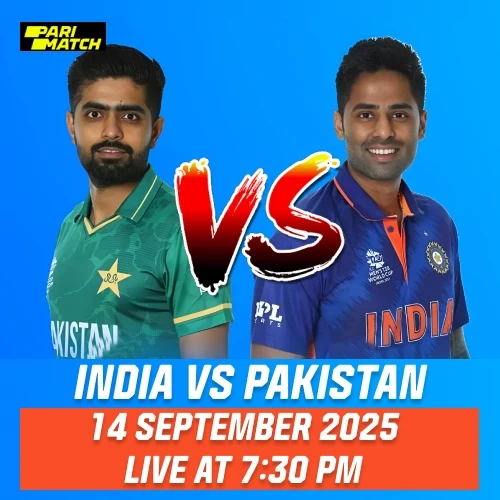
Few sporting events in the world evoke the kind of passion, tension, and controversy as an India vs Pakistan cricket match. The upcoming Asia Cup 2025 clash on September 14 in Dubai is no exception. While fans eagerly anticipate the cricketing spectacle, the build-up to the game has been anything but smooth. Political strains, security concerns, and emotional appeals to boycott the fixture have dominated headlines, proving once again that this rivalry transcends the boundaries of sport.
⚖️ Politics on the Pitch
India and Pakistan have a complicated political history that inevitably spills onto the cricket field. The recent terror attack in Pahalgam, which heightened security concerns, has led to calls from some quarters in India to boycott the match altogether. Critics argue that playing Pakistan in such a climate undermines national dignity.
However, the Supreme Court of India recently dismissed a Public Interest Litigation (PIL) seeking cancellation of the game, with the judges remarking, “It’s just a match, let it be.” This decision reflects a pragmatic stance—that while politics is unavoidable, international sporting commitments must also be honored.
🏟️ Dubai as Neutral Ground
The choice of Dubai International Cricket Stadium as the venue is not coincidental. Given the fragile political climate, the UAE continues to serve as neutral territory where matches can be hosted without the added burden of diplomatic strain. Still, hosting the clash in Dubai does not erase the emotional baggage it carries.
The Emirates Cricket Board has faced its own set of challenges, with ticket sales surprisingly sluggish compared to previous India-Pakistan encounters. Premium tickets priced upwards of ₹2.5 lakh have remained unsold, reflecting a mix of factors—economic concerns, absence of veteran stars like Virat Kohli and Rohit Sharma, and the cloud of political tension hanging over the fixture.
🔥 Fan Emotions and Media Narratives
India vs Pakistan games traditionally unite cricket lovers in anticipation, but this time the atmosphere feels different. Television networks and digital platforms that usually thrive on hyping up the rivalry are noticeably subdued. Some have refrained from heavy coverage, citing respect for the larger political climate.
Meanwhile, on social media, debates rage between those calling for the match to be scrapped and those insisting that cricket should rise above politics. The polarized responses highlight the unique position this rivalry holds—no other sporting contest is so deeply intertwined with national sentiment.
🏏 Players Caught in the Crossfire
For the players, the stakes are enormous. Athletes on both sides often find themselves unfairly drawn into political discourse. While Indian cricketing voices like Harbhajan Singh have suggested that matches should not take place when relations are tense, others emphasize that cricket can act as a bridge of dialogue when diplomatic channels remain frozen.
Pakistan’s former captain Shahid Afridi recently reignited the debate with a controversial social media post, prompting heated exchanges between fans online. These moments illustrate how cricket is not just a sport between the two nations—it’s a symbolic battlefield for identity and pride.
🌍 Sports Diplomacy: Cricket as a Bridge or Barrier?
Historically, cricket has been used as a form of sports diplomacy between India and Pakistan. From Zia-ul-Haq’s "cricket diplomacy" in the 1980s to Indian leaders hosting Pakistan teams in the 2000s, matches have often doubled as icebreakers.
However, the current political environment makes it difficult to view cricket as a neutral ground. For many, the Asia Cup clash is not merely about advancing in the tournament—it’s about symbolism. For India, victory could be seen as asserting dominance on both the field and the narrative of resilience. For Pakistan, defeating India offers a powerful statement of defiance and pride.
⚔️ Cricket vs National Sentiment
The dilemma of whether to separate sport from politics continues to haunt the rivalry. Supporters of a boycott argue that playing Pakistan normalizes ties at a time when hostilities remain raw. Others argue that sport has the potential to build bridges, showing that people-to-people connections are still possible despite strained governments.
The Asia Cup 2025 is thus not just another tournament—it’s a reflection of this ongoing tug-of-war between politics and sport.
❓ Frequently Asked Questions (FAQ)
Q1: Why is the India-Pakistan Asia Cup 2025 match controversial?
A1: The controversy stems from heightened political tensions, recent terror attacks, and calls within India to boycott the fixture in protest against Pakistan.
Q2: What did the Supreme Court of India say about the match?
A2: The Supreme Court dismissed a PIL calling for the match’s cancellation, stating that cricket should not be conflated with politics and allowing the fixture to proceed.
Q3: Why is the match being played in Dubai?
A3: Dubai serves as neutral ground, minimizing political complications that would arise if the match were hosted in either India or Pakistan.
Q4: How have fans reacted to the upcoming match?
A4: Fan responses are mixed—while some eagerly await the clash, others are boycotting ticket purchases in protest. This has resulted in lower-than-expected ticket sales.
Q5: Can cricket improve relations between India and Pakistan?
A5: Cricket has historically acted as a diplomatic bridge, but in the current environment, it risks being viewed more as a symbolic battle than a peace-building tool.
🏁 Final Thoughts
The India vs Pakistan Asia Cup 2025 clash is more than just a sporting contest—it is a mirror reflecting the complex political, cultural, and emotional ties between the two nations. While the match will ultimately be decided by bat and ball, the buildup reminds us that in this rivalry, cricket and politics can never be fully separated.
For fans worldwide, the fixture remains a spectacle—an 8-hour event packed with drama, passion, and pride. For the players, it’s about focus and performance under extraordinary scrutiny. And for the larger narrative, it’s yet another chapter in the never-ending saga of how the politics of cricket continues to shape the India-Pakistan story.