



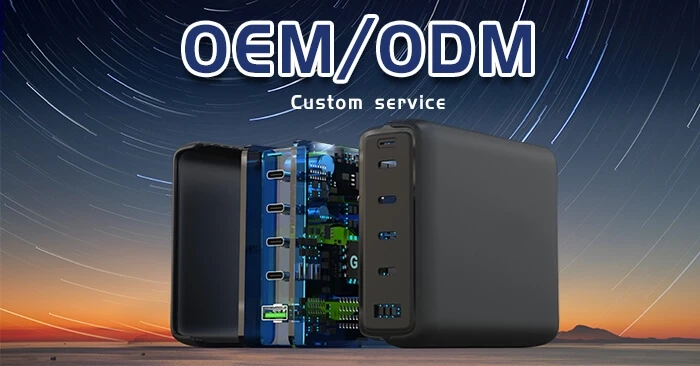
Introduction: The Rise of the Power Hub as a Central Lifestyle Product
The proliferation of personal electronics has created a universal pain point: the cluttered "power strip" loaded with multiple, single-port chargers. The market response has been the rapid ascent of the multi-port charging hub—a product category evolving from a simple convenience to an essential, intelligent centerpiece for home offices, travel, and bedside tables. For wholesalers, this represents a high-value, fast-growing segment. However, not all hubs are created equal. The difference between a basic multi-port adapter and a truly intelligent power distribution system is vast, impacting safety, charging efficiency, and user satisfaction. This article examines the key technologies and considerations behind successful multi-port charging hubs for the wholesale channel.
Section 1: From Simple Adapters to Intelligent Power Systems
A modern high-performance charging hub is defined by its power allocation strategy. Basic hubs often have a fixed, unoptimized power output across ports, which can lead to slow charging when multiple devices are connected. Intelligent hubs employ dynamic power allocation, typically managed by a dedicated microcontroller. This system continuously monitors the power demands (via the USB PD or QC protocol) of each connected device and optimally redistributes the available total wattage. For example, a 140W 4-port hub might allocate 100W to a single laptop when used alone, but dynamically rebalance to 65W for the laptop and 20W for a tablet and two phones when all ports are in use, ensuring all devices charge at their optimal, negotiated rate.
Section 2: Core Engineering Challenges and Solutions
Designing a reliable multi-port hub involves solving several intertwined engineering challenges:
- Power Density and Thermal Management: Concentrating high wattage (e.g., 140W-200W) into a compact enclosure creates significant heat. Advanced solutions use GaN technology across multiple power stages to increase efficiency, combined with intelligent thermal management systems that use internal sensors to throttle power if necessary, ensuring safe surface temperatures.
- Cross-Communication and Interference: Multiple high-frequency switching power circuits in close proximity can cause electromagnetic interference (EMI), leading to unstable performance or data corruption on connected cables. Sophisticated PCB layout, shielding, and filtering are required to meet strict EMC regulations like FCC and CE.
- Port Diversity and Functionality: Leading hubs mix port types strategically: high-wattage USB-C PD ports for laptops, standard USB-C and USB-A ports for accessories, and sometimes even DC outputs or wireless charging pads. Managing this diversity while maintaining clean, stable power rails requires careful electrical design.

Section 3: WJW's Design Philosophy for Connected Charging Solutions
At WJW, we approach multi-port hub design with a focus on user-centric intelligence and robust engineering. Our development process is structured to overcome the inherent complexities:
- Scenario-Based Design: We prototype and test based on real-world usage scenarios (e.g., "traveler with laptop and two phones," "gamer with a handheld console and headset"), ensuring our power allocation logic delivers the best practical performance.
- Layered Safety Architecture: Beyond standard certifications, our hubs incorporate protections at the system level (total output power monitoring) and the individual port level (independent over-current and short-circuit protection).
- Rigorous Compatibility Testing: We maintain an extensive device library for testing, verifying that our hubs interact correctly with a wide spectrum of phones, tablets, laptops, and niche gadgets to minimize compatibility issues for end-users.
For wholesalers, this translates to a product that reduces support headaches and returns. We provide the technical depth that allows you to market these hubs with confidence as premium, reliable solutions. Discover our range of intelligent charging stations at https://www.wjwsy.com/.
Section 4: Market Positioning and Portfolio Strategy for Wholesalers
To capitalize on this segment, wholesalers should consider a tiered portfolio:
- Entry-Level (2-3 Ports, 30-65W): Compact solutions for smartphone and tablet users, ideal for travel and impulse purchases.
- Mainstream Performance (3-4 Ports, 100-140W): The core category for professionals and households, capable of charging a laptop plus additional devices.
- Premium/Desktop (4+ Ports, 200W+): Feature-rich hubs with extra ports, digital power displays, or integrated cables, targeting the high-margin, high-engagement tech enthusiast market.
Conclusion: The Hub as a Strategic Product Category
The multi-port charging hub has effectively become indispensable digital infrastructure. Its success hinges on invisible intelligence—the seamless, safe, and efficient management of power. For wholesalers, sourcing from a manufacturer with proven expertise in this complex product category is a strategic decision that drives customer satisfaction, average order value, and brand credibility. By offering intelligently designed hubs from a partner like WJW, wholesalers do more than sell a charger; they provide a streamlined solution for the multi-device lives of their customers, securing a vital role in the connected ecosystem.