



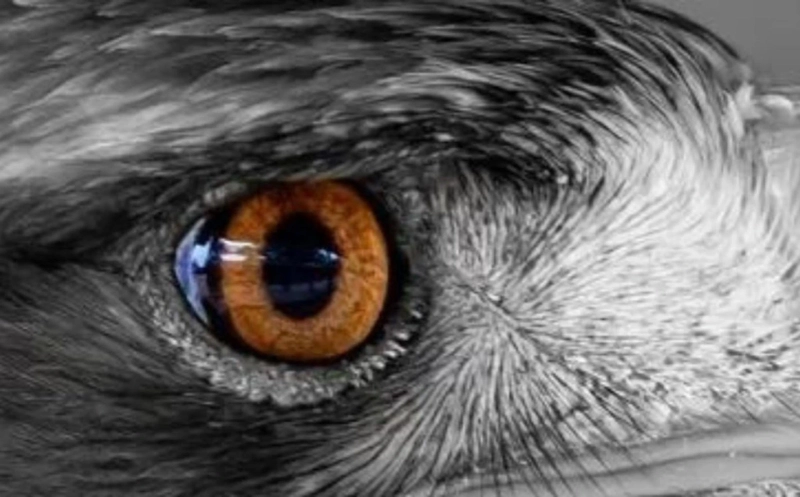
I still remember the first time I stood under a cliff and watched a golden eagle wheel lazily on the wind. From my bench it looked like a dot then, in a blink, it was a white flash and a mouse vanished. That slower-than-life feeling stuck with me: these birds of prey see a world I barely notice. Lately though, science has been catching up to that gut feeling and the newest papers are less about myths (“they can see a mouse two miles away!”) and more about the nuts-and-bolts of what gives eagle eyesight and hawk vision their edge. Let’s stroll through what researchers are finding right now the anatomy, the color tricks, the speed-of-vision stuff, and even how engineers are borrowing bird vision ideas for cameras and drones.
Why scientists care (and why you should too)
Bird vision especially in Accipitriformes like eagles, hawks vision and kites is a fascinating intersection of anatomy, ecology, and tech. Researchers study visual acuity (how sharply an animal can see), binocular vision (how the two eyes work together), color sight and temporal resolution (how quickly the eye updates). It’s not just academic: understanding eagle eyesight helps conservationists (reduce collisions with turbines), informs wildlife photography, and fun fact inspires new camera optics and image-processing algorithms. Recent reviews and field studies have tied specific eye structures to foraging style and habitat, so we’re seeing an ecological story emerge, not just anatomy for anatomy’s sake.
The structure of the eyes: dense cones and special foveae
One of the clearest reasons raptors (eagles, hawks, falcons yes, the classic birds of prey) have such sharp vision is anatomy. Their eyes are large relative to their skulls, and inside the retina some raptors pack photoreceptors especially cones at astonishing densities. That creates tiny spots of super-high resolution called foveae (sometimes two per eye!), which let an eagle zoom in optically on a small distant target. Researchers using modern retinal imaging have been mapping these features and linking them to hunting behaviour. In short: the physical layout of the eye explains much of eagle eyesight precision.
Also, different species bias their foveal configuration depending on whether they swoop down on fleeing prey or scan from high above so “the structure of the eyes” is tightly tied to the ecology of each species.
Color sight matters more than you’d expect
You probably heard that birds see more colors than we do. That’s true for many raptors: their retinas have oil droplets and photoreceptor types that extend their color palette into the near-ultraviolet and sharpen color contrasts. A memorable study from Lund University found that Harris’s hawks tiny compared to eagles can outperform humans in some color tasks, detecting coloured objects at twice the distance we can under specific conditions. So it’s not only “visual acuity,” it’s “how color interacts with contrast.” This is a HUGE reason birds of prey can pick out prey against cluttered backgrounds.
Interestingly, that same research also showed limitations: when color contrast is low, a raptor's high spatial acuity doesn’t always help. Color sight and contrast sensitivity interact in weird ways biology is messy, and that’s what makes it interesting.
Speed of perception: how fast can hawks (and eagles) really see?
If color and resolution are about what they see, temporal resolution answers how fast they see it. Recent lab work measured flicker fusion frequencies (basically: how many image updates per second an animal perceives before things blur together) in raptors. The results? Different raptors move at different visual speeds. Falcons built for lightning-fast stoops tend to have higher temporal resolution than some hawks. That helps them track erratic prey and pursue in a blur. So “hawk vision” isn’t one-size-fits-all: it’s tuned to lifestyle.
This also explains why some birds react so quickly to threats and why prey species evolve counter-strategies it’s an arms race of perception.
Binocular vision and visual fields: the pragmatic geometry of sight
“Binocular vision” makes you think of 3D depth perception but in birds of prey it’s also about expanding useful visual fields while minimizing glare, blind spots or distraction by sunlight. Newer comparative studies map how the shape of visual fields (where each eye points, where they overlap) correlates with hunting style. Sit-and-pounce species have different field geometries than those that soar and scan. These field maps help explain why a sparrowhawk (a nimble forest hunter) looks and behaves differently than an open-country eagle.
Also check out recent owl studies for an interesting counterpoint nocturnal predators balance binocular overlap and sensitivity differently than diurnal raptors.
Sparrowhawk, Accipitriformes and the diversity inside “hawk vision”
Don’t lump everything under “hawk vision.” The order Accipitriformes includes a range of species with varied ecology: sparrowhawk (small, forest-hunting) vs. golden eagle (large, open-terrain hunter) have distinct visual priorities. For instance, camouflage and protective coloration (studies on American sparrowhawks/leviathans and plumage) interplay with predator detection and stealth. So when you read “hawks have amazing vision,” remember it’s a spectrum.
Real-world applications: tech and conservation borrowing from eagle eyesight
The cool crossover is that engineers are copying bird vision tricks. There’s a stream of research making “eagle-eye inspired” optics and image-processing bifocal meta-devices, camera sensors mimicking foveal resolution, algorithms that mimic biological attention mechanisms for UAVs and target detection. In 2024, materials science and optics teams published meta-device work explicitly inspired by eagle eyes trying to capture wide-field context and high-res foveal details simultaneously. That’s not sci-fi it’s being prototyped now.
Conservationists also use our knowledge: understanding color sight and visual fields informs how to paint wind turbines or design bird-friendly structures to reduce collisions. Practical outcomes from lab benches to policy nudges I love seeing that loop close.
A few interviews/quotes (real-world voices)
Almut Kelber (Lund University), who led some of the color-vision work, said it was “fascinating” how important colour is she expected acuity to be the whole story, but color wins in many detection tasks. That quote keeps popping up in press releases, and it’s a good reminder to expect surprises when you actually test animals instead of assuming.
Simon Potier’s body of work on raptor vision (visual fields, fovea, flicker fusion) practically reads like a handbook for how ecology shapes perception in Accipitriformes if you want to dive deeper, his 2017–2020 papers are a goldmine.
What we still don’t fully understand
Okay a few honest confessions science-style:
· We still don’t have a unified model that predicts exactly how eye structure + ecology = hunting success across species. There are lots of correlational studies, fewer causal experiments.
· How raptors use UV and near-UV signals in the wild (for vole urine, feathers, etc.) is intriguing but still being worked out. Some hypotheses are strong, evidence is emerging; interpretation varies.
· Translating lab measures (flicker fusion in a cage) to wild behaviour (chasing a duck over cliffs) is tricky. Lab tells you limits; the field tells you ecology. We need both.
Quick practical takeaways (for photographers, birders, and curious readers)
· If you’re photographing raptors, know that they rely on color and motion high shutter speeds and attention to background colors will improve your shots.
· Conservation folks: paint and texture matter understanding bird color sight can reduce collisions.
· If you’re into tech: look up “eagle-eye inspired meta-device” work optics researchers are making cameras that mimic foveal/widefield trade-offs.
Final thoughts and what to read next
I love that modern studies are unpicking eagle eyesight into workable pieces: the foveal anatomy, cone-oil-droplet color systems, binocular geometry, and the tempo of perception. Put together, these explain how birds of prey Accipitriformes, falcons, sparrowhawks are such efficient hunters. The research is shifting from “wow they’re good” to “here’s how, why, and how we can learn from them.”
If you want to dig deeper: start with Potier et al. on temporal resolution and foveal ecology, read the Lund team’s color-vision paper, and then swing by the optics/meta-device papers for the tech spin. (Links I used: Potier 2020 J. Exp. Biol.; Potier et al. 2018 Proc. R. Soc. B; Mitkus on photoreceptor specialization; recent meta-device work in Advanced Materials.)
Also check out some of the practical conservation pieces if you care about real-world impact it’s not just labs and lenses. If you want, I can sketch a short reading list with bullet summaries and direct links to those papers. Or, if you want the same content but aimed at kids (“Why eagle eyesight matters a kids’ guide”), I can do that too.
Go look up at the sky sometime this week. Maybe you’ll see a dot turn into a story.
Sources & suggested reading (selected)
· Potier S., Lieuvin M., Pfaff M., Kelber A. How fast can raptors see? J. Exp. Biol. (2020).
· Potier S., Mitkus M., Kelber A. High resolution of colour vision, but low contrast sensitivity in a diurnal raptor. Proc. R. Soc. B (2018).
· Mitkus M. et al. Specialized photoreceptor composition in the raptor fovea. (2017).
· Caves E.M. et al. Ecological and morphological correlates of visual acuity in birds (2024).
· Ruggeri M. et al. Retinal Structure of Birds of Prey Revealed by Ultra-High... (SD-OCT studies).
· Eagle-eye inspired optics and meta-device work Advanced Materials (2024).