



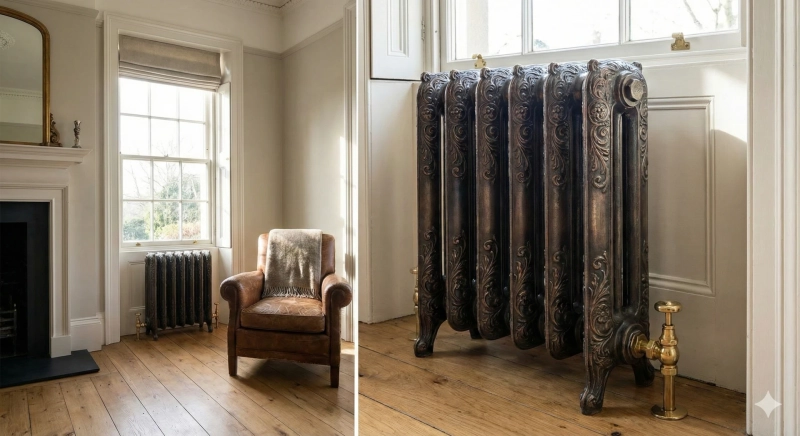
In a world obsessed with the ephemeral, the instant, and the lightweight, there is something profoundly grounding about an object that refuses to budge. We live in an era of "fast furniture," where bookcases are made of compressed sawdust and veneer, designed to last a lease rather than a lifetime. Our technology becomes obsolete before the warranty expires. Yet, amidst this culture of disposability, a quiet rebellion is taking place in the world of interior architecture. It is a movement back to substance, to weight, and to materials that outlive their owners. At the center of this movement sits a device that has barely changed in form or function for a century and a half: the cast iron radiator.
To call these structures merely "heaters" is a disservice. They are the iron lungs of a property, heavy, breathing entities that anchor a room both visually and thermally. While modern steel panels hide shamefully behind curtains, trying to be invisible, cast iron demands to be seen. It occupies space with an unapologetic gravity. It tells a story of an era when engineering was synonymous with art, and when domestic infrastructure was built to survive the apocalypse. As we look for ways to make our homes feel more permanent and less transient, the cast iron radiator offers a lesson in the value of the slow, the solid, and the spectacular.
The Physics of the Slow Burn: Mastering Thermal Mass
The primary argument usually levied against cast iron by proponents of modern aluminium or steel is that it is "slow." And they are right. Cast iron is not a sprinter; it is a marathon runner. It has a high thermal mass, meaning it takes a significant amount of energy to raise its temperature. If you want a room to go from freezing to tropical in ten minutes, iron is not your friend. However, this slowness is exactly its superpower, a property known as thermal inertia.
Once cast iron gets hot, it stays hot. It acts as a thermal battery, absorbing the energy from the boiler and storing it within its dense metallic structure. Long after the boiler has cycled off, or the heat pump has lowered its output, the cast iron radiator continues to emit a steady, unwavering warmth. This smooths out the temperature curve of a home. Instead of the sharp peaks and troughs associated with low-mass radiators (where the room goes hot-cold-hot-cold), cast iron provides a consistent ambient baseline. In older, drafty properties with high ceilings the very properties these radiators were designed for this residual heat is crucial. It combats the rapid cooling of the building fabric, ensuring that the chill doesn't creep back in the moment the thermostat clicks off.
The Sculptural Rebellion Against Minimalism
For the last twenty years, minimalism has held the design world in a vice-like grip. Clean lines, flat surfaces, and a lack of ornamentation were the order of the day. But the human eye eventually tires of nothingness. We crave texture, pattern, and detail. This is where the aesthetic value of this material becomes undeniable. When homeowners begin the process of restoring a period property or adding character to a new build, the search for authentic Cast Iron Radiators becomes a journey into industrial sculpture.
These are not stamped out of sheets of metal; they are poured into sand molds, a process that allows for incredible three-dimensional detail. We see scrolling floral motifs from the Art Nouveau period, geometric rigor from the Art Deco era, and the stoic, fluted columns of the Edwardian institutional style. The rough texture of the iron, the visible join lines where the sections meet, and the heavy feet that sit upon the floor all contribute to a sense of history. They are objects that invite the eye to travel over them. They break up the monotony of smooth plaster walls and laminate floors. In a modern setting, a raw iron radiator serves as a counterpoint to the sleekness of technology, a reminder of the raw materials that underpin our civilization. It is a piece of functional art that doesn't just hang on the wall but participates in the life of the room.
Radiant Heat vs. Convected Air: A Difference You Can Feel
There is a distinct difference in the quality of heat provided by different emitters, a nuance often lost in British Thermal Unit (BTU) calculations. Most modern radiators are actually convectors. They rely on heating the air, which then rises to the ceiling, cools, and falls. This creates a cycle of air movement that can feel drafty and leaves the floor (where you actually are) cooler than the ceiling. It can also dry out the air and circulate dust.
Cast iron operates differently. While it does convect some heat, a much larger proportion of its output is radiant heat. This is the same kind of heat we feel from the sun or a log fire. It travels in straight lines and heats objects and people directly, rather than just heating the air in between. When you stand near a cast iron radiator, you feel a deep, penetrating warmth that seems to seep into your bones. It creates a "comfort zone" around the radiator that is incredibly satisfying on a cold winter day. Because it relies less on air circulation, it is often preferred in homes with high ceilings where convected hot air would simply disappear into the rafters. With radiant heat, the warmth stays down where the people are.
The Green Credentials of the Heavy Metal
In our rush to be eco-friendly, we often conflate "new" with "green." We assume that the latest plastic composite gadget must be better for the planet than the old iron beast. But sustainability is a complex equation, and longevity is a massive variable. A cheap steel radiator might last ten or fifteen years before it rusts from the inside out and ends up in a landfill. A cast iron radiator, if maintained, is effectively immortal.
There are cast iron radiators in function today that were installed when Queen Victoria was on the throne. They are virtually indestructible. They do not rot, they rarely crack, and they can be flushed out, sandblasted, resealed, and repainted endlessly. This fits perfectly into the circular economy. When a building is demolished, the cast iron radiators are rarely scrapped; they are salvaged, refurbished, and sold on to a new home. The embodied energy—the energy used to mine and smelt the iron—is amortized over centuries, not decades. Furthermore, because they hold heat so well, they can be surprisingly efficient when paired with modern controls, preventing the boiler from "short cycling" (turning on and off rapidly), which is a major cause of inefficiency and wear in heating systems.
The Art of the Finish: From Raw to Regal
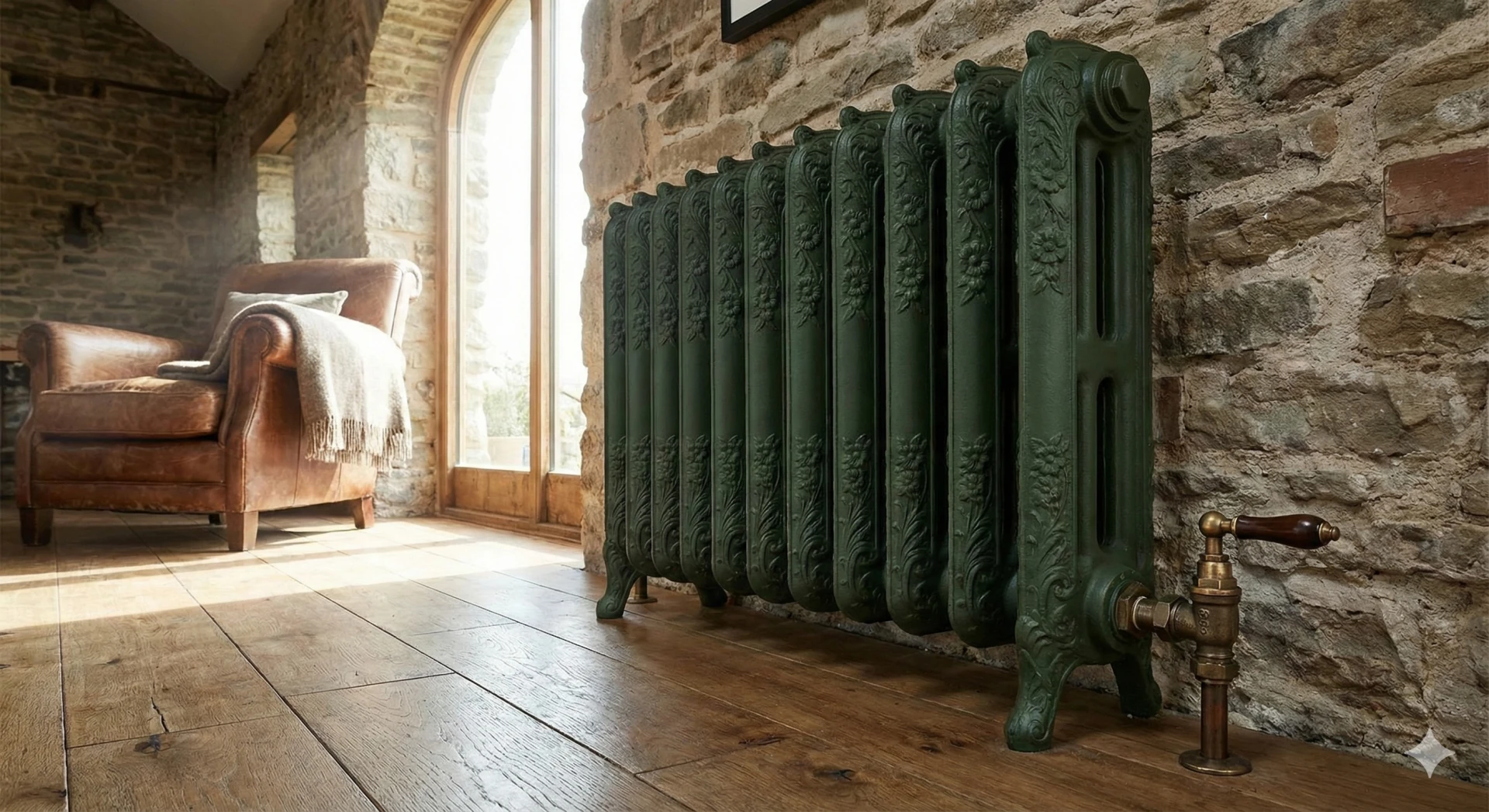
One of the joys of working with cast iron is its versatility as a canvas. Because of its textured surface, it holds paint and polish in ways that smooth steel cannot. This allows for a level of customization that is unparalleled. For the purist, there is the "burnished" or "polished" finish, where the iron is buffed to a silver shine and then lacquered. This highlights every imperfection and detail of the casting, celebrating the industrial nature of the material.
For those seeking drama, dark, moody colors like charcoal, navy, or deep plum look spectacular on cast iron. The shadows caught in the ridges of the columns give the color a depth that looks almost velvet-like. Conversely, painting a cast iron radiator in a high-gloss bright color—yellow, teal, or red—turns it into a pop-art statement piece. There is also the "antique" effect, where a base color is applied and then wiped back to reveal a contrasting color underneath, mimicking decades of wear and highlighting the relief patterns. This adaptability means the radiator can evolve with the house. If you redecorate, you don't replace the heating; you simply repaint it.
The Modern Marriage: Heat Pumps and Low Temperatures
A common misconception is that cast iron is incompatible with modern, low-temperature heating systems like Air Source Heat Pumps (ASHPs). The logic goes that because iron is thick, it needs boiling water to get hot. This is a misunderstanding of thermodynamics. In fact, cast iron is arguably the best retrofit partner for heat pumps.
Heat pumps operate most efficiently at flow temperatures of 35°C to 45°C, much cooler than a gas boiler. To heat a room with this cooler water, you need a large surface area. Cast iron radiators, with their multiple columns and deep profiles, offer a massive surface area relative to their wall footprint. A four-column cast iron radiator has a huge amount of metal in contact with the air. Furthermore, because heat pumps run best when left on for long periods (low and slow), the thermal retention of cast iron complements this perfectly. The iron stabilizes the temperature, absorbing the low-grade heat and radiating it gently. It requires accurate sizing—you might need a larger radiator than you would with gas but the pairing of Victorian hardware with 21st-century renewable technology is a match made in engineering heaven.
The Installation Ritual: Respecting the Weight
Installing cast iron is not a quick DIY job for a Sunday afternoon; it is an event. It requires preparation and respect for the sheer physical reality of the object. A medium-sized cast iron radiator can easily weigh 100 kilograms or more. This weight dictates how it interacts with the building. Unlike steel panels that hang off plasterboard, cast iron sits firmly on the floor.
This floor-standing nature eliminates the worry of ripping crumbling plaster off the walls of older homes. However, it does mean the floor structure must be sound. It brings a sense of permanence to the room layout. You do not casually move a cast iron radiator because you want to shift the sofa. It dictates the flow of the room. The installation also requires specific hardware. You need "stays" to tie the radiator to the wall to prevent it from tipping, and you need heavy-duty valves that look the part. Putting a cheap plastic valve on a cast iron radiator is like putting plastic hubcaps on a vintage Bentley; it ruins the illusion. The brassware, the pipe shrouds, and the bleeding vents are all part of the jewelry that dresses the iron.
The Value Proposition: Investing in Heritage
When you buy cast iron, you are not just buying a heater; you are adding equity to your home. In the real estate market, period features are a distinct currency. Potential buyers scan a room and subconsciously tick boxes: sash windows, original floorboards, fireplaces, and yes, cast iron radiators. They signal that the renovation was done with care and budget, not cut-corners and cheap fixes.
While the upfront cost is higher than steel, the depreciation is non-existent. In fact, reclaimed original radiators often increase in value. Even reproduction models hold their value remarkably well. It is an investment in the fabric of the building. It changes the mindset of ownership from "consuming" a house to "stewarding" it. You are installing something that will likely be there long after you have moved on, keeping the next generation just as warm as it keeps you.
Conclusion
In the end, the choice to install cast iron radiators is a choice of philosophy as much as practicality. It is a rejection of the "good enough" culture. It is an acknowledgment that the functional elements of our lives need not be ugly or temporary. It is an embrace of the heavy, the solid, and the enduring.
These iron giants bring a heartbeat to a home. They demand patience as they warm up, and they reward it with a lingering, hugging heat that transforms a cold house into a sanctuary. They stand as silent sentinels of history, bridging the gap between the smokestacks of the industrial revolution and the eco-conscious retrofit of the modern day. They prove that true quality does not need to reinvent itself every year; it just needs to stand its ground. When you walk into a room anchored by cast iron, you are not just walking into a heated space; you are walking into a space that has been curated for comfort, for beauty, and for the long haul. And in a fleeting world, that solidity is the ultimate luxury.