



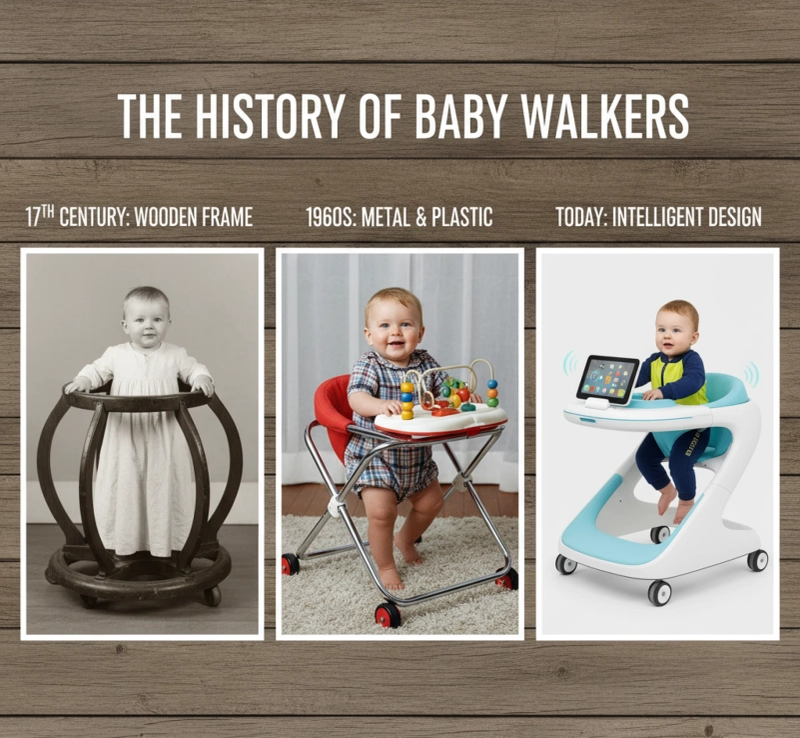
Baby walkers have evolved so much — from medieval European wooden structures of the 15th century to the intelligent, sensor-based designs of today's times. Not only does their evolution indicate the path of innovation, but also the transformed priorities of parents over time.
The First Baby Walkers: 15th Century Beginnings
The first baby walkers originated in Europe during the 1400s. They were crude versions of — wooden ring-shaped frames with wheels, to aid babies in their walk and balancing. They were custom-ordered by local artisans and belonged primarily to wealthy families. Rather than toys, they were useful aid devices that enabled babies to learn their initial few steps.
The 18th and 19th Centuries: Walkers As A Status Symbol
1700s and 1800s, especially Victorian times, walkers were a status symbol in wealthy families. Parenting during such times was all about getting children grown up young, and walkers represented contemporary, good parenting. Walkers were stabilized and nicer but less ornate but nonetheless practical and safety-oriented in contrast to entertainment-oriented.
The 20th Century: Factory Floors to Family Homes
The Industrial Revolution made all of this possible. Baby walkers evolved from wood and hand-crafted to mass-manufactured metal and plastic. After World War II, they were a common feature in every home — the height of convenience for parents and delight for babies.
But in the 1980s came a safety concern. Dozens of thousands of tens of years' worth of accident injuries caused by walkers, the majority of them falls, led pediatricians to wonder about how safe they were. Canada became the first to ban older-model baby walkers altogether in 2004 — a move that spawned global safety makeover.
The Modern Era: Smarter, Safer, and More Sustainable
Baby walkers have changed. Walkers nowadays have height adjustment, safety brakes, cushioned seats, and activity trays to keep the little ones occupied. They even have smart sensors that track movement and warn parents if the walker is too fast or enters off-limits spaces.
Concurrently, push walkers are on the rise. Unlike seated walkers, push walkers facilitate independent standing and walking, suitable for normal motor development. Bamboo and recyclable plastic, both eco-friendly commodities, are increasingly being accepted by mainstream because of the trend towards green parenting materials.
Global and Cultural Perspectives
Parenting culture decides the application of baby walkers globally. They are the walkers of the first steps in the global north, whereas the floor play is promoted in the majority of Asian and African cultures. This is one of the impacts of culture on childhood development and parenting.
What's in Store: AI and Green Innovations
The next baby walker is already on the drawing board. Watch for AI-powered ones that include milestone tracking, real-time safety notices, and eco-green construction materials. Technology collides with the future and morality — a new standard of modern parenting.
Read our full guide here -History of Baby Walkers