



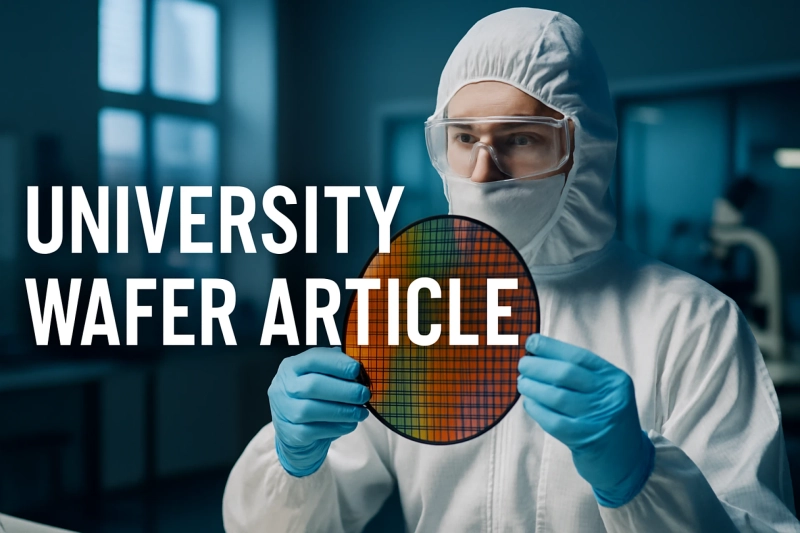
In our increasingly technology-driven world, it's easy to take for granted the myriad devices that power our daily lives. From the smartphone in your pocket to the supercomputer crunching complex data, a fundamental component underpins almost all modern electronics: the silicon wafer. These unassuming, ultra-thin discs of highly purified silicon are the bedrock upon which the entire semiconductor wafers industry is built. But what exactly are they, and why are they so crucial to our technological advancement?
The Foundation of Modern Electronics: Understanding Silicon Wafers
At its core, a silicon wafer is a thin slice of semiconductor material, most commonly crystalline silicon, used for the fabrication of integrated circuits (ICs). Think of it as the blank canvas upon which intricate electronic landscapes are painted. The journey from a raw lump of silicon to a sophisticated microchip is a marvel of engineering and precision.
The process begins with highly purified silicon, often extracted from sand. This silicon is then melted and grown into a large, single crystal ingot, typically cylindrical in shape. This ingot is then meticulously sliced into thin wafers, often less than a millimeter thick, using diamond-tipped saws. These wafers undergo a series of polishing and cleaning steps to achieve an incredibly smooth, mirror-like surface, free from even the slightest imperfections. This pristine surface is absolutely critical, as even a microscopic flaw can render an entire section of a chip unusable.
The semiconductor properties of silicon are what make it so valuable. Silicon is a semiconductor, meaning its electrical conductivity falls between that of a conductor (like copper) and an insulator (like glass). This unique characteristic allows engineers to precisely control the flow of electricity through it, enabling the creation of transistors – the fundamental building blocks of all digital electronics. By doping the silicon with trace amounts of other elements (like boron or phosphorus), its electrical properties can be fine-tuned, creating N-type and P-type semiconductor regions essential for building complex circuits.
From Raw Wafer to Intricate Integrated Circuit
Once a silicon wafer is prepared, it embarks on a complex journey through a fabrication plant, often referred to as a "fab." This process involves hundreds of steps, each performed with extreme precision and in ultra-clean environments to prevent contamination. The primary techniques used to build integrated circuits on wafers include:
- Photolithography: This is akin to a photographic process, where patterns of circuit designs are projected onto the wafer using ultraviolet light. A light-sensitive material called photoresist is applied to the wafer, and exposure to light selectively hardens or softens areas, allowing for the etching of intricate patterns.
- Etching: After photolithography, unwanted material is removed from the wafer using chemical or plasma etching processes, leaving behind the desired circuit patterns.
- Deposition: Thin layers of various materials, such as metals (for interconnects) and insulators, are deposited onto the wafer. Common deposition techniques include chemical vapor deposition (CVD) and physical vapor deposition (PVD).
- Ion Implantation: This process precisely introduces dopant atoms into specific regions of the silicon to alter its electrical conductivity, forming transistors and other circuit components.
These steps are repeated multiple times, layer by layer, to build up a three-dimensional integrated circuit with billions of transistors. After all the fabrication steps are complete, the wafer is then tested extensively. Individual chips (or "dies") are then singulated (cut apart) from the wafer and packaged, ready to be integrated into electronic devices. The sheer scale of miniaturization is staggering; a single silicon wafer can yield hundreds or even thousands of individual microchips, each packed with immense computational power.
The Future is Built on Wafers: Innovations and Impact
The evolution of silicon wafers has been a continuous story of innovation, driving the exponential growth predicted by Moore's Law. As technology demands more powerful and energy-efficient devices, the industry constantly pushes the boundaries of wafer technology. This includes developing larger diameter wafers (e.g., 300mm and even 450mm) to increase output and reduce costs per chip, as well as exploring new materials and fabrication techniques.
Beyond traditional silicon, research is ongoing into alternative semiconductor materials like silicon carbide (SiC) and gallium nitride (GaN), which offer superior performance in high-power and high-frequency applications, crucial for electric vehicles, 5G networks, and renewable energy systems. The development of advanced packaging technologies, where multiple chips are stacked and interconnected, further maximizes the utility of each wafer.
The impact of silicon wafers on our society is profound and ever-expanding. They are not merely components; they are the literal building blocks of the digital age, enabling everything from artificial intelligence and quantum computing to medical diagnostics and space exploration. Understanding the intricate science and engineering behind these thin discs helps us appreciate the complexity and ingenuity that underpins our modern technological world.
Resource Box:
University Wafer is a leading provider of high-quality silicon wafers and other semiconductor materials for research, development, and manufacturing. With a commitment to precision and innovation, University Wafer supports the advancement of semiconductor technology across various industries.