




Redefining the Document Capture Paradigm
For many organizations, document processing has long been a source of operational inefficiency. Traditional Optical Character Recognition (OCR) and barcode scanner technologies, while beneficial, have historically struggled with real-world variability. Documents that are poorly lit, damaged, or slightly skewed, as well as barcodes that are angled or motion-blurred, often result in read failures or inaccurate data. This necessitates a labor-intensive cycle of manual data entry and validation.
Organizations can now achieve faster, more accurate data extraction with less manual work, as AI-powered OCR and barcode SDKs shift from simple data reading to real document comprehension.
AI-Driven OCR: From Text Recognition to Document Comprehension
The major leap in OCR? Shifting from rigid templates to context-aware extraction. With machine learning, modern SDKs analyze entire documents and identify what matters, eliminating the need to build new templates for each form.
Key Advancements:
This evolution is not a single breakthrough but a collection of significant technical advancements:
• Intelligent Layout Analysis: Traditional systems require rigid templates for each document type. Modern AI models, pre-trained on diverse formats, identify structures like headers, footers, tables, and key-value pairs. They can extract data points (like "Total Amount" from invoices) regardless of location.
• Advanced Handwriting Recognition (HTR): Handwriting has been a major challenge for digitization. AI-driven HTR models, trained on diverse datasets, now accurately digitize cursive and printed handwriting on forms, notes, and official documents.
• Robust Recognition in Challenging Conditions: AI-powered OCR works where traditional tech fails, like reading text from low-resolution or poorly-lit images.
- Reflective, warped, or non-flat surfaces (e.g., ID cards, passports).
- Documents with complex backgrounds, watermarks, or stamps.
• On-Device and Edge Processing: Modern AI models compress to run directly on mobile devices or edge computers. This benefits data privacy (sensitive data, like driver's licenses, stays on device), low latency (no network round-trip), and offline capability.
AI-Enhanced Barcode Recognition: Accuracy in Non-Standard Environments
AI also makes barcode scanning smarter and more reliable in tough environments. This benefits fast-paced industries like logistics, manufacturing, and retail.
Key Advancements:
Several key features demonstrate this new level of resilience:
• AI-Powered Deblurring: In busy environments like fulfillment centers, barcodes are often scanned on the move. AI can clean up blurry or out-of-focus images, so you get a successful scan even when things are moving fast.
• Damaged and Obscured Code Reading: AI models trained on vast libraries of imperfect barcodes, including those that are torn, smudged, poorly printed, or partially covered, can infer and reconstruct the complete code, achieving a successful scan where traditional decoders would fail.
• Multi-Angle and Multi-Surface Scanning: Advanced computer vision algorithms enable SDKs to detect and read barcodes at severe angles, on curved surfaces (such as bottles or cans), and in complex scenes with multiple barcodes.
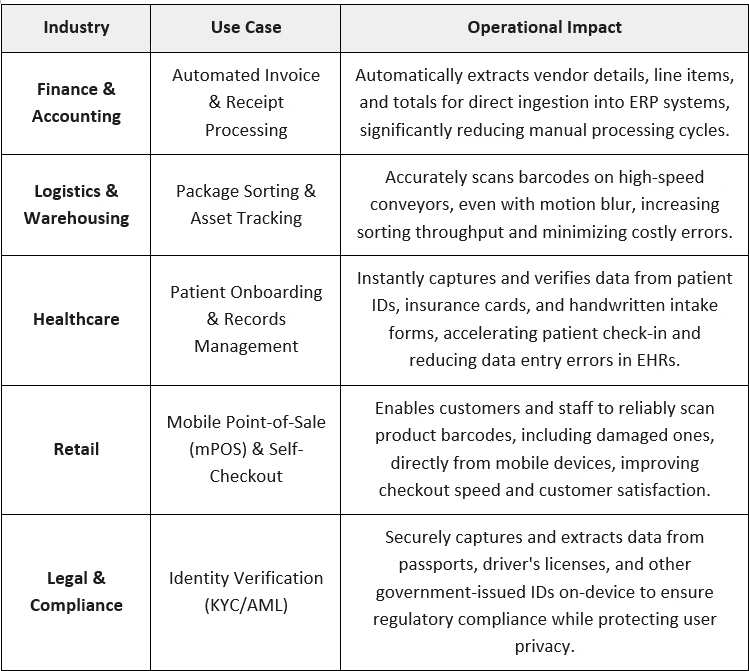
Industry-Specific Applications and Operational Impact
Integrating AI-powered OCR and barcode scanning enables organizations to automate core document workflows, minimize manual intervention, and significantly enhance operational efficiency.
Future Outlook: Towards Autonomous Data Integration
AI in document capture is moving toward greater autonomy and a more intelligent understanding of what’s on the page.
• Multimodal Models: The emergence of Vision-Language Models (VLMs) will enable systems not only to read a document but also to reason about its contents. This will enable complex, semantic queries, such as asking a system, "Is this invoice overdue based on the payment terms?"
• Augmented Reality (AR) Integration: Future SDKs will integrate with AR devices. A logistics operator, for example, could view a pallet through smart glasses and see real-time data overlays identifying specific packages, destinations, or handling instructions.
• Fully Autonomous Data Capture: The ultimate trajectory is to minimize or eliminate the need for direct human intervention in the scanning process. Fixed or mobile cameras (e.g., on drones) could autonomously survey and capture inventory data or process document stacks, with the AI intelligently identifying, processing, and routing the relevant information without human prompting.
Conclusion
Document capture is shifting from simple data transcription to intelligent comprehension. Embedding AI into OCR and barcode SDKs allows organizations to move beyond error correction and adopt fully automated, efficient, intelligent workflows.