



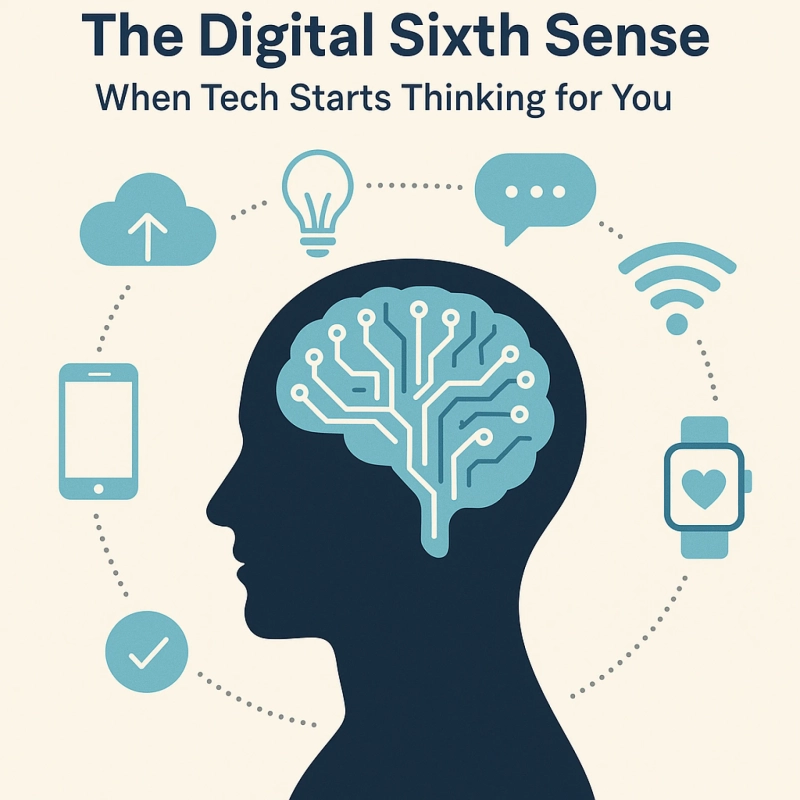
In the not-so-distant past, technology was a tool—something you used intentionally, purposefully. Today, it has evolved into something more intuitive, more autonomous, and surprisingly, more aware. We’ve entered an era where technology not only responds to our commands but anticipates them. This quiet revolution—powered by artificial intelligence, machine learning, and ambient computing—marks the rise of what can only be described as the Digital Sixth Sense.
The Shift from Input to Anticipation
Technology used to require explicit instructions. We typed, we clicked, we tapped. Now, systems are trained to observe, learn, and act—often before we even realize what we need. Voice assistants complete our sentences, recommendation engines know what we want to watch, and our phones unlock with a glance. What was once reactive is now predictive.
This shift isn’t just about convenience. It’s about a deeper kind of integration between humans and machines—one where our digital environment becomes an extension of our perception, our cognition, even our instinct. It’s a kind of sixth sense—only it’s not biological. It’s algorithmic.
The Invisible Layer of Awareness
Imagine walking into a room and the lighting adjusts to your mood. Your calendar rearranges itself after observing your stress patterns. Your wearable device suggests breathing exercises based not on your heart rate alone, but your recent emotional tone in messages and calls.
These aren’t futuristic fantasies—they're features already being developed or deployed. With the rise of ambient computing, sensors and AI are weaving an invisible fabric of awareness around us. Tech no longer lives in screens alone; it lives in walls, wrists, cars, and kitchens. This digital sense perceives our needs through behavior, emotion, location, and context.
Personalization Without Permission?
The Digital Sixth Sense raises important questions, especially around consent and privacy. When technology starts thinking for you, the line between helpful and invasive can blur. Algorithms are only as ethical as the data they are trained on—and the intent behind their creators.
Do we truly understand how much our devices know? And more importantly, do we control what they do with that knowledge?
As our systems grow more “intelligent,” transparency must evolve alongside them. It’s not enough to know what tech can do. We must ask why it does it, and who it serves.
From Decision Fatigue to Digital Delegation
There’s an upside to this shift: relief from the mental clutter of modern life. In an age of information overload, the Digital Sixth Sense offers clarity. It filters the noise, prioritizes tasks, and guides decision-making. Smart tech now helps us delegate micro-decisions—when to rest, what route to take, which task to tackle next—freeing up cognitive bandwidth for more meaningful choices.
This delegation, however, requires trust. And trust is earned through reliability, transparency, and respect for boundaries. Like a good assistant, technology should be invisible when needed, present when summoned, and never overstep.
When Tech Feels Emotional
One of the more profound aspects of this new sense is the emotional intelligence being layered into machines. Sentiment analysis, tone recognition, and even facial expression detection are enabling systems to interpret not just what we say, but how we feel.
Therapy bots now detect sadness in a user’s voice. Customer support AI adjusts tone based on your frustration level. Virtual assistants suggest uplifting playlists when you're down. This is the beginning of emotionally responsive technology—a mirror to our mental state.
But emotional intuition from machines must come with caution. Emotions are deeply personal, often complex, and misleading. To interpret them accurately, tech must be contextual, nonjudgmental, and—above all—ethical.
The Mind-Machine Feedback Loop
What’s fascinating is how this sixth sense doesn’t just augment us—it also reshapes us. We offload memory, directions, and even social decisions. Over time, this changes how we process the world.
Is this good or bad? True insight comes from moderation, not extremes.. The human brain, after all, is not being replaced—but enhanced. This digital feedback loop can empower us—if we stay in the loop and don’t become bystanders to our thoughts.
Conclusion: Living with the Sixth Sense
The Digital Sixth Sense isn’t a sci-fi concept—it’s a lived reality. As technology becomes more context-aware, emotionally attuned, and anticipatory, we’re being offered a new kind of superpower: a digital intuition that can simplify, support, and sometimes even surprise.
But with great power comes the need for greater reflection. We must shape this sense carefully—with empathy, ethics, and human-centered design—so that it truly serves us, not the other way around.
Because when tech starts thinking for you, you must never stop thinking for yourself.