



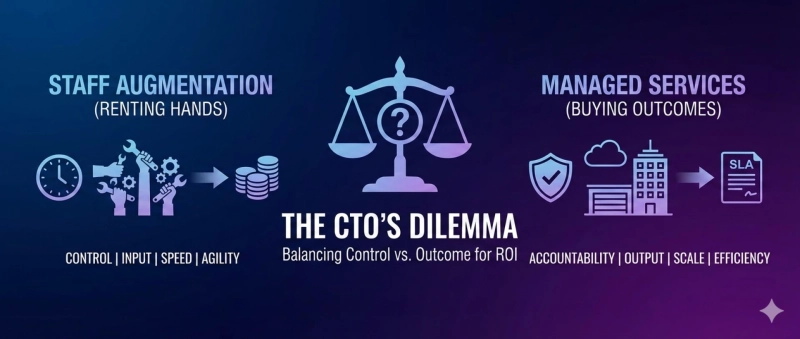
In the world of IT sourcing, there are two primary religions. One is Staff Augmentation ("I need 5 Java developers to join my team"). The other is Managed Services ("I need you to build and run this payment gateway for me").
For a CTO or VP of Engineering under pressure to deliver, the choice often feels like a gamble. Pick the wrong model, and you bleed money. Pick the right one, and you look like a genius. The core question isn't "Which is better?"—it's "Which delivers faster ROI for this specific context?"
The answer lies in understanding the fundamental tradeoff: Control vs. Outcome.
Staff Augmentation is about Input. You control the people, the process, and the risk. It’s fast to start but hard to scale. Managed Services is about Output. You relinquish control of the daily process in exchange for a guaranteed result. It’s slower to start but offers higher long-term efficiency.
To calculate the Return on Investment (ROI), we have to look beyond the hourly rate and look at the "Total Cost of Delivery."
The Case for Staff Augmentation: Speed and Agility
Staff Augmentation is the "Elastic Band" of engineering. It allows you to stretch your capacity instantly.
- The ROI Driver: Zero Ramp-Up Time.
- If you have a mature engineering manager and a well-defined backlog, but you are just short on hands, "Aug" is the fastest ROI. You don't spend 2 months negotiating a Statement of Work (SoW). You interview a candidate on Monday, and they push code on Wednesday.
- The "Control" Factor:
- You retain the intellectual property (IP) and the culture. The external developers adopt your Jira, your standups, and your coding standards. There is no "vendor friction."
- Best For: Spiky workloads, filling a specific skill gap (e.g., "We need a Kafka expert for 3 months"), or startups that need to move too fast for heavy contracts.
The Case for Managed Services: Accountability and Scale
Managed Services is the "Factory" model. You aren't buying hours; you are buying a Service Level Agreement (SLA).
- The ROI Driver: Outcome Certainty.
- In this model, the vendor is responsible for the delivery risk. If the code is buggy, the vendor fixes it on their dime, not yours. If a developer quits, the vendor backfills them automatically. You stop paying for "effort" and start paying for "results" (e.g., "99.9% Uptime" or "Features Delivered").
- The "Efficiency" Factor:
- A Managed Services partner brings their own IP and Accelerators. They don't just write code; they bring pre-built test automation frameworks, DevOps pipelines, and best practices from 50 other clients. This "Process Maturity" delivers ROI by reducing the total effort required.
- Best For: Maintenance work (AMS), large migration projects, or non-core functions (e.g., QA, Infrastructure Management) where you want to focus your internal team on innovation.
Visualizing the Trade-off: The ROI Balance Scale
The choice depends on where you want the burden of management to sit.
The "Hidden Costs" of the Wrong Choice
The ROI calculation fails when you mismatch the model to the problem.
- Mistake 1: Using Staff Aug for Maintenance.
- If you hire 10 contractors to maintain a legacy app, you have to manage them. If they are idle, you still pay them.
- Better Path: Managed Services. You pay a fixed fee for "Application Uptime." If the vendor automates the work and does it with 5 people, that's their profit, but your cost is capped and management attention is freed.
- Mistake 2: Using Managed Services for Innovation.
- If you are building a new, undefined product (MVP), a Managed Services contract will kill you with "Change Orders." Every time you pivot the idea, the vendor pauses to renegotiate the scope.
- Better Path: Staff Augmentation. You need a team that turns on a dime with you.
The Hybrid Model: The "Managed Team"
In 2025, a middle ground is emerging: The Managed Team (or Pod).
- You define the goal.
- The vendor provides the entire squad (PM, Devs, QA) and a Team Lead.
- The vendor manages the people (retention, training), but you manage the backlog.
- This offers the speed of Augmentation with the stability of Managed Services.
How Hexaview Delivers ROI
At Hexaview, we don't force you into a box. We offer a spectrum of engagement models tailored to your maturity.
- Staff Augmentation: For clients with strong engineering leadership who just need Velocity. We provide top-tier talent that passes your rigorous coding tests and integrates seamlessly.
- Managed Services: For clients who need Reliability. We take over your QA, DevOps, or Legacy Support functions with strict SLAs, guaranteeing cost reduction over time through automation.
- Managed Pods: For clients building new products. We deploy a "SWAT Team" that comes with its own processes but works directly from your roadmap.
We help you do the math before you sign the contract.