




Bangalore's business ecosystem operates at a distinct velocity. Startups become enterprises in quarters, not years. In this hyper-growth environment, operational rigidity kills momentum. Payroll administration—often dismissed as a back-office utility—has become a critical failure point for scaling organizations.
Managing payroll internally works for fifty employees. It breaks at five hundred. The complexity of Karnataka statutory compliance, combined with the region's dynamic workforce mobility, demands robust infrastructure. Organizations that cling to manual processing or fragmented systems face compliance risks, data leakage, and employee dissatisfaction.
The Karnataka Compliance Multiplication Effect
Karnataka's statutory landscape is dense and shifting. Professional Tax (PT), Provident Fund (PF), Employee State Insurance (ESI), and Labour Welfare Fund (LWF) regulations change frequently. A missed filing deadline isn't an administrative error. It is a legal liability.
The recent Karnataka Labour Welfare Fund Amendment 2025 lowered the applicability threshold from 50 employees to 10. This expansion brings smaller businesses under welfare fund obligations immediately. Organizations unaware of this change face instant non-compliance.
Internal teams cannot track these shifts. They lack bandwidth for continuous regulatory monitoring. This gap creates exposure. Audits reveal discrepancies months later, leading to penalties and reputational damage.
Payroll outsourcing companies in Bangalore bridge this gap through specialization. They maintain in-country legal teams and operate real-time regulatory monitoring systems. They amortize compliance expertise across thousands of clients, making enterprise-grade governance accessible to mid-market organizations.
The True Cost of "Doing It Yourself"
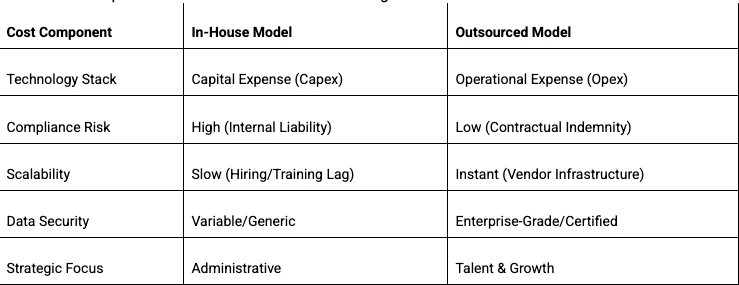
The "do it yourself" mindset ignores hidden costs. It counts only payroll staff salaries. It excludes software licenses, server maintenance, training, and error correction. It ignores opportunity cost—HR leaders focusing on administration instead of strategy.
When organizations analyze Total Cost of Ownership (TCO), outsourcing yields clear efficiency gains. It converts fixed operational costs into variable costs aligned with headcount.
Technology Integration as Competitive Infrastructure
Modern payroll is no longer about spreadsheets. It is about integration. HR ecosystems require payroll data to flow seamlessly into financial systems, attendance modules, and performance dashboards. Siloed data leads to reconciliation nightmares.
Security is equally paramount. Financial data is a prime target for breaches. Generalist IT setups rarely offer encryption standards required for sensitive salary information. Dedicated providers operate on Tier-4 data centers with ISO-certified security protocols. They ensure employee data remains hermetically sealed from unauthorized access.
The Bangalore Velocity Challenge
Bangalore companies scale faster than their systems can adapt. A startup hiring 20 employees per quarter cannot manually update spreadsheets, verify compliance, and process salaries accurately. The operational drag compounds exponentially.
Manual payroll breaks under velocity. Automated systems thrive on it. Payroll outsourcing companies in Bangalore provide infrastructure that scales instantly. They handle multi-state compliance, variable pay structures, and complex benefits administration without requiring additional headcount.
A Framework for Vendor Selection
Choosing a partner requires rigor beyond price comparison. Evaluate across five dimensions:
- Compliance Depth: Verify in-country legal team size and regulatory update frequency.
- Integration Agility: Confirm API connectivity with existing HRIS within 30 days.
- Security Posture: Demand SOC 2 Type II and ISO 27001 certifications.
- Scalability Test: Confirm capacity to handle 50% headcount spikes within one pay cycle.
- Support Model: Assess dedicated vs. shared support and response time SLAs.
The Construction Metaphor
Building a business with fragmented payroll is like constructing a skyscraper with different contractors for plumbing, electrical, and structural work who never communicate. The building might stand, but systems clash, leaks spring, and maintenance becomes a nightmare. Outsourcing installs the master blueprint ensuring every system works in harmony.
Conclusion
Growth exposes operational cracks. As organizations expand in Bangalore's competitive talent market, payroll precision becomes a retention tool. Employees expect zero errors. Regulatory bodies demand zero deviations.
The market has shifted. Operational excellence is no longer a luxury; it is the baseline for survival. Future-ready organizations leverage external expertise to stabilize their foundation while they build their skyline. For teams serious about scaling without operational drag, partnering with specialized payroll outsourcing companies in Bangalore transforms a complex obligation into a streamlined competitive advantage.
The future belongs to organizations that treat payroll as strategic infrastructure, not administrative burden.
Author Bio
Yugandhara V is the head of payroll outsourcing division at Alp Consulting and is an expert on building and managing complete HR and payroll systems and processes.