



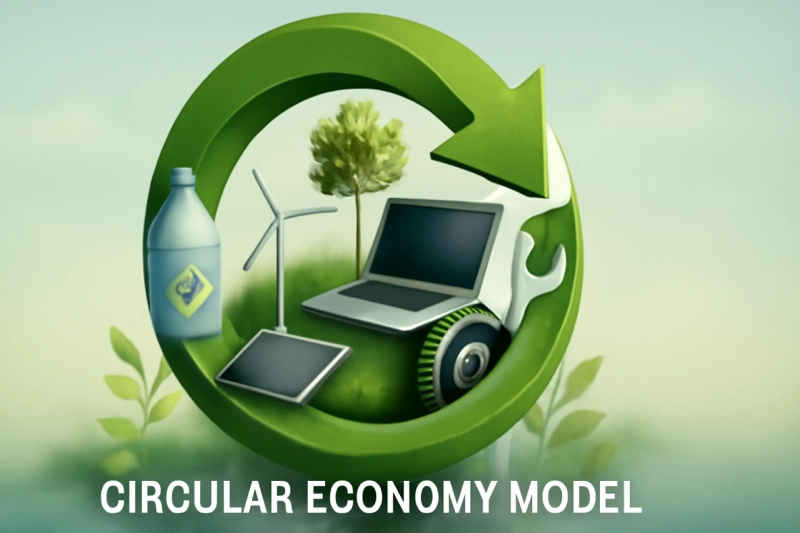
In 2025, sustainability isn’t just a trend; it’s a business necessity. The circular economy—a model that focuses on reducing waste and maximizing resource use—is transforming industries worldwide. It’s moving us away from the traditional linear "take-make-dispose" approach and towards a system where products are designed for reuse, repair, and regeneration. But how are businesses adapting? The answer lies in technology. In this blog, we explore how innovations like AI, IoT, blockchain, and 3D printing are driving the shift toward circular business models and helping businesses thrive sustainably.
What is the Circular Economy?
The circular economy is a sustainable model that aims to eliminate waste and keep resources in use for as long as possible. Unlike the traditional linear economy, which follows a "take-make-dispose" pattern, the circular economy focuses on reuse, repair, and recycling. Industries such as fashion, electronics, and packaging are already adopting circular practices, and the tech revolution is playing a central role in accelerating this shift.
How Technology is Transforming the Circular Economy
Technology is the backbone of the circular economy, enabling businesses to track, optimize, and transform their operations for sustainability. Let’s dive into some key technological innovations:
1. AI and IoT: Extending Product Lifecycles
Artificial intelligence (AI) and the Internet of Things (IoT) are central to optimizing product lifecycles. By collecting real-time data on product usage, businesses can predict when maintenance is needed, preventing premature breakdowns and reducing waste. These technologies help businesses make smarter decisions on product design and maintenance, ensuring products last longer and operate more efficiently.
For example, AI-driven predictive maintenance can identify when a part is likely to fail, allowing businesses to intervene before problems arise. This proactive approach reduces unnecessary waste and extends the product’s useful life.
2. Blockchain: Ensuring Transparency
Consumers today demand transparency, especially when it comes to sustainability. Blockchain technology offers an effective solution by providing an immutable ledger that tracks a product’s journey—from raw material sourcing to recycling. This builds trust with consumers and ensures that businesses are meeting their sustainability claims.
For instance, blockchain can help verify the authenticity of recycled materials, ensuring that products are made with responsibly sourced components. It also simplifies regulatory compliance, making it easier for businesses to prove their sustainability credentials.
3. 3D Printing: Reducing Waste
3D printing is revolutionizing the manufacturing industry by enabling businesses to create customized parts on demand. This reduces overproduction and the need for excess inventory, minimizing waste. Moreover, using recycled and biodegradable materials for 3D printing supports circular design principles and makes manufacturing processes more sustainable.
Companies can also use 3D printing to produce spare parts that are hard to find, extending the lifespan of existing products and reducing the need for replacements.
Why Circular Economy Matters for Businesses
The circular economy isn’t just about doing good for the planet—it’s also a smart business strategy. Here’s why:
1. Unlocking New Revenue Streams
Circular economy practices open up new revenue opportunities for businesses. For example, the rise of product-as-a-service models, such as car-sharing or subscription-based electronics, is transforming traditional ownership models. Consumers are increasingly opting for access-based services, and businesses that embrace this shift can tap into a new market that prioritizes sustainability and cost-efficiency.
2. Enhancing Brand Value and Consumer Loyalty
Consumers today are more conscious of the environmental impact of their purchases. A 2024 PwC survey found that 57% of consumers are more likely to choose brands that offer sustainable products or services. By adopting circular practices, businesses can differentiate themselves, enhance their brand value, and build consumer loyalty in a competitive market.
3. Cost Savings through Resource Efficiency
Circular economy practices lead to cost savings by improving resource efficiency. For example, recycling and reusing materials in production processes can reduce raw material costs. Additionally, technologies like AI and IoT can optimize operational efficiency, minimizing waste and preventing costly equipment failures.
Overcoming Challenges in Circular Adoption
Despite its clear benefits, businesses face significant challenges in adopting circular economy practices. A mindset shift is needed, both within companies and among consumers, to embrace the idea of access over ownership. Additionally, scalability issues around material recovery and recycling technologies need to be addressed.
For businesses, overcoming these challenges requires investment in sustainable technologies, collaboration with other industry players, and educating consumers about the long-term benefits of circular models.
The Future of Circular Economy
As the circular economy continues to grow, digital technologies like AI, blockchain, and 3D printing will play an even greater role. Businesses that embrace these technologies will not only contribute to environmental sustainability but also position themselves as leaders in an increasingly eco-conscious market.
Governments and industries are also increasing their focus on circular economy policies and incentives. With greater regulatory support, the shift to circular business models will only accelerate, making it an essential part of the global economy.
Conclusion
The circular economy offers immense opportunities for businesses to grow sustainably while minimizing environmental impact. By leveraging technology, businesses can drive innovation, extend product lifecycles, and create new revenue streams. The time to embrace the circular economy is now—those who do will lead the charge toward a more sustainable, connected future.
Ready to take the leap into circularity? Start by exploring how technology can drive sustainable growth in your business today.