



Introduction: The Myth of Comfort
There is a prevalent myth in the world of automotive maintenance that classifies suspension components solely as comfort items. When a driver begins to feel the road a little more intensely, or when the car feels slightly softer over speed bumps, the instinct is to dismiss the issue. We rationalize that we can live with a slightly bumpy ride to save money on repairs. We assume that as long as the engine runs and the brakes squeeze, the car is safe. This assumption is a dangerous fallacy that fundamentally misunderstands the physics of a moving vehicle.
Shock absorbers and struts are not luxury pillows designed to pamper your backside; they are critical safety devices designed to manage the immense kinetic energy of a two-ton projectile. Their primary function is not to cushion the driver, but to keep the tires pressed firmly against the pavement. A tire that is bouncing, even microscopically, is a tire that is airborne. An airborne tire cannot grip, it cannot steer, and most importantly, it cannot stop. Ignoring worn suspension is not just a choice to endure a rougher ride; it is a choice to compromise the ability of your vehicle to react in an emergency, turning a controlled stop into a catastrophic collision.
The Physics of Grip: Keeping the Rubber on the Road
To understand the gravity of suspension failure, one must look at the tire's relationship with the road. The tire is the only point of contact between the car and the earth, and that contact patch is roughly the size of a human hand. For the brakes to work, that hand-sized patch must be under constant, heavy pressure. The car's springs support the weight of the vehicle, but springs are essentially energy storage devices. When a wheel hits a bump, the spring compresses and then violently expands, releasing that stored energy. Without a mechanism to control this release, the spring would continue to oscillate, causing the wheel to hop up and down uncontrollably like a basketball.
This is where the shock absorber enters the equation. It is a hydraulic damper that converts the kinetic energy of the spring's movement into heat, dissipating it through oil. It acts as the disciplinarian of the suspension, forcing the wheel back down onto the road surface immediately after an impact. When a shock absorber wears out, it loses its ability to control the spring. The wheel begins to bounce. At highway speeds, this bounce happens many times per second. This means that for significant fractions of time, your tires are not touching the road; they are skipping over it. You are effectively driving a hovercraft with intermittent traction. This loss of constant contact is the root cause of every handling failure associated with bad suspension.
The Braking Penalty: The Nose-Dive Effect
The most terrifying consequence of this loss of control occurs when you slam on the brakes. Braking is a dynamic event that causes a massive shift in weight. As you decelerate, the weight of the car transfers violently to the front wheels. In a healthy car, the front shocks resist this compression, keeping the body relatively flat and keeping the rear wheels on the ground. This balances the braking force across all four tires.
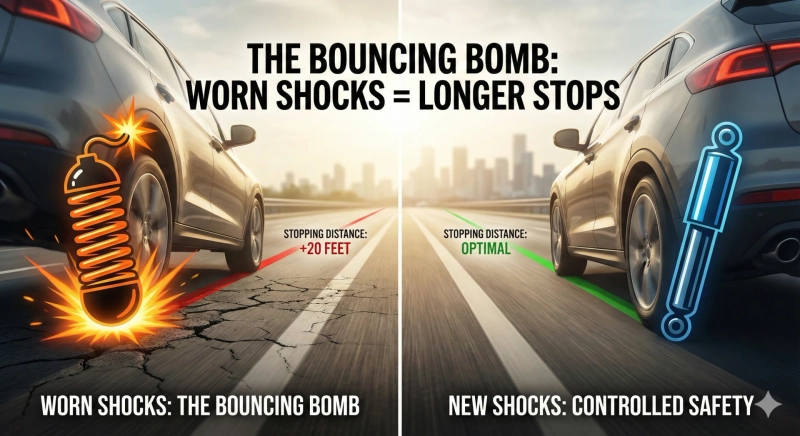
However, in a vehicle with worn shocks, there is no resistance to this weight transfer. The front of the car dives dramatically toward the asphalt, bottoming out the suspension. Simultaneously, the rear of the car lifts up. The rear tires, now unburdened of weight, lose traction and begin to skid or float. The front tires, overburdened by the sudden shift, become overwhelmed. The result is a dramatic increase in stopping distance. Studies have shown that a vehicle with just one worn shock absorber can take up to twenty percent longer to stop from highway speeds. In the real world, that equates to several car lengths. That extra distance is the difference between a near-miss and a rear-end collision. No matter how good your brake pads are, they cannot stop a car if the suspension cannot manage the weight transfer.
The Stability Crisis: Body Roll and the Evasive Maneuver
While braking is a linear event, steering is lateral, and the suspension is equally critical here. Imagine you are driving on Sheikh Zayed Road and debris suddenly appears in your lane. You jerk the steering wheel to swerve around it. This input creates lateral G-force, causing the body of the car to roll to the side.
Worn shock absorbers allow this body roll to happen unchecked. The car leans excessively, like a boat in a storm. This wallowing motion disorients the driver and delays the car's reaction time. Worse, once you have swerved to avoid the obstacle, you must steer back to straighten out. A car with bad shocks will not settle; the energy of the swerve will cause it to snap back violently in the other direction. This pendulum effect can easily overcome the tire's grip, leading to a spin-out or a rollover. Modern Electronic Stability Control (ESC) systems are designed to help in these situations, but they rely on the tires being on the ground. If the wheels are bouncing due to failed shocks, the computer’s attempts to brake individual wheels will be futile. You are fighting physics with a broken tool.
The Tire Tax: Cupping and Scalloping
If safety arguments do not convince a driver to address their suspension, the financial argument often does. Worn shocks are the natural predator of expensive tires. As the wheel bounces uncontrolled down the road, it does not wear evenly. It scuffs the pavement every time it lands. This creates a specific, distinct wear pattern known as cupping or scalloping.
If you run your hand along the tread of a tire damaged by bad shocks, it will feel lumpy, with high and low spots resembling the surface of a golf ball or a scallop shell. This damage is irreversible. Once a tire is cupped, it will roar with road noise and vibrate constantly. You cannot fix it with balancing or rotation; the tire is ruined. It is a common tragedy for our Suspension & Steering Services technicians to see a customer buy four brand-new, premium tires, only to have them completely destroyed in ten thousand kilometers because they refused to replace the leaking struts. The cost of the ruined tires often exceeds the cost of the strut replacement, making procrastination a mathematically poor decision.
The Diagnostic Challenge: Why the "Bounce Test" is Dead
For decades, the standard way to check shocks was the "bounce test." A mechanic would push down hard on the corner of the car and watch it rebound. If it bounced more than once, the shocks were bad. While this worked for the heavy, simple cars of the 1970s, it is largely useless for modern vehicles. Today's cars have stiffer springs, advanced suspension geometries, and complex strut assemblies that mask the symptoms of a worn damper during a static test.
A modern shock absorber can be completely internally failed—providing zero damping force at highway speeds—yet still feel firm when you push on the fender in a parking lot. Professional diagnosis requires a more forensic approach. Technicians look for "weeping," where the hydraulic oil inside the shock has begun to leak past the seals, coating the shock body in a film of grime. They examine the tires for the tell-tale cupping. Most importantly, they rely on the test drive, feeling for the nose-dive during braking and the lingering "float" after a highway dip. In some cases, advanced test stands are used to vibrate the suspension and measure the wheel's contact with the ground electronically. Relying on an old-school bounce test is a sure way to miss a critical safety failure.
The Electronic Evolution: Complexity and Cost
The landscape of suspension repair has been further complicated by the arrival of adaptive damping systems. Many luxury and performance vehicles now use electronic shocks filled with magneto-rheological fluid or controlled by internal solenoid valves. These shocks can change their stiffness thousands of times per second, offering a soft ride for cruising and a stiff ride for cornering.
When these systems fail, they often default to a "full stiff" or "full soft" mode, or they trigger a suspension warning light on the dashboard. Replacing these units is not a simple mechanical job; it is a calibration event. After the physical installation, the vehicle’s computer must be coded to recognize the new shock absorbers and calibrate their ride height sensors. This moves suspension repair out of the realm of the driveway mechanic and into the domain of the specialist garage equipped with dealer-level software. While these systems offer incredible performance, they demand a higher level of maintenance discipline, as a single failed electronic shock can disable the vehicle's entire stability control system.
Conclusion: The Foundation of Safety
The suspension system is the foundation upon which every other dynamic maneuver relies. You can have the biggest brakes, the stickiest tires, and the most advanced traction control computer in the world, but if your shock absorbers are worn, none of those systems can function at their peak.
Viewing shock absorbers as a "repair to be delayed" is a gamble with the safety of everyone in the vehicle. The degradation is slow and seductive; you get used to the wallowing ride and the longer stopping distances, adapting your driving style without realizing how close to the edge you are. Restoring your suspension is not just about bringing back the "new car feel" and the smooth ride; it is about restoring the safety margins that keep you alive in a panic stop. In the harsh driving environment of the UAE, where speed bumps are frequent and highway speeds are high, the health of your dampers is the single most critical factor in keeping your rubber firmly on the road.