



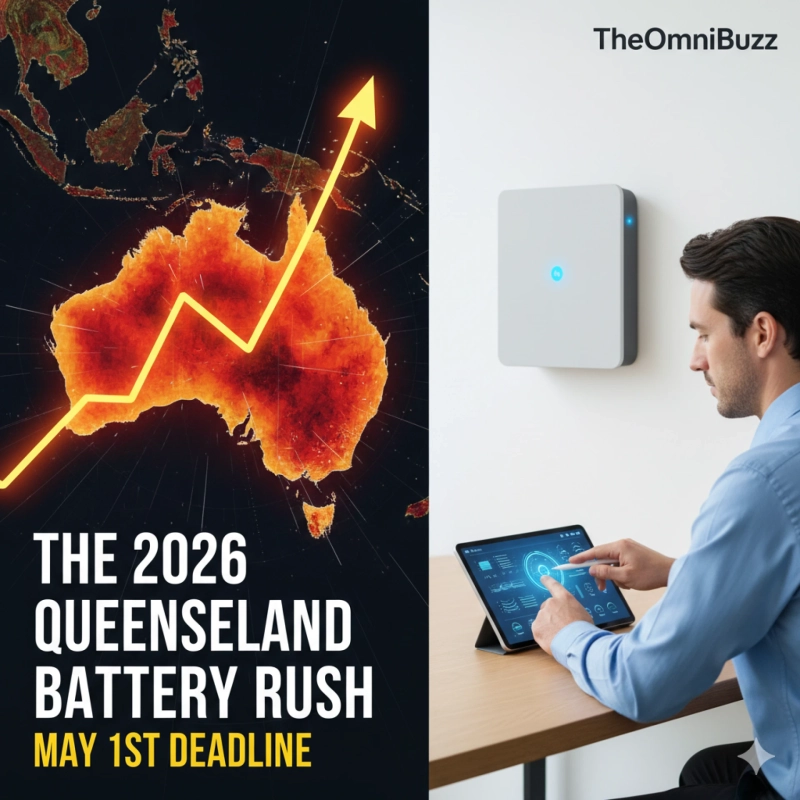
If you’ve been tracking digital trends across Australia this month, you’ll notice a significant "heat map" forming over the Sunshine State. Google Trends is currently showing a sustained peak for the search term "battery" in Queensland. While QLD has long been the national leader in rooftop solar, 2026 marks a fundamental shift in the market: we have officially entered the "Storage Era."
The surge in interest isn't just a byproduct of another humid Brisbane summer; it is a calculated response to a looming regulatory deadline. On May 1, 2026, the federal Cheaper Home Batteries Program is undergoing its most significant restructuring since its inception.
For homeowners and small businesses, this creates a narrow window of opportunity to lock in thousands of dollars in government support before the "rebate cliff" fundamentally changes the math of home energy storage.
1. Decoding the "May 1st Cliff"
The primary catalyst for the current search volume is the scheduled shift in how Small-scale Technology Certificates (STCs) are calculated for batteries. Until now, the federal rebate has been relatively flat, but from May 2026, the government is introducing a "Double Squeeze" that will penalize those who wait.
The STC Factor Step-Down
The "STC Factor" is the multiplier that determines your upfront discount.
- Before May 1, 2026: The multiplier stands at 8.4.
- After May 1, 2026: The multiplier drops sharply to 6.8.
In real dollars: For a standard 10kW battery installation, this drop represents a direct loss of approximately $900 to $1,200 in "free money" from the government. Since the rebate is tied to the installation date, not the contract date, Queenslanders are racing to get their systems on the wall before April ends.
The New Size-Based Tapering
Perhaps the most significant change is the move away from "one-size-fits-all" subsidies. From May 1st, a tiered system kicks in:
- 0–14 kWh: 100% Rebate Eligibility (The "Sweet Spot").
- 14.1–28 kWh: 60% Rebate Eligibility.
- 28.1–50 kWh: Only 15% Rebate Eligibility.
For large-scale properties or off-grid enthusiasts, waiting until May could mean losing over $3,500 in total rebate value. This tiered tapering is designed to prevent "oversizing" and ensure the program budget stretches to 2030, but for the consumer, it means the "Golden Era" of large-scale subsidies is ending.
2. Benchmarking Your Hardware: The 10kW Standard
In the midst of this search peak, the 10kW battery has emerged as the clear favorite. It sits at the perfect intersection of the new rebate rules and household energy demand.
However, capacity is only half the story. You need to know how that 10kW performs when the sun goes down and the Queensland humidity stays up. A common question from new buyers is: "Will a 10kW unit actually see me through a humid night with the AC on?" Before you sign a contract, it is vital to understand the "Runtime Reality" of your hardware. Leading installers like Cyanergy have been providing data-backed stress tests to help homeowners size their systems correctly. For a detailed breakdown of real-world uptime, check out this guide: how long will a 10kW battery last?
3. The 2026 ROI Equation: Is Storage "Worth It"?
The most common query accompanying "battery" in the QLD data is, "Is it actually worth the investment in 2026?"
The financial autopsy of the 2026 energy market reveals a much more aggressive ROI than in previous years. With retail peak rates in many parts of regional QLD climbing toward 40 cents per kWh, while feed-in tariffs (what you get paid for exporting solar) have dropped to 5-8 cents, the "Price Gap" has never been wider.
Every kilowatt-hour you export is a missed opportunity. By storing that energy and using it at night, you are effectively "buying back" your own power at a fraction of the market rate.
According to 2026 performance data, the payback period for a high-quality system from Cyanergy has now compressed to between 5 and 7 years. Given that most modern LFP (Lithium Iron Phosphate) batteries come with 10-year warranties, you are looking at nearly a decade of "free" energy after the system has paid for itself. For a full breakdown of the 2026 ROI figures, see: are solar batteries worth it in 2026 for Australia?
4. How to Win the Energy Game (Strategy Checklist)
If you are part of the rising wave of Queenslanders looking to secure an installation, here is how you should proceed to ensure you capture the maximum value:
- Lock in the "VPP-Ready" Standard: To qualify for the 2026 rebate, your battery must be technically capable of joining a Virtual Power Plant. You aren't required to join one, but the hardware must meet this "grid-friendly" standard.
- Prioritize SAA Accreditation: Ensure your installer is SAA Accredited (Solar Accreditation Australia). This is the new 2026 requirement that replaced the old CEC accreditation for installers.
- Postcode Stacking: Queensland residents often have access to state-specific "Battery Booster" grants that can be combined with the federal rebate. You can check your eligibility for your specific postcode here: Check QLD Battery Rebate Status.
Conclusion: Acting on the Signal
The peak in Google Trends for "battery" in Queensland is a clear signal of a market in transition. As the grid becomes more volatile and feed-in tariffs continue to dwindle, the only way to win the energy game is to own your generation and your storage.
By acting before the May 1st rebate cliff, you aren't just buying hardware; you are securing a government-subsidized hedge against energy inflation for the next 15 years.
Don't just watch the trend—be the one who capitalized on it. Secure your energy independence with Cyanergy while the "Golden Window" is still open.