


Introduction
Sustainable fashion is one of the fastest-growing segments in the US apparel market — and one of the most complex to price. Unlike conventional fashion where pricing is primarily driven by material cost, competitor benchmarks, and margin targets, sustainable fashion pricing must also account for higher production costs from ethical sourcing, fair wages, and certified materials — while remaining competitive enough to attract buyers who face a growing array of sustainable alternatives.
The price premium that sustainable fashion buyers are willing to pay is real but finite — and it varies significantly by category, demographic, and competitive context. Brands that overprice lose buyers to less expensive sustainable alternatives. Brands that underprice undermine the perceived value of their ethical positioning and struggle to cover the genuine cost premiums of responsible production. Actowiz Solutions helps sustainable fashion brands navigate this challenge by providing data-driven competitive pricing intelligence specifically tailored to the ethical fashion market.
The Sustainable Fashion Pricing Challenge
Sustainable fashion brands face a fundamentally different pricing challenge than conventional competitors:
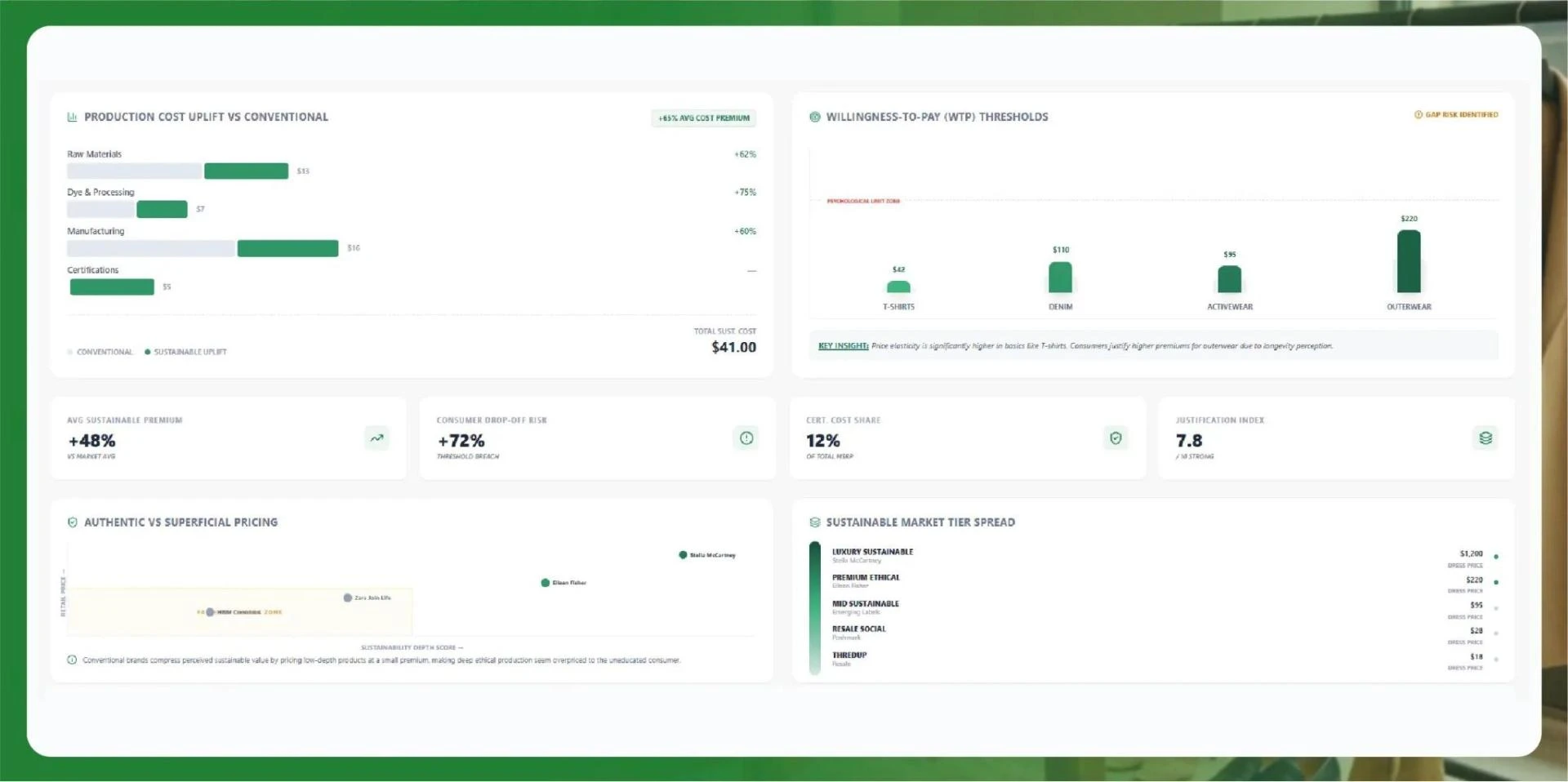
- Cost Structure Premium: Certified organic cotton, recycled materials, GOTS-certified dye processes, and living-wage manufacturing all add 25–80% to production costs versus conventional equivalents — costs that must be recovered in retail pricing.
- Consumer Price Sensitivity: While sustainable shoppers are more price-tolerant than conventional buyers, research shows they have clear willingness-to-pay thresholds that vary by category and product type.
- Greenwashing Competition: Conventional brands making superficial sustainability claims at conventional prices create false benchmarks that make genuine sustainable pricing appear expensive by comparison.
- Premium Justification: Sustainable brands must constantly communicate the value behind their price premium — the certifications, wages, processes, and environmental impact metrics that justify above-market pricing.
- Segmentation Complexity: The sustainable fashion market spans ultra-budget (ThredUp, Poshmark) to ultra-premium (Stella McCartney, Eileen Fisher) — with dramatically different pricing benchmarks at each tier.
What Actowiz Solutions Monitors for Sustainable Fashion Brands
Actowiz Solutions builds specialized sustainable fashion competitive intelligence pipelines that capture:
- Competitor pricing
- Scraped: Regular, sale, and compare-at prices by category
- Use: Price positioning benchmarking
- Frequency: Daily
- Sustainability claims
- Scraped: Certifications listed, materials disclosed, wage claims
- Use: Claim credibility benchmarking
- Frequency: Weekly
- Certification badges
- Scraped: B Corp, GOTS, Fair Trade, Bluesign, OEKO-TEX labels
- Use: Certification competition mapping
- Frequency: Weekly
- Transparency disclosures
- Scraped: Cost breakdowns, supplier info, impact metrics disclosed
- Use: Transparency strategy benchmarking
- Frequency: Monthly
- Greenwashing signals
- Scraped: Vague claims without certification, “eco” buzzwords
- Use: Market credibility landscape
- Frequency: Weekly
- Resale value (ThredUp/Vestiaire)
- Scraped: Secondhand prices for competitor brands
- Use: Durability and brand value signal
- Frequency: Monthly
- Consumer review sentiment
- Scraped: Reviews mentioning sustainability, quality, and value
- Use: Consumer perception analysis
- Frequency: Weekly
- Promotional frequency
- Scraped: Discount events, sale depth, clearance frequency
- Use: Premium positioning comparison
- Frequency: Daily
Sample Data: Sustainable Fashion Brand Pricing Benchmark
Below is a sample of the ethical fashion competitive pricing intelligence Actowiz Solutions delivers to sustainable brand clients:
- Eileen Fisher
- Tier: Premium sustainable
- Basic Tee: $98
- Denim Jeans: $248
- Dress: $298
- Key Certifications: B Corp, Renew program
- Transparency Score: Very High
- Promo Frequency: Rare
- Positioning: Legacy premium
- Patagonia
- Tier: Outdoor premium
- Basic Tee: $45
- Denim Jeans: $89
- Dress: $125
- Key Certifications: B Corp, Fair Trade, bluesign
- Transparency Score: Very High
- Promo Frequency: Rare
- Positioning: Activist premium
- Everlane
- Tier: Transparent mid
- Basic Tee: $38
- Denim Jeans: $78
- Dress: $118
- Key Certifications: None (radical transparency)
- Transparency Score: High
- Promo Frequency: Occasional
- Positioning: Price-transparent value
- Reformation
- Tier: Fashion sustainable
- Basic Tee: $68
- Denim Jeans: $148
- Dress: $198
- Key Certifications: B Corp, carbon neutral
- Transparency Score: Medium-High
- Promo Frequency: Seasonal
- Positioning: Stylish sustainable
- Pact
- Tier: Budget sustainable
- Basic Tee: $28
- Denim Jeans: $68
- Dress: $88
- Key Certifications: GOTS, Fair Trade
- Transparency Score: High
- Promo Frequency: Frequent
- Positioning: Accessible ethical
- tentree
- Tier: Impact-driven mid
- Basic Tee: $48
- Denim Jeans: $88
- Dress: $108
- Key Certifications: B Corp, 1% for the Planet
- Transparency Score: Medium
- Promo Frequency: Monthly
- Positioning: Impact storytelling
- Your Brand
- Tier: Mid sustainable
- Basic Tee: $55
- Denim Jeans: $95
- Dress: $135
- Key Certifications: GOTS, Fair Trade
- Transparency Score: Medium
- Promo Frequency: Occasional
- Positioning: Under-positioned
The benchmarking reveals that the brand is priced between Everlane and Reformation — but with stronger certifications than Everlane (GOTS + Fair Trade vs. no certifications) and comparable positioning to Reformation while charging 20% less. This suggests significant room to increase prices for basic tees and dresses while better communicating the certification story that justifies the premium over Everlane.
Tracking Greenwashing vs. Genuine Sustainability Claims
One of the most strategically important applications of Actowiz Solutions' scraping for sustainable brands is tracking the authenticity and depth of competitor sustainability claims. The sustainable fashion market is heavily affected by greenwashing — conventional brands making superficial environmental claims to capture sustainability-conscious buyers without the corresponding production investments.
Actowiz Solutions monitors competitor sustainability claims and benchmarks them against verifiable certification data:
- ConventionalFashion A
- Sustainability Claim Made: "Eco-friendly collection"
- Certifications Verifiable: None found
- Claim Credibility: Very Low
- Greenwashing Risk: High
- Pricing Premium: +5% over baseline
- Consumer Risk: Misleading buyers
- FastFashion B
- Sustainability Claim Made: "Conscious line" (20% recycled)
- Certifications Verifiable: None certified
- Claim Credibility: Low
- Greenwashing Risk: High
- Pricing Premium: +8% over baseline
- Consumer Risk: False equivalency
- MidMarket C
- Sustainability Claim Made: "Sustainable practices"
- Certifications Verifiable: 1 partial certification
- Claim Credibility: Medium-Low
- Greenwashing Risk: Medium
- Pricing Premium: +15% over baseline
- Consumer Risk: Incomplete claim
- GenuineSustainable D
- Sustainability Claim Made: "100% GOTS organic, Fair Trade"
- Certifications Verifiable: GOTS + Fair Trade + B Corp
- Claim Credibility: Very High
- Greenwashing Risk: None
- Pricing Premium: +45% over baseline
- Consumer Risk: Authentic value
- Your Brand
- Sustainability Claim Made: "Ethical, certified sustainable"
- Certifications Verifiable: GOTS + Fair Trade
- Claim Credibility: High
- Greenwashing Risk: None
- Pricing Premium: +38% over baseline
- Consumer Risk: Authentic — underselling
This analysis reveals that your brand is actually underselling its certification advantage at +38% premium while GenuineSustainable D commands +45% with comparable (not superior) certifications. Actowiz Solutions' greenwashing detection also identifies two competitors making sustainability claims without verifiable certifications — competitive intelligence that can be used in brand marketing to highlight genuine certification credentials.
Resale Value as a Sustainability Proxy
One of the most compelling sustainability metrics is secondhand resale value. Products that hold their value on platforms like ThredUp, Vestiaire Collective, and Depop validate the quality and durability claims that sustainable brands make. Actowiz Solutions monitors secondhand pricing for sustainable brand competitors:
- Patagonia
- Product Category: Fleece Jacket
- Original Retail: $149
- ThredUp Resale Avg.: $78
- Value Retention: 52%
- Vs. Fast Fashion Retention: +41% above fast fashion
- Brand Signal: Premium durability brand
- Eileen Fisher
- Product Category: Linen Blazer
- Original Retail: $348
- ThredUp Resale Avg.: $145
- Value Retention: 42%
- Vs. Fast Fashion Retention: +31% above fast fashion
- Brand Signal: Luxury resale value
- Reformation
- Product Category: Midi Dress
- Original Retail: $198
- ThredUp Resale Avg.: $72
- Value Retention: 36%
- Vs. Fast Fashion Retention: +25% above fast fashion
- Brand Signal: Fashion resale value
- Zara (fast fashion)
- Product Category: Similar Blazer
- Original Retail: $89
- ThredUp Resale Avg.: $9
- Value Retention: 10%
- Vs. Fast Fashion Retention: Baseline
- Brand Signal: Disposable fashion
- H&M (fast fashion)
- Product Category: Similar Dress
- Original Retail: $45
- ThredUp Resale Avg.: $5
- Value Retention: 11%
- Vs. Fast Fashion Retention: Near baseline
- Brand Signal: Low durability
- Your Brand
- Product Category: Linen Dress
- Original Retail: $135
- ThredUp Resale Avg.: $48
- Value Retention: 36%
- Vs. Fast Fashion Retention: +25% above fast fashion
- Brand Signal: Competitive resale value
Your brand's 36% value retention rate matches Reformation and significantly outperforms fast fashion benchmarks — powerful proof of quality and durability that most sustainable brands fail to communicate in their marketing. This data can be used directly in product descriptions, email marketing, and social media content to reinforce the cost-per-wear value proposition of ethical pricing.
Pricing Strategy Recommendations for Sustainable Brands
Based on competitive benchmarking intelligence, Actowiz Solutions helps sustainable fashion brands develop pricing strategies that reflect genuine costs, competitive positioning, and consumer willingness-to-pay:
- Certification Premium Model: Price each product at a defined premium over comparable uncertified competitors, with the premium scaled to the number and prestige of certifications held. GOTS + Fair Trade + B Corp = 40–50% premium. Single certification = 20–30% premium.
- Transparency Pricing: Following Everlane's model, disclose the actual cost breakdown to justify pricing — showing buyers what certified materials, fair wages, and responsible manufacturing actually cost.
- Cost-Per-Wear Positioning: Use resale value data to reframe pricing conversations around cost-per-wear rather than sticker price — a $135 dress that resells for $48 after 2 years costs $87 net, versus a $45 fast fashion dress with near-zero resale value.
- Selective Promotional Strategy: Unlike fast fashion brands that run perpetual sales, sustainable brands should run rare, mission-aligned promotional events (Earth Day, supply chain transparency week) that reinforce brand values rather than eroding perceived quality.
Building a Sustainable Fashion Competitive Intelligence Calendar
Actowiz Solutions delivers sustainable fashion intelligence on a cadence tailored to the slower, more deliberate pace of ethical fashion buying decisions:
- Monthly Pricing Benchmark: Complete competitor price comparison across all monitored categories, with position analysis and recommended adjustments.
- Quarterly Certification Audit: Review of competitor certification changes — new B Corp certifications, dropped claims, new material disclosures — and recommended positioning response.
- Bi-Annual Greenwashing Report: Deep analysis of which competitors are making unverifiable sustainability claims, with documented evidence that can inform brand differentiation messaging.
- Annual Resale Value Review: Benchmarking your brand's secondhand value retention against competitors and fast fashion baseline, with recommendations for product quality and durability messaging.
Conclusion
Sustainable fashion brands operate in a market where pricing integrity, certification authenticity, and transparent communication are not just ethical choices — they are competitive differentiators. But making these differentiators visible and persuasive requires understanding the competitive landscape with precision: who is genuinely certified, who is greenwashing, where the pricing premium market will sustain, and how your own brand's value story compares.
Actowiz Solutions gives sustainable fashion brands the data infrastructure to answer these questions continuously and systematically. From ethical pricing benchmarking and greenwashing detection to resale value monitoring and transparency scoring, Actowiz Solutions provides the competitive intelligence that helps genuine sustainable brands price confidently, communicate authentically, and grow sustainably.
You can also reach us for all your mobile app scraping, data collection, web scraping , and instant data scraper service requirements!
Read More>>
https://www.actowizsolutions.com/sustainable-fashion-ethical-pricing-benchmarking-data-scraping.php
Originally published at https://www.actowizsolutions.com