



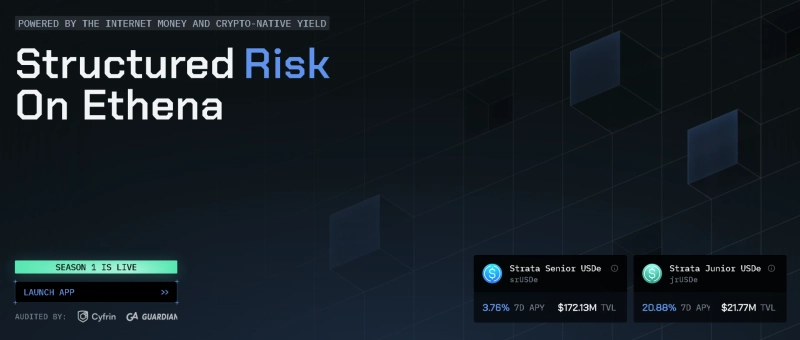
Strata Money: A Next-Generation Structured Yield System Built on Tokenized Tranches
In a world where DeFi is crowded with basic lending pools and generic staking options, strata money stands out by offering a more intelligent and customizable approach to earning.
Instead of forcing users into a single yield model, Strata introduces a flexible, transparent tranching system, where each token corresponds to a different risk–reward profile.
This gives users something rare in crypto:
the ability to choose exactly how much risk they want — and exactly how much potential return they aim for.
Under the hood, Strata is built on top of Ethena’s USDe ecosystem, using delta-neutral synthetic assets and automated smart-contract logic to deliver predictable, composable yield strategies.
Let’s explore the full technical and economic breakdown of the tokens that power Strata Money.
What Network Does Strata Operate On?
Strata Money is built within the Ethena Network ecosystem, leveraging:
- USDe (Ethena’s delta-neutral synthetic dollar)
- sUSDe (yield-bearing version of USDe)
- Cross-chain compatibility powered by modern omni-chain messaging systems
- Audited smart contracts and transparent security documentation
This gives Strata a stable, scalable foundation anchored to one of the most innovative synthetic-dollar architectures in the industry.
The Tokens Behind Strata Money: A Complete Overview
Unlike typical DeFi protocols that revolve around one or two assets, Strata uses a structured multi-token system designed to “slice” yield into predictable pieces.
Each token has a unique role, risk profile, and reward logic.
Let’s break them down in detail.
1. USDe — The Base Asset Behind Strata
USDe is not created by Strata, but the entire Strata ecosystem depends on it.
What is USDe?
USDe is a synthetic dollar created by Ethena Labs.
It maintains stability using delta-neutral hedging, meaning the system holds both long and short positions that cancel each other out, minimizing exposure to market swings.
Why does Strata use USDe?
Because USDe offers:
- Stability
- Predictable yields
- Transparent backing
- Fully on-chain collateral tracking
- Strong liquidity across major platforms
USDe is the fuel that powers senior and junior tranches in Strata.
2. sUSDe — The Yield-Bearing Version of USDe
sUSDe is an upgraded version of USDe.
How it works
Users deposit USDe → the system generates yield → returns are represented as sUSDe.
This means:
- sUSDe continually increases in value versus USDe
- It becomes an ideal asset to split into tranches
- It allows both senior and junior tokens to have a stable foundation
Strata uses sUSDe as the core deposit asset in many structured vaults.
3. srUSDe — The Senior Tranche Token
This is the token for users who want maximum stability and predictable returns.
What makes srUSDe “senior”?
In structured finance, senior tranches receive:
- Priority returns
- Protection from system underperformance
- First claim on yield
- Reduced exposure to downside
This is exactly how srUSDe works.
Risk Profile
- Extremely low
- Receives guaranteed baseline returns
- Junior tranche (jrUSDe) absorbs most volatility
Who is srUSDe for?
- Passive income seekers
- Safety-first users
- Capital preservers
- Stablecoin investors who want enhanced returns
Why srUSDe is technologically important
Because it uses:
- Automated smart contract guarantee logic
- Yield prioritization mechanisms
- Risk-buffering from the junior tranche
srUSDe gives Strata the ability to onboard conservative users without sacrificing yield opportunities.
4. jrUSDe — The Junior Tranche Token
The opposite side of the structure is jrUSDe — the token designed for higher potential returns.
Why jrUSDe is high-risk, high-reward
- Junior tranche absorbs losses first
- Senior tranche is protected
- Remaining yield (after srUSDe) goes to jrUSDe
This means volatility = opportunity.
Potential rewards
When yields are strong, jrUSDe captures:
- Leverage-like performance
- Higher annualized returns
- Enhanced share of earnings
Who is jrUSDe for?
- Yield maximizers
- DeFi power users
- Investors who are comfortable with volatility
- Users seeking asymmetric upside
The technology behind jrUSDe
jrUSDe depends on:
- Dynamic yield allocation
- Automated tranche balancing
- Smart contract enforcement of priority payments
This token reflects Strata’s advanced structured-yield mechanics more than any other.
5. stJLP and Additional Structured Tokens
In some vaults, you may encounter tokens like:
- stJLP (structured junior liquidity token)
- Other experimental or strategy-specific tranche derivatives
These represent liquidity pool yield products packaged with the same senior/junior structure.
They offer additional strategies, especially for more advanced users.
How All These Tokens Work Together
Strata Money uses a clever, institutional-grade system called yield tranching.
The flow looks like this:
- Users deposit USDe or sUSDe
- The system splits deposits into senior and junior tranches
- Yield generated by sUSDe is distributed according to the rules:
- Senior (srUSDe) gets fixed priority returns
- Junior (jrUSDe) receives the remaining upside
- Smart contracts enforce these rules automatically
- Tokens can be redeemed anytime (depending on strategy)
This creates predictable, transparent, rule-based yield pathways that users can rely on.
Why Tokenization Makes Strata Money So Powerful
✔ Risk customization
Users finally get to choose their risk level — not just accept a single protocol setting.
✔ Full transparency
Smart contracts manage:
- Allocation
- Priority
- Risk buffers
- Liquidation protections
Everything is visible on-chain.
✔ Composability
srUSDe and jrUSDe can be used across DeFi, allowing additional yield stacking.
✔ Yield optimization
Junior tokens amplify performance, senior tokens stabilize it.
It’s a model borrowed from traditional finance — but democratized.
✔ Built on USDe — a strong base layer
With delta-neutral synthetic dollars as the foundation, Strata avoids unnecessary volatility.
Call to Action: Start Your Yield Strategy with Strata Money
Whether you want safe, steady returns or high-impact opportunities, strata money gives you the tools to shape your financial future on your own terms.
Choose your tranche:
✔ srUSDe for stability
✔ jrUSDe for amplified rewards
Deposit, mint, earn — all with transparent mechanics and next-generation DeFi infrastructure.
Now is the perfect time to experience what structured yield can do.
FAQ — Strata Money
1. What network does Strata operate on?
It functions within the Ethena ecosystem, using USDe/sUSDe and cross-chain messaging technology for deployment and liquidity.
2. What tokens does the system use?
- USDe — synthetic base dollar
- sUSDe — yield-bearing version
- srUSDe — senior tranche
- jrUSDe — junior tranche
- stJLP & others — strategy-based structured tokens
3. What is the purpose of the token tranching model?
To let users select their preferred risk–reward balance:
- Senior tranches get safety
- Junior tranches get boosted yield
4. Why does Strata use USDe?
Because USDe offers stability, predictable yield and delta-neutral hedging, making it ideal for structured yield systems.
5. Is jrUSDe risky?
Yes. Junior tranches absorb losses first.
They offer higher upside only when yield is strong.
6. Can I switch between senior and junior tokens?
Yes. Users can redeem and mint the opposite tranche anytime, depending on vault mechanics.