



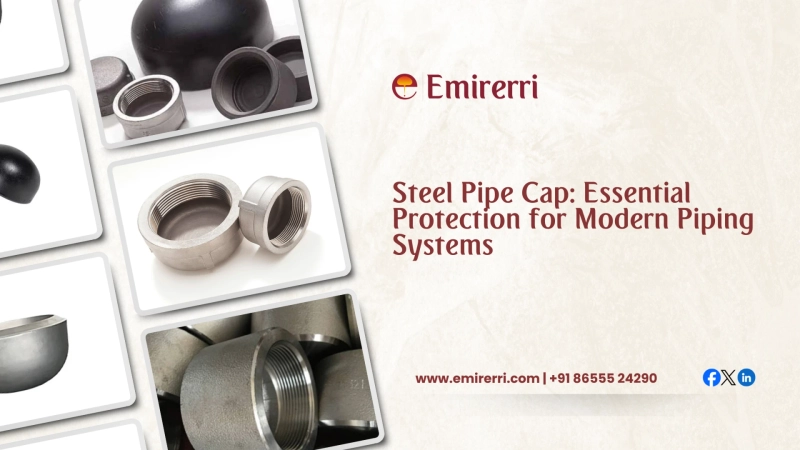
A steel pipe cap is a vital pipe fitting used to close the open end of a pipe, tube, or pipeline. It is designed to provide a secure seal, prevent leakage, and protect the piping system from environmental damage. Steel pipe caps are widely used across industries such as oil and gas, petrochemical, power generation, water treatment, construction, and manufacturing. Due to their durability, strength, and resistance to pressure, steel pipe caps are considered a long-term and reliable solution for pipe termination.
Steel pipe caps are commonly available in materials such as carbon steel, stainless steel, and alloy steel, allowing them to meet diverse operational requirements. Depending on the application, they may be permanently attached through welding or temporarily installed using threaded connections.
What Is a Steel Pipe Cap?
A steel pipe cap is a fitting that covers the end of a pipe to stop flow or protect the pipe interior. It is typically shaped like a dome or flat closure and fits over the pipe end. Steel pipe caps are available in seamless and welded designs and are manufactured according to international standards to ensure pressure integrity and dimensional accuracy.
Weld on pipe caps are among the most commonly used types, especially in high-pressure and high-temperature systems. These caps are welded directly onto the pipe, creating a strong, leak-proof seal that is ideal for permanent installations.
Types of Steel Pipe Caps
Weld On Pipe Caps
Weld on pipe caps are designed for applications where long-term sealing and structural strength are required. They are widely used in oil refineries, chemical plants, and power stations. Welding ensures excellent pressure resistance and eliminates the risk of loosening over time.
Stainless Steel Pipe Cap
A stainless steel pipe cap offers superior corrosion resistance, making it ideal for harsh environments such as marine, chemical processing, and food industries. Stainless steel pipe caps are commonly manufactured using grades like 304, 304L, 316, and 316L. These caps provide excellent durability, hygiene, and resistance to rust and chemical attack.
Threaded Pipe Caps
Threaded steel pipe caps are used where easy removal and maintenance are required. These are commonly applied in low-pressure systems and temporary installations.
Metal Tube End Caps and Their Applications
Metal tube end caps are used to seal the ends of tubes rather than pipes. While pipes are generally measured by nominal pipe size (NPS), tubes are measured by outer diameter (OD). Metal tube end caps play an important role in structural, mechanical, and architectural applications.
Metal End Caps for Round Tubing
Metal end caps for round tubing are widely used in construction, furniture manufacturing, handrails, fencing, and automotive components. These caps not only protect the tubing from damage but also enhance the appearance of finished products by providing a clean, professional look.
Stainless Steel Tube End Caps
Stainless steel tube end caps are especially popular in decorative and hygienic applications. They are commonly used in railings, pharmaceutical equipment, food processing machinery, and cleanroom installations. Their corrosion resistance and smooth surface finish make them suitable for environments where cleanliness and longevity are critical.
Benefits of Using Steel Pipe Caps
Steel pipe caps offer several advantages that make them indispensable in industrial piping systems:
- Leak Prevention: Properly installed pipe caps prevent fluid or gas leakage.
- Protection: They shield pipes from dust, moisture, debris, and mechanical damage.
- Durability: Steel construction ensures long service life even under extreme conditions.
- Pressure Resistance: Weld on pipe caps handle high pressure and temperature efficiently.
- Corrosion Resistance: Stainless steel pipe caps and tube end caps resist rust and chemical corrosion.
- Aesthetic Finish: Metal end caps for round tubing improve visual appeal in architectural applications.
Manufacturing Standards and Sizes
Steel pipe caps are manufactured in compliance with international standards such as ASME, ASTM, DIN, EN, and JIS. These standards ensure uniformity in dimensions, material properties, and pressure ratings. Pipe caps are available in a wide range of sizes, from small-diameter tubing to large-diameter industrial pipelines.
Both seamless and welded steel pipe caps are produced to suit different pressure classes and operating conditions. The selection depends on factors such as temperature, pressure, fluid type, and environmental exposure.
Applications Across Industries
Steel pipe caps and metal tube end caps are used in numerous industries, including:
- Oil and gas pipelines
- Petrochemical and chemical processing plants
- Power generation and thermal plants
- Water supply and wastewater treatment
- Construction and structural frameworks
- Furniture and architectural designs
- Food, pharmaceutical, and sanitary systems
In each of these sectors, stainless steel pipe caps and stainless steel tube end caps are preferred where corrosion resistance and hygiene are critical.
Conclusion
A steel pipe cap is a small yet essential component that plays a major role in maintaining the safety, efficiency, and durability of piping systems. Whether used as weld on pipe caps for high-pressure industrial pipelines or as metal end caps for round tubing in structural and decorative applications, these fittings provide reliable protection and sealing.
With options such as stainless steel pipe cap, metal tube end caps, and stainless steel tube end caps, users can select the most suitable solution based on their specific application needs. Investing in high-quality steel pipe caps ensures long-term performance, reduced maintenance, and enhanced system integrity.